. 2014 Dec 14;11(1):61.
doi: 10.1186/s12970-014-0061-8. eCollection 2014.

Amino acid supplementation and impact on immune function in the context of exercise

Affiliations

Amino acid supplementation and impact on immune function in the context of exercise

Vinicius Fernandes Cruzat et al. J Int Soc Sports Nutr. .

Abstract

Moderate and chronic bouts of exercise may lead to positive metabolic, molecular, and morphological adaptations, improving health. Although exercise training stimulates the production of reactive oxygen species (ROS), their overall intracellular concentration may not reach damaging levels due to enhancement of antioxidant responses. However, inadequate exercise training (i.e., single bout of high-intensity or excessive exercise) may result in oxidative stress, muscle fatigue and muscle injury. Moreover, during the recovery period, impaired immunity has been reported, for example; excessive-inflammation and compensatory immunosuppression. Nutritional supplements, sometimes referred to as immuno-nutrients, may be required to reduce immunosuppression and excessive inflammation. Herein, we discuss the action and the possible targets of key immuno-nutrients such as L-glutamine, L-arginine, branched chain amino acids (BCAA) and whey protein.

Keywords: Immunonutrition; L-arginine; L-glutamine; L-leucine; Oxidative stress.


Figures
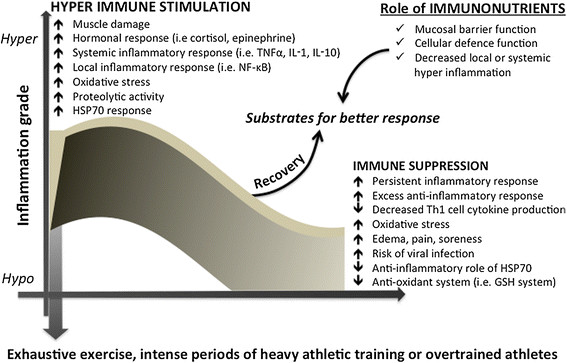
Figure 1
Figure 1
Biphasic immuno-inflammatory response to severe exercise and the possible immunonutrition role. Immuno-inflammatory response induced by severe exercise or heavy periods of training and the proposed role of specific nutrients with immune benefits, also called immunonutrition. Abbreviations: tumor necrosis factor-alpha (TNF-α), interleukin-1 (IL-1), interleukin-10 (IL-10), nuclear Factor-κB (NF-κB), glutathione (GSH), heat shock protein 70 kda (HSP70).
Figure 2
Figure 2
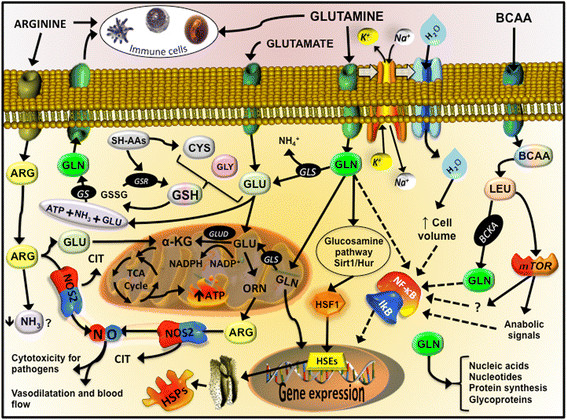
Immune, antioxidant and inflammatory targets that L-glutamine, L-arginine and BCAA are involved. From L-glutamine, glutamate (GLU) is produced through glutaminase activity (GLS), releasing ammonium ion (NH4+). Inside of mitochondria or in the cytosol, glutamate from L-glutamine, L-leucine (LEU) or L-arginine (ARG) is an important fuel (ATP) and/or precursor for the synthesis of intermediate metabolism of amino acids such as ornithine (ORN), antioxidant defenses such as glutathione (GSH), anabolic signals through mTOR cascade, and cell repair system such the as the heat shock proteins (HSPs). HSPs are modulated by the heat shock factor 1, which is activated by the glucosamine pathway, sirtuin 1 (Sirt1) and human antigen R (Hur), also known as nutrient sensors. De novo L-glutamine synthesis can occur through L-glutamine synthetase (GS), using glutamate, ATP and ammonia (NH3). L-glutamine is transported inside the cell trough active transport with sodium (Na+) potassium (K+) ATPase, which augment the absorption of water, altering the volume of the cell and stimulate the resistance to damage. L-arginine availability is important to NO production through nitric oxide synthase 2 (NOS2) and citrulline (CIT). Other Abbreviations: heat shock elements (HSEs); oxidized GSH (GSSG); GSH-S reductase (GSR); glutamate dehydrogenase (GLUD); alpha-ketoglutarato (α-KG).
Figure 3
Figure 3
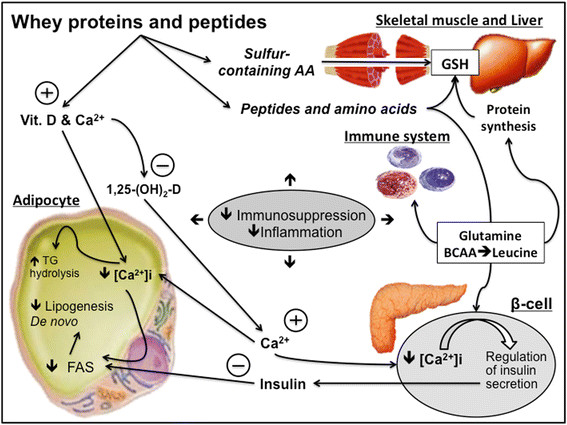
Mechanisms involving whey proteins as a source of different immuno-nutrients. Whey proteins can influence lipid metabolism, muscle protein synthesis/breakdown, antioxidant system, mediated by GSH. Abbreviations: Calcium (Ca2+), 1,25 Hydroxycholecalciferol (1,25-(OH)2-D), intracellular Calcium concentration ([Ca2+]i), Fatty Acid Synthase (FAS), Triacylglycerols (TGs).

References

    1. Finaud J, Lac G, Filaire E. Oxidative stress: relationship with exercise and training. Sports Med. 2006;36:327–358. doi: 10.2165/00007256-200636040-00004. - DOI - PubMed
    1. Gleeson M. Immune function in sport and exercise. J Appl Physiol. 2007;103:693–699. doi: 10.1152/japplphysiol.00008.2007. - DOI - PubMed
    1. Tanskanen M, Atalay M, Uusitalo A. Altered oxidative stress in overtrained athletes. J Sports Sci. 2010;28:309–317. doi: 10.1080/02640410903473844. - DOI - PubMed
    1. Gleeson M, Nieman DC, Pedersen BK. Exercise, nutrition and immune function. J Sports Sci. 2004;22:115–125. doi: 10.1080/0264041031000140590. - DOI - PubMed
    1. Kreher JB, Schwartz JB. Overtraining syndrome: a practical guide. Sports Health. 2012;4:128–138. doi: 10.1177/1941738111434406. - DOI - PMC - PubMed

LinkOut - more resources