


A systematic review of the incidence and prevalence of sleep disorders and seizure disorders in multiple sclerosis
- PMID: 25533301
- PMCID: PMC4429167
- DOI: 10.1177/1352458514564486
A systematic review of the incidence and prevalence of sleep disorders and seizure disorders in multiple sclerosis
Abstract
Background: Several studies have suggested that comorbid neurologic disorders are more common than expected in multiple sclerosis (MS).
Objective: To estimate the incidence and prevalence of comorbid seizure disorders and sleep disorders in persons with MS and to evaluate the quality of studies included.
Methods: The PUBMED, EMBASE, Web of Knowledge, and SCOPUS databases, conference proceedings, and reference lists of retrieved articles were searched. Two reviewers independently screened abstracts to identify relevant articles, followed by full-text review of selected articles. We assessed included studies qualitatively and quantitatively (I² statistic), and conducted meta-analyses among population-based studies.
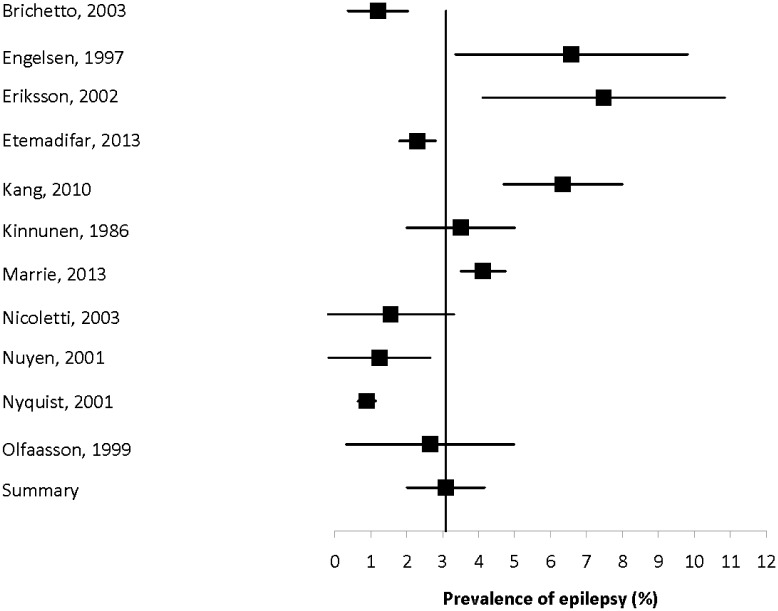
Results: We reviewed 32 studies regarding seizure disorders. Among population-based studies the incidence of seizure disorders was 2.28% (95% CI: 1.11-3.44%), while the prevalence was 3.09% (95% CI: 2.01-4.16%). For sleep disorders we evaluated 18 studies; none were population-based. The prevalence ranged from 0-1.6% for narcolepsy, 14.4-57.5% for restless legs syndrome, 2.22-3.2% for REM behavior disorder, and 7.14-58.1% for obstructive sleep apnea.
Conclusion: This review suggests that seizure disorders and sleep disorders are common in MS, but highlights gaps in the epidemiological knowledge of these conditions in MS worldwide. Other than central-western Europe and North America, most regions are understudied.
Keywords: Multiple sclerosis; comorbidity; epilepsy; incidence; prevalence; seizures; sleep.
© The Author(s), 2015.
Conflict of interest statement
Nadia Reider reports no disclosures.
Olaf Stuve is an associate editor of
Jeffrey Cohen reports personal compensation for consulting from EMD Serono, Genentech, Genzyme, Innate Immunotherapeutics, Novartis, and Vaccinex. Dr. Cohen receives research support paid to his institution from Biogen Idec, Consortium of MS Centers, US Department of Defense, Genzyme, US National Institutes of Health, National MS Society, Novartis, Receptos, Synthon, Teva, and Vaccinex.
Per Soelberg Sorensen has received personal compensation for serving on scientific advisory boards, steering committees, independent data monitoring boards in clinical trials, or speaking at scientific meetings from Biogen Idec, Merck Serono, Novartis, Genmab, TEVA, GSK, Genzyme, Bayer Schering, Sanofi-aventis, and MedDay Pharmaceuticals. His research unit has received research support from Biogen Idec, Merck Serono, TEVA, Sanofi-aventis, Novartis, RoFAR, Roche, and Genzyme.
Maria Trojano has served on scientific Advisory Boards for Biogen Idec, Novartis, and Merck Serono; has received speaker honoraria from Biogen-Idec, Sanofi Aventis, Merck-Serono, Tev,a and Novartis; has received research grants from Biogen-Idec, Merck-Serono, and Novartis.
Gary Cutter has served on scientific advisory boards for and/or received funding for travel from Innate Immunity, Klein-Buendel Incorporated, Genzyme, Medimmune, Novartis, Nuron Biotech, Spiniflex Pharmaceuticals, Somahlution, Teva Pharmaceuticals; receives royalties from publishing Evaluation of Health Promotion and Disease Prevention (The McGraw Hill Companies, 1984); has received honoraria from GlaxoSmithKline, Novartis, Advanced Health Media Inc., Biogen Idec, EMD Serono Inc., EDJ Associates, Inc., the National Heart, Lung, and Blood Institute, National Institute of Neurological Diseases and Stroke, National Marrow Donor Program, Consortium of Multiple Sclerosis Centers; Mt. Sinai School of Medicine and Teva Pharmaceuticals; has served on independent data and safety monitoring committees for Apotek, Ascendis, Biogen-Idec, Cleveland Clinic, Glaxo Smith Klein Pharmaceuticals, Gilead Pharmaceuticals, Modigenetech/Prolor, Merck/Ono Pharmaceuticals, Merck, Neuren, PCT Bio, Teva, Vivus, NHLBI (Protocol Review Committee), NINDS, NMSS, NICHD (OPRU oversight committee).
Stephen Reingold reports personal consulting fees from the National Multiple Sclerosis Society (NMSS) and the European Committee for Treatment and Research in Multiple Sclerosis (ECTRIMS), during the conduct of this work; and over the past three years, personal consulting fees from Bayer HealthCare, Biogen Idec, Coronado Biosciences Inc, the Cleveland Clinic Foundation, Eli Lilly & Company, from EMD Serono and Merck Serono, Genentech, F. Hoffmann-LaRoche, Ironwood Pharmaceuticals Inc, ISIS Pharmaceuticals Inc, Medimmune Inc, Novartis Pharmaceuticals Corporation, Observatoire Français de la Sclérosis en Plaques, Opexa Therapeutics, Sanofi-Aventis, SK Biopharmaceuticals, Synthon Pharmaceuticals Inc, TEVA Pharmaceutical Industries, and Fondation pour l’aide à la Recherche sur la Sclérosis en Plaques, for activities outside of the submitted work.
Figures

References
-
- Compston A, Coles A. Multiple sclerosis. Lancet 2002; 359: 1221–1231. - PubMed
-
- Weinstock-Guttman B, Zivadinov R, Horakova D, et al. Lipid profiles are associated with lesion formation over 24 months in interferon-β treated patients following the first demyelinating event. J Neurol Neurosurg Psychiatry 2013; 84: 1186–1191. - PubMed
-
- Warren SA, Turpin KV, Pohar SL, et al. Comorbidity and health-related quality of life in people with multiple sclerosis. Int J MS Care 2009; 11: 6–16.
-
- Nicoletti A, Sofia V, Biondi R, et al. Epilepsy and multiple sclerosis in Sicily: a population-based study. Epilepsia 2003; 44: 1445–1448. - PubMed
Publication types
MeSH terms
Grants and funding
LinkOut - more resources
Full Text Sources
Other Literature Sources
Medical
