


CT-guidance interstitial (125)Iodine seed brachytherapy as a salvage therapy for recurrent spinal primary tumors
- PMID: 25534142
- PMCID: PMC4299295
- DOI: 10.1186/s13014-014-0301-8
CT-guidance interstitial (125)Iodine seed brachytherapy as a salvage therapy for recurrent spinal primary tumors
Abstract
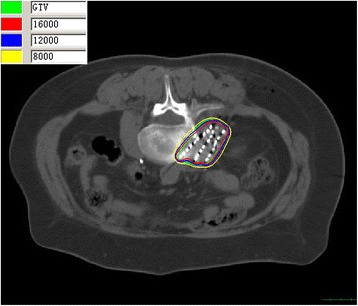
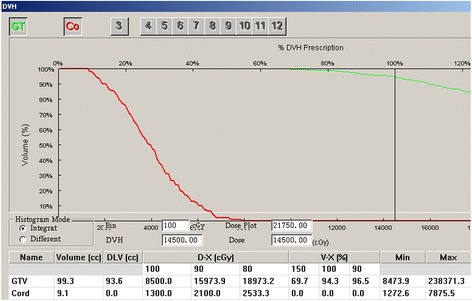
Background: Management of spinal neoplasms has relied on open surgery and external beam radiotherapy (EBRT). Although primary spinal tumors are rare, their treatment remains a pervasive problem. This analysis sought to evaluate the safety and efficacy of CT-guided (125)I seed brachytherapy for recurrent paraspinous and vertebral primary tumors.
Methods: From November 2002 to June 2014, 17 patients who met the inclusion criteria were retrospectively reviewed. 14 (82.4%) had previously undergone surgery, 15 (88.2%) had received conventional EBRT and 3 (17.6%) had chosen chemotherapy. The number of (125)I seeds implanted ranged from 7 to 122 (median 79) with specific activity of 0.5-0.8 mCi (median 0.7 mCi). The post-plan showed that the actuarial D90 of (125)I seeds were 90-183 Gy (median 137 Gy). The follow-up period ranged from 2 to 69 months (median 19 months). The local control rate was calculated by the Kaplan-Meier method.
Results: For 5 Chondrosarcomas, the 1-, 2-, 3-year local control rates were 75%, 37.5%, and 37.5%, respectively, with a median of 34 months (range, 4-39 months). For 4 chordomas, the local control rate was 50% with a median follow-up of 13 months (range, 3-17 months). For 3 fibromatosis, all of them were survival without local recurrence at the end of follow-up. During the follow-up period, 35.3% (6/17) died from metastases, 17.6% (3/17) developed local recurrence by 8, 14 and 34 months while 64.7% (11/17) remained alive. 100% experienced pain relief and normal or improved ambulation, without more than Frankel grade 3 radiation myelopathy.
Conclusions: Percutaneous (125)I seed implantation can be an alternative or retreatment for recurrent spinal primary tumors.
Figures
References
-
- Markoe AM, Schwade JG. The role of radiation therapy in the management of spine and spinal cord tumors. In: Rea GL, editor. Spine Tumors. Park Ridge,IL: American Association of Neurological Surgeons; 1994. pp. 23–35.
MeSH terms
Substances
LinkOut - more resources
Full Text Sources
Other Literature Sources
Miscellaneous
