


Intercepting wrong-patient orders in a computerized provider order entry system
- PMID: 25534652
- PMCID: PMC4447590
- DOI: 10.1016/j.annemergmed.2014.11.017
Intercepting wrong-patient orders in a computerized provider order entry system
Abstract
Study objective: We evaluate the short- and long-term effect of a computerized provider order entry-based patient verification intervention to reduce wrong-patient orders in 5 emergency departments.
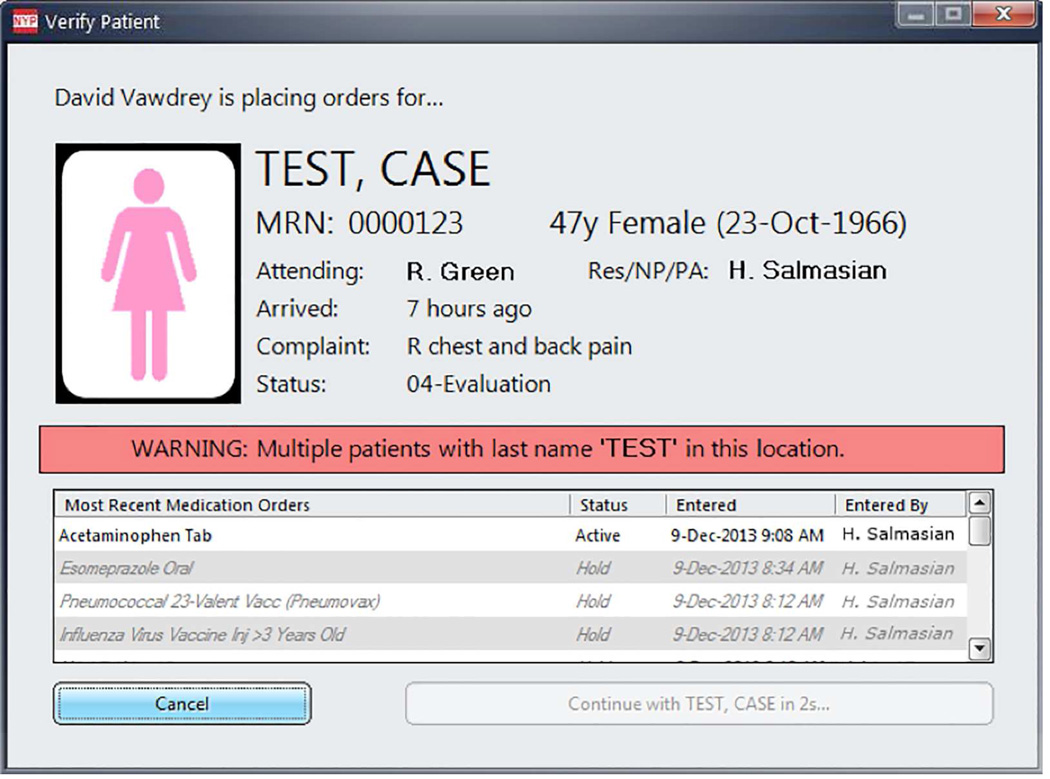
Methods: A patient verification dialog appeared at the beginning of each ordering session, requiring providers to confirm the patient's identity after a mandatory 2.5-second delay. Using the retract-and-reorder technique, we estimated the rate of wrong-patient orders before and after the implementation of the intervention to intercept these errors. We conducted a short- and long-term quasi-experimental study with both historical and parallel controls. We also measured the amount of time providers spent addressing the verification system, and reasons for discontinuing ordering sessions as a result of the intervention.
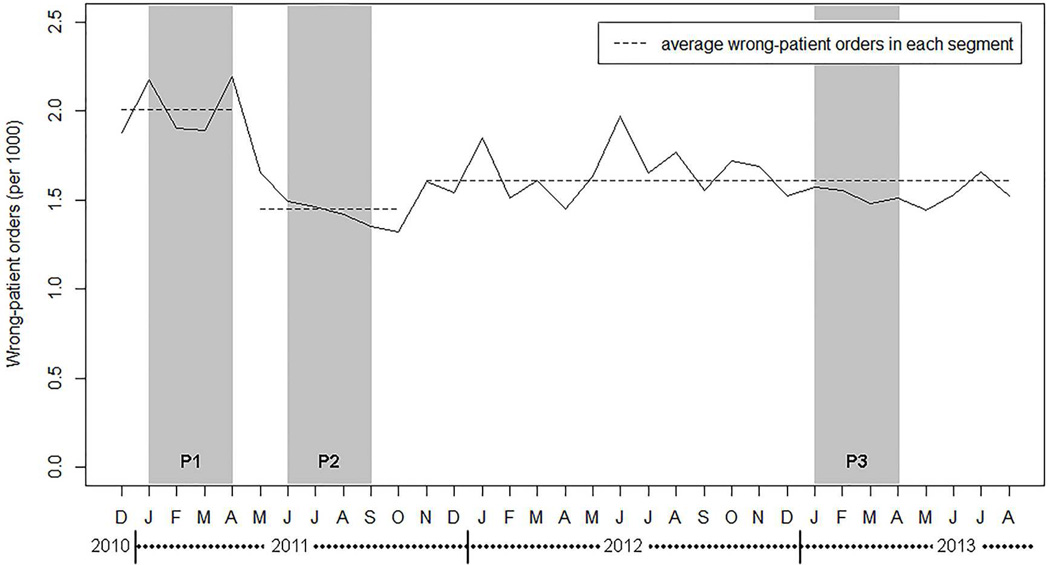
Results: Wrong-patient orders were reduced by 30% immediately after implementation of the intervention. This reduction persisted when inpatients were used as a parallel control. After 2 years, the rate of wrong-patient orders remained 24.8% less than before intervention. The mean viewing time of the patient verification dialog was 4.2 seconds (SD=4.0 seconds) and was longer when providers indicated they placed the order for the wrong patient (4.9 versus 4.1 seconds). Although the display of each dialog took only seconds, the large number of display episodes triggered meant that the physician time to prevent each retract-and-reorder event was 1.5 hours.
Conclusion: A computerized provider order entry-based patient verification system led to a moderate reduction in wrong-patient orders that was sustained over time. Interception of wrong-patient orders at data entry is an important step in reducing these errors.
Copyright © 2014 American College of Emergency Physicians. Published by Elsevier Inc. All rights reserved.
Figures
Comment in
-
"Just a few seconds of your time…" at least 130 million times a year.Ann Emerg Med. 2015 Jun;65(6):687-9. doi: 10.1016/j.annemergmed.2015.02.006. Epub 2015 Feb 25. Ann Emerg Med. 2015. PMID: 25724623 No abstract available.
References
-
- Kaushal R, Shojania KG, Bates DW. Effects of computerized physician order entry and clinical decision support systems on medication safety: a systematic review. Arch Intern Med. 2003 Jun 23;163(12):1409–1416. - PubMed
-
- Georgiou A, Prgomet M, Paoloni R, Creswick N, Hordern A, Walter S, et al. The effect of computerized provider order entry systems on clinical care and work processes in emergency departments: a systematic review of the quantitative literature. Ann Emerg Med. 2013 Jun;61(6):644–653. e16. - PubMed
Publication types
MeSH terms
Grants and funding
LinkOut - more resources
Full Text Sources
Other Literature Sources
