. 2015 Mar;59(3):1549-57.
doi: 10.1128/AAC.04516-14. Epub 2014 Dec 22.

Targeting Mycobacterium tuberculosis topoisomerase I by small-molecule inhibitors

Affiliations

Targeting Mycobacterium tuberculosis topoisomerase I by small-molecule inhibitors

Adwait Anand Godbole et al. Antimicrob Agents Chemother. 2015 Mar.

Abstract

We describe inhibition of Mycobacterium tuberculosis topoisomerase I (MttopoI), an essential mycobacterial enzyme, by two related compounds, imipramine and norclomipramine, of which imipramine is clinically used as an antidepressant. These molecules showed growth inhibition of both Mycobacterium smegmatis and M. tuberculosis cells. The mechanism of action of these two molecules was investigated by analyzing the individual steps of the topoisomerase I (topoI) reaction cycle. The compounds stimulated cleavage, thereby perturbing the cleavage-religation equilibrium. Consequently, these molecules inhibited the growth of the cells overexpressing topoI at a low MIC. Docking of the molecules on the MttopoI model suggested that they bind near the metal binding site of the enzyme. The DNA relaxation activity of the metal binding mutants harboring mutations in the DxDxE motif was differentially affected by the molecules, suggesting that the metal coordinating residues contribute to the interaction of the enzyme with the drug. Taken together, the results highlight the potential of these small molecules, which poison the M. tuberculosis and M. smegmatis topoisomerase I, as leads for the development of improved molecules to combat mycobacterial infections. Moreover, targeting metal coordination in topoisomerases might be a general strategy to develop new lead molecules.


Figures

FIG 1
FIG 1
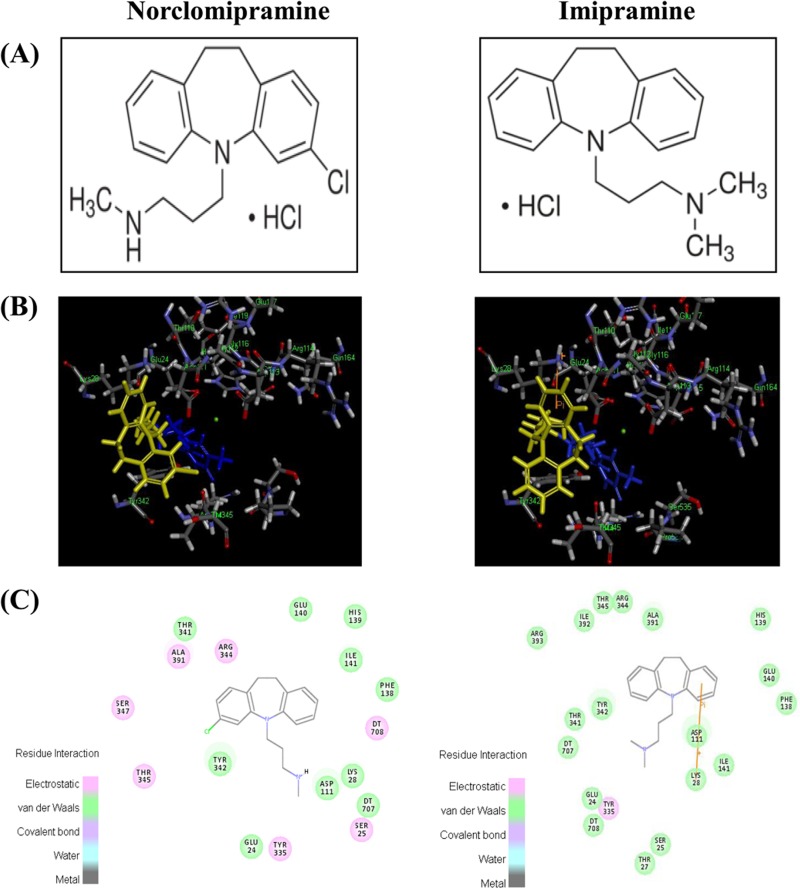
Chemical structure and docking of norclomipramine and imipramine. (A) Chemical structure of norclomipramine and imipramine. (B) Docking of norclomipramine (LibDock score of 95.2) and imipramine (LibDock score of 103) shown in yellow in the topoI homology model with a DNA fragment (blue) and Mg2+ (green). (C) The region harbors the residues involved in Mg2+ coordination.
FIG 2
FIG 2
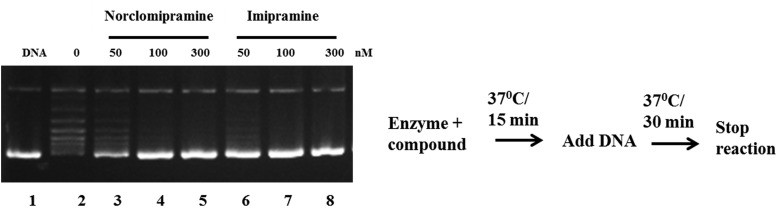
Inhibition of DNA relaxation activity of MttopoI by norclomipramine and imipramine. One unit of MttopoI was incubated with various concentrations of the molecules at 37°C for 15 min following which 500 ng of supercoiled pUC18 was added. The incubation was further continued at 37°C for 30 min, and the reactions were terminated by addition of 0.6% SDS-agarose dye. The reaction products were resolved on a 1.2% agarose gel followed by staining with EtBr. Lane 1, supercoiled pUC18; lane 2, relaxation reaction in the absence of the compounds; lanes 3 to 5, various concentrations (50 to 300 nM) of norclomipramine; lanes 6 to 8, various concentrations (50 to 300 nM) of imipramine.
FIG 3
FIG 3
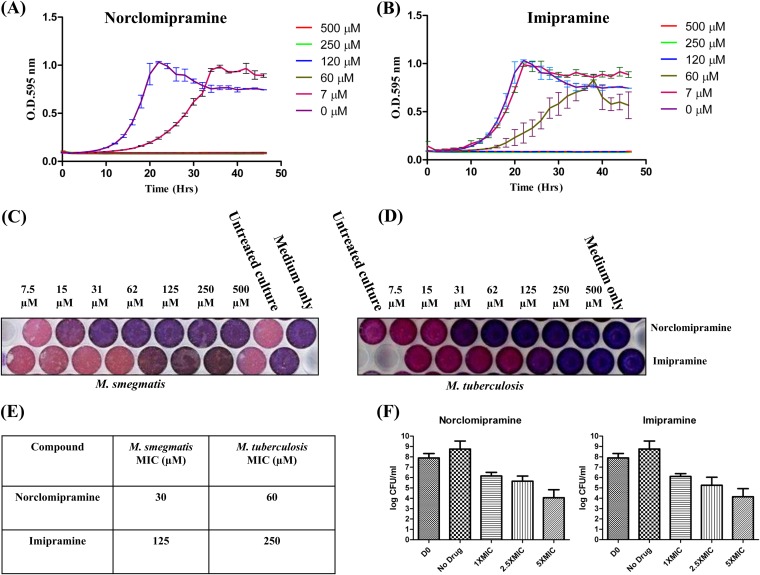
Inhibition of mycobacterial growth by norclomipramine and imipramine and determination of MIC values. M. smegmatis cells were grown in the presence of various concentrations of norclomipramine (A) or imipramine (B). The growth was followed over a period of 48 h with the OD being measured every 2 h. The growth curve was plotted. The sterile medium and untreated culture were used as controls. M. smegmatis (C) or M. tuberculosis (D) cells were grown in the presence of various concentrations of the compounds. Resazurin dye was added to a final concentration of 0.02% to each well. (E) The plate was incubated at 37°C to determine the MIC values. The sterile medium and untreated culture were used as controls. (F) M. smegmatis cells in the log phase were exposed to 1×, 2.5×, and 5× MIC of imipramine and norclomipramine. Untreated cells were taken as controls. Serial dilutions of the treated and untreated cells were plated on Middlebrook 7H9 agar plates, and the CFU/ml values were determined. The values were plotted as log (CFU/ml) versus concentration. Error bars indicate the standard deviations obtained in three independent experiments.
FIG 4
FIG 4
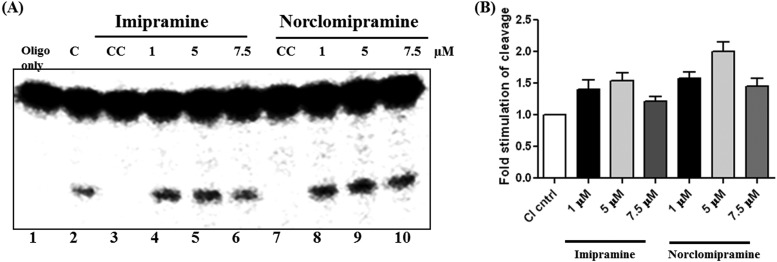
Imipramine and norclomipramine stimulate the DNA cleavage activity. (A) MttopoI was incubated with a 5′-end-labeled specific 32-mer annealed to a complementary sequence on ice for 15 min following which various concentrations of imipramine or norclomipramine were added, and the reaction was allowed to proceed at 37°C for 30 min. The reactions were terminated by the addition of 45% formamide and heating at 95°C for 2 min. The products were resolved by 12% denaturing PAGE and analyzed by phosphorimager. Lane 2 indicates the cleavage reaction by the enzyme in the absence of compound (C), and lanes 3 and 7 indicate compound control (CC) for imipramine and norclomipramine, respectively. (B) Quantification of cleavage products. Error bars represent the standard deviations obtained in three experiments.
FIG 5
FIG 5
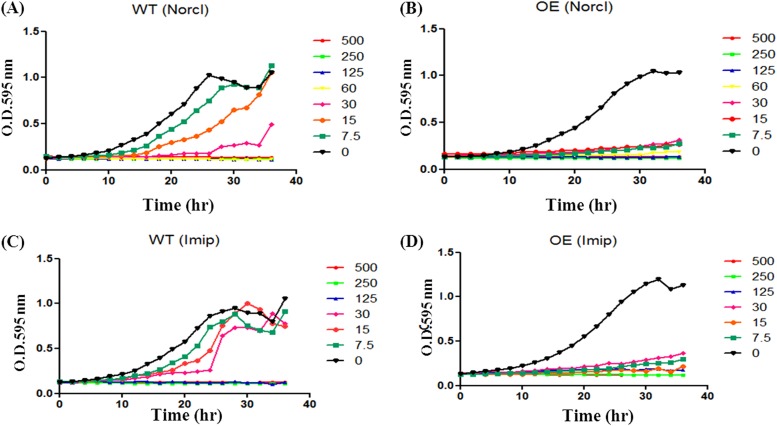
Increased cytotoxicity upon topoI overexpression in M. smegmatis. M. smegmatis cells overexpressing (OE) MstopoI or normal level (N) of MstopoI were grown in the presence of various concentrations (0 to 500 μM) of norclomipramine (A and B) or imipramine (C and D). The growth was followed over a period of 40 h with OD being measured every 2 h. The growth curve was plotted using GraphPad Prism (version 5.0). The sterile medium and untreated cultures were used as controls.
FIG 6
FIG 6
Metal binding mutants of MstopoI are affected differently. One unit of D108A (lane 5) or E112A (lane 9) was incubated with various concentrations of imipramine (A) or norclomipramine (B) (lanes 6 and 7 and 10 and 11, respectively) at 37°C for 15 min. Following this, 500 ng of supercoiled pUC18 was added to each reaction tube and incubated for an additional 30 min. The reactions were terminated by the addition of 0.6% SDS-agarose dye. The reaction products were resolved on a 1.2% agarose gel followed by staining with EtBr. Monoclonal antibody (mAb) 2F3G4, which inhibits the DNA relaxation reaction of mycobacterial topoisomerase I, was used as a positive control.

References

    1. Zumla A, Raviglione M, Hafner R, von Reyn CF. 2013. Tuberculosis. N Engl J Med 368:745–755, 2013. doi: 10.1056/NEJMra1200894. - DOI - PubMed
    1. World Health Organization. 2013. Global tuberculosis report 2013. Report WHO/HTM/TB/2013.11. World Health Organization, Geneva, Switzerland.
    1. Blumberg HM, Burman WJ, Chaisson RE, Daley CL, Etkind SC, Friedman LN, Fujiwara P, Grzemska M, Hopewell PC, Iseman MD, Jasmer RM, Koppaka V, Menzies RI, O'Brien RJ, Reves RR, Reichman LB, Simone PM, Starke JR, Vernon AA. 2003. American Thoracic Society/Centers for Disease Control and Prevention/Infectious Diseases Society of America: treatment of tuberculosis. Am J Respir Crit Care Med 167:603–662. doi: 10.1164/rccm.167.4.603. - DOI - PubMed
    1. Zignol M, van Gemert W, Falzon D, Sismanidis C, Glaziou P, Floyd K, Raviglione M. 2012. Surveillance of anti-tuberculosis drug resistance in the world: an updated analysis, 2007-2010. Bull World Health Organ 90:111D–119D. doi: 10.2471/BLT.11.092585. - DOI - PMC - PubMed
    1. Gandhi NR, Nunn P, Dheda K, Schaaf HS, Zignol M, van Soolingen D, Jensen P, Bayona J. 2010. Multidrug-resistant and extensively drug-resistant tuberculosis: a threat to global control of tuberculosis. Lancet 375:1830–1843. doi: 10.1016/S0140-6736(10)60410-2. - DOI - PubMed

Publication types

MeSH terms