


A genome-wide association study of autism using the Simons Simplex Collection: Does reducing phenotypic heterogeneity in autism increase genetic homogeneity?
- PMID: 25534755
- PMCID: PMC4379124
- DOI: 10.1016/j.biopsych.2014.09.017
A genome-wide association study of autism using the Simons Simplex Collection: Does reducing phenotypic heterogeneity in autism increase genetic homogeneity?
Abstract
Background: Phenotypic heterogeneity in autism has long been conjectured to be a major hindrance to the discovery of genetic risk factors, leading to numerous attempts to stratify children based on phenotype to increase power of discovery studies. This approach, however, is based on the hypothesis that phenotypic heterogeneity closely maps to genetic variation, which has not been tested. Our study examines the impact of subphenotyping of a well-characterized autism spectrum disorder (ASD) sample on genetic homogeneity and the ability to discover common genetic variants conferring liability to ASD.
Methods: Genome-wide genotypic data of 2576 families from the Simons Simplex Collection were analyzed in the overall sample and phenotypic subgroups defined on the basis of diagnosis, IQ, and symptom profiles. We conducted a family-based association study, as well as estimating heritability and evaluating allele scores for each phenotypic subgroup.
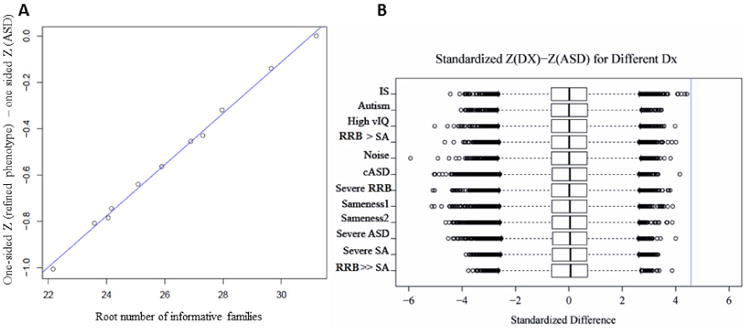
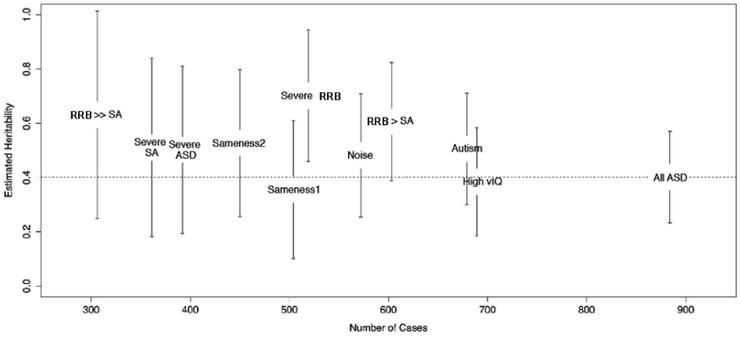
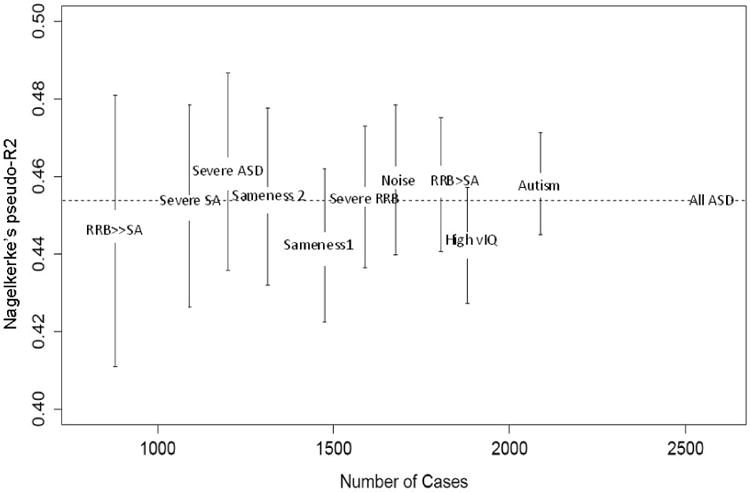
Results: Association analyses revealed no genome-wide significant association signal. Subphenotyping did not increase power substantially. Moreover, allele scores built from the most associated single nucleotide polymorphisms, based on the odds ratio in the full sample, predicted case status in subsets of the sample equally well and heritability estimates were very similar for all subgroups.
Conclusions: In genome-wide association analysis of the Simons Simplex Collection sample, reducing phenotypic heterogeneity had at most a modest impact on genetic homogeneity. Our results are based on a relatively small sample, one with greater homogeneity than the entire population; if they apply more broadly, they imply that analysis of subphenotypes is not a productive path forward for discovering genetic risk variants in ASD.
Keywords: Autism; GWAS; Genetics; Heterogeneity; Phenotype; Power.
Copyright © 2015 Society of Biological Psychiatry. Published by Elsevier Inc. All rights reserved.
Figures
Comment in
-
DSM-5 and psychiatric genetics - round hole, meet square peg.Biol Psychiatry. 2015 May 1;77(9):766-8. doi: 10.1016/j.biopsych.2015.02.031. Epub 2015 Feb 28. Biol Psychiatry. 2015. PMID: 25843333 No abstract available.
References
-
- Georgiades S, Szatmari P, Boyle M, Hanna S, Duku E, Zwaigenbaum L, et al. Investigating phenotypic heterogeneity in children with autism spectrum disorder: a factor mixture modeling approach. J Child Psychol Psychiatry. 2013;54:206–215. - PubMed
-
- Hus V, Pickles A, Cook EH, Jr, Risi S, Lord C. Using the autism diagnostic interview--revised to increase phenotypic homogeneity in genetic studies of autism. Biol Psychiatry. 2007;61:438–448. - PubMed
-
- Veatch OJ, Veenstra-Vanderweele J, Potter M, Pericak-Vance MA, Haines JL. Genetically meaningful phenotypic subgroups in autism spectrum disorders. Genes Brain Behav. 2013;13:276–285. - PubMed
-
- Amir RE, Van den Veyver IB, Wan M, Tran CQ, Francke U, Zoghbi HY. Rett syndrome is caused by mutations in X-linked MECP2, encoding methyl-CpG-binding protein 2. Nat Genet. 1999;23:185–188. - PubMed
Publication types
MeSH terms
Grants and funding
- R01 MH083565/MH/NIMH NIH HHS/United States
- R01MH089390/MH/NIMH NIH HHS/United States
- R37 MH057881/MH/NIMH NIH HHS/United States
- R01 HD065272/HD/NICHD NIH HHS/United States
- 5R25MH071584-07/MH/NIMH NIH HHS/United States
- 5 T32 MH19961-14/MH/NIMH NIH HHS/United States
- R01HD065272/HD/NICHD NIH HHS/United States
- R25 MH071584/MH/NIMH NIH HHS/United States
- UL1 TR000142/TR/NCATS NIH HHS/United States
- R01 MH089390/MH/NIMH NIH HHS/United States
- T32 MH019961/MH/NIMH NIH HHS/United States
- U54 HD083092/HD/NICHD NIH HHS/United States
LinkOut - more resources
Full Text Sources
Other Literature Sources
Medical
