. 2015 Feb 3;112(5):E467-71.
doi: 10.1073/pnas.1418264112. Epub 2014 Dec 22.

Fear and C-reactive protein cosynergize annual pulse increases in healthy adults

Affiliations

Fear and C-reactive protein cosynergize annual pulse increases in healthy adults

Shani Shenhar-Tsarfaty et al. Proc Natl Acad Sci U S A. .

Abstract

Recent international terror outbreaks notably involve long-term mental health risks to the exposed population, but whether physical health risks are also anticipated has remained unknown. Here, we report fear of terror-induced annual increases in resting heart rate (pulse), a notable risk factor of all-cause mortality. Partial least squares analysis based on 325 measured parameters successfully predicted annual pulse increases, inverse to the expected age-related pulse decline, in approximately 4.1% of a cohort of 17,380 apparently healthy active Israeli adults. Nonbiased hierarchical regression analysis among 27 of those parameters identified pertinent fear of terror combined with the inflammatory biomarker C-reactive protein as prominent coregulators of the observed annual pulse increases. In comparison, basal pulse primarily depended on general physiological parameters and reduced cholinergic control over anxiety and inflammation, together indicating that consistent exposure to terror threats ignites fear-induced exacerbation of preexisting neuro-immune risks of all-cause mortality.

Keywords: C-reactive protein; acetylcholinesterase; cholinergic status; pulse; terror.


Conflict of interest statement

The authors declare no conflict of interest.

Figures
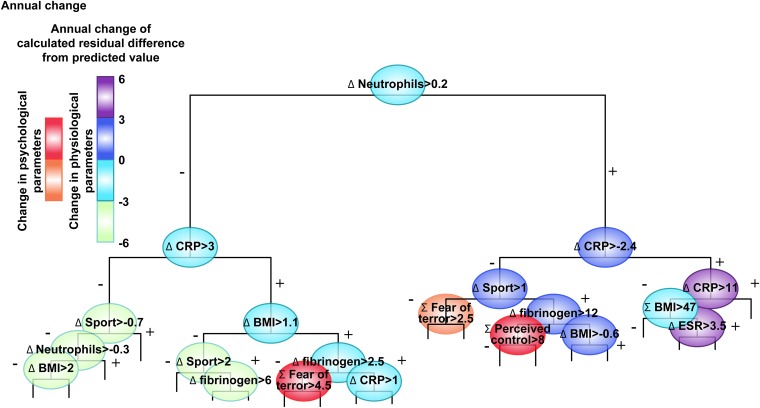
Fig. 1.
Fig. 1.
FOT-inducible pulse changes: Hierarchical plot of predictors of residual annual pulse change. An analysis regression tree was constructed of the residual score of annual pulse change [adjusted for age, sex, and body mass index (BMI) for 9,946 of the 17,380 cohort members (details in SI Materials and Methods)]. Branches were hierarchically organized, such that the higher is more important and each branch divides the rest of the cohort using the calculated cut-point value noted in the circle (left side = statement in parent circle confirmed). Circles are color-coded by the calculated effect on residual annual pulse change (increase or decrease; scale). Of the physiological, psychological, and medical parameters entered into the model, inflammation parameters, sport activity, and FOT and perceived control emerged as significant predictors. ESR, erythrocyte sedimentation rate.
Fig. 2.
Fig. 2.
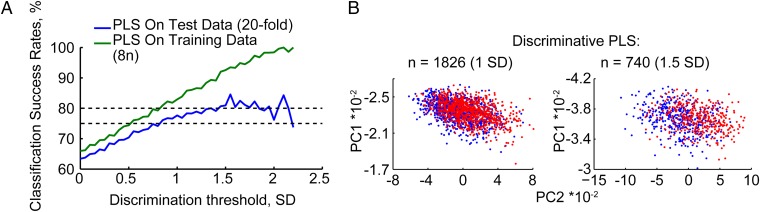
PLS identified pulse changes. (A) PLS classification of pulse changes. Shown are classification success rates as a function of threshold for pulse changes on a training dataset of 95% of the volunteers (green) and a 20-fold cross-validation test dataset (blue) for the noted discrimination SD threshold values. (B) Discriminative classification results. Shown are example classified principal component values for pulse changes (up, red; down, blue) at 1 and 1.5 SD levels for the noted numbers of volunteers.
Fig. 3.
Fig. 3.
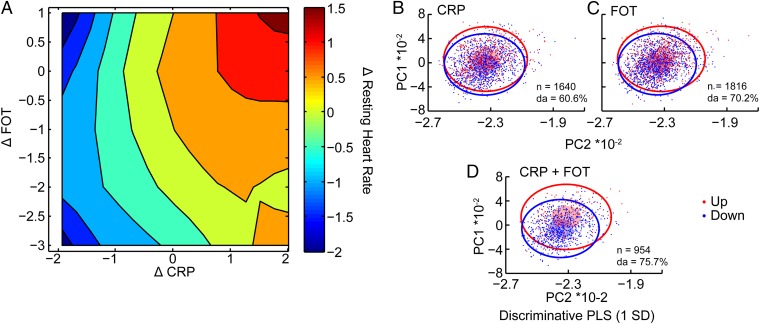
FOT–CRP interactions affect pulse changes. (A) Coelevated FOT and CRP strongly correlate with pulse increases. Triple association of FOT, inflammation, and annual pulse change presents the differences between the observed and expected value for individuals with the same age, sex, and BMI. Annual pulse changes (color code) were square root transformed. Note the increasing tendency for elevated pulse (red) in those participants with coincreased FOT and CRP. (BD) CRP and FOT changes coclassify volunteers with pulse variations. Volunteers with elevated or decreased pulse (1 SD) were classified by CRP (B), FOT (C), or CRP and FOT (D). Small translucent ellipsoids represent 0.5 × SD and outer circles 3 × SD for each group. To illustrate the true (eight-dimensional) separation between volunteers we present the discrimination ability (DA) with closer values to their own group mean than to the other group.
Fig. 4.
Fig. 4.
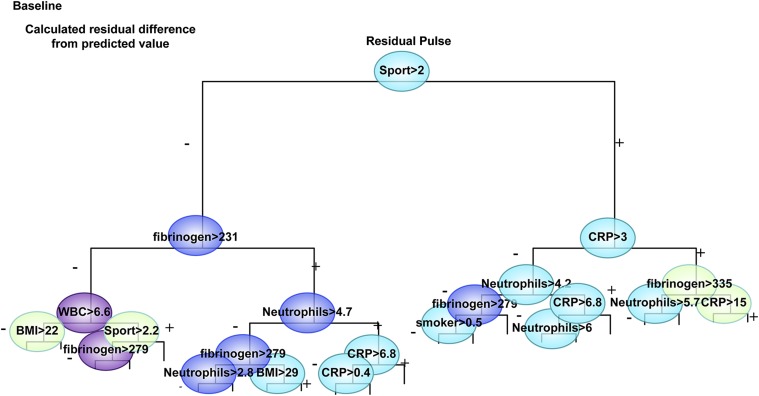
CRP and cholinergic interactions affect basal pulse values: Hierarchical plot of predictors of residual pulse. An analysis regression tree was constructed of the residual score of basal pulse (adjusted for age, sex, and BMI) for 17,380 cohort members, essentially as in Fig. 1. Of the physiological, psychological, and medical parameters entered into the model, inflammation parameters and sport activity but not FOT and perceived control emerged as significant predictors.
Fig. 5.
Fig. 5.
Cholinergic status (CS) and pulse. (A) A multiple linear regression model was constructed with pulse as the dependent variable and age, current smoking, vascular, anxiety, and inflammation risk factors as independent variables. The variables that remained significantly associated with pulse were age, sport, inflammatory markers, and cholinergic status. The addition of cholinergic status was significant (F change 3.56, P = 0.03). (B) Cholinergic status. Shown is a schematic representation of the cholinergic status test, which measures cumulative AChE and BChE capacities to hydrolyze acetylcholine into choline and acetate. (C) General scheme. Basal pulse values are primarily affected by sport and inflammation, which may be controlled by cholinergic signaling. Pulse changes, in comparison, are coaffected by inflammation and FOT.

Comment in

References

    1. Whalley MG, Brewin CR. Mental health following terrorist attacks. Br J Psychiatry. 2007;190:94–96. - PubMed
    1. Ghuman SJ, Brackbill RM, Stellman SD, Farfel MR, Cone JE. Unmet mental health care need 10-11 years after the 9/11 terrorist attacks: 2011-2012 results from the World Trade Center Health Registry. BMC Public Health. 2014;14:491. - PMC - PubMed
    1. Kass MD, Rosenthal MC, Pottackal J, McGann JP. Fear learning enhances neural responses to threat-predictive sensory stimuli. Science. 2013;342(6164):1389–1392. - PMC - PubMed
    1. Picciotto MR, Higley MJ, Mineur YS. Acetylcholine as a neuromodulator: Cholinergic signaling shapes nervous system function and behavior. Neuron. 2012;76(1):116–129. - PMC - PubMed
    1. Lovett-Barron M, et al. Dendritic inhibition in the hippocampus supports fear learning. Science. 2014;343(6173):857–863. - PMC - PubMed

Publication types

Substances

LinkOut - more resources