Clinical analysis of epidural fluid collection as a complication after cranioplasty
- PMID: 25535519
- PMCID: PMC4273000
- DOI: 10.3340/jkns.2014.56.5.410
Clinical analysis of epidural fluid collection as a complication after cranioplasty
Abstract
Objective: The epidural fluid collection (EFC) as a complication of cranioplasty is not well-described in the literature. This study aimed to identify the predictive factors for the development of EFC as a complication of cranioplasty, and its outcomes.
Methods: From January 2004 to December 2012, 117 cranioplasty were performed in our institution. One-hundred-and-six of these patients were classified as either having EFC, or not having EFC. The two groups were compared to identify risk factors for EFC. Statistical significance was tested using the t-test and chi-square test, and a logistic regression analysis.
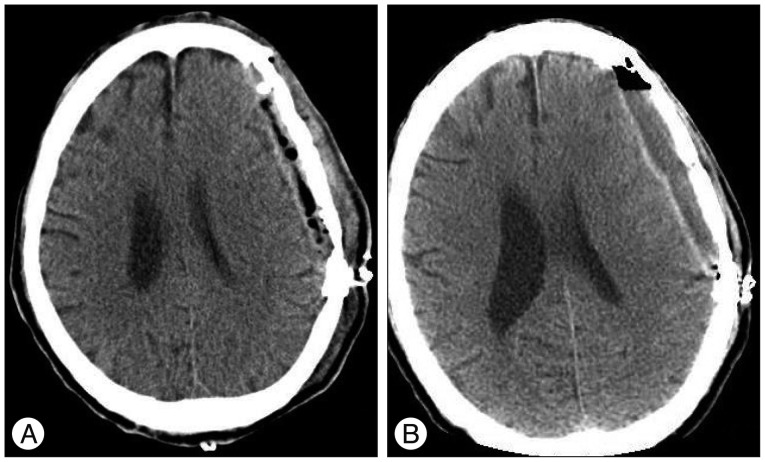
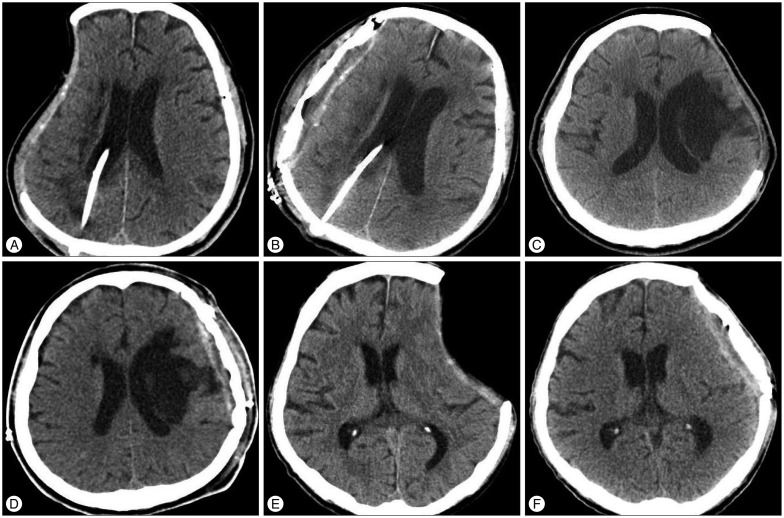
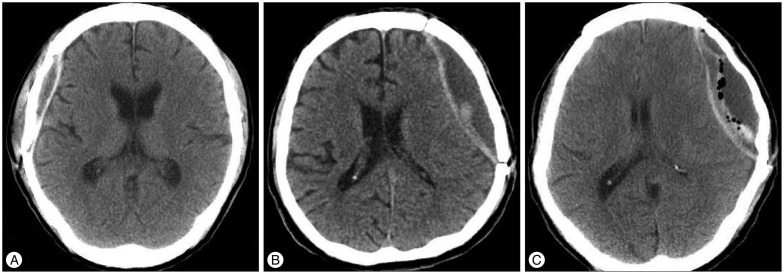
Results: Of the 117 patients undergoing cranioplasty, 59 (50.4%) suffered complications, and EFC occurred in 48 of the patients (41.0%). In the t-test and chi-test, risk factors for EFC were size of the skull defect (p=0.003) and postoperative air bubbles in the epidural space (p<0.001). In a logistic regression, the only statistically significant factor associated with development of EFC was the presence of postoperative air bubbles. The EFC disappeared or regressed over time in 30 of the 48 patients (62.5%), as shown by follow-up brain computed tomographic scan, but 17 patients (35.4%) required reoperation.
Conclusion: EFC after cranioplasty is predicted by postoperative air bubbles in the epidural space. Most EFC can be treated conservatively. However, reoperation is necessary to resolve about a third of the cases. During cranioplasty, special attention is required when the skull defect is large, since EFC is then more likely.
Keywords: Cranioplasty; Epidural fluid collection; Size of skull defect.
Figures
References
-
- Albanèse J, Leone M, Alliez JR, Kaya JM, Antonini F, Alliez B, et al. Decompressive craniectomy for severe traumatic brain injury : evaluation of the effects at one year. Crit Care Med. 2003;31:2535–2538. - PubMed
-
- Beauchamp KM, Kashuk J, Moore EE, Bolles G, Rabb C, Seinfeld J, et al. Cranioplasty after postinjury decompressive craniectomy : is timing of the essence? J Trauma. 2010;69:270–274. - PubMed
-
- Bullock MR, Chesnut R, Ghajar J, Gordon D, Hartl R, Newell DW, et al. : Surgical management of acute subdural hematomas. Neurosurgery. 2006;58(3 Suppl):S16–S24. discussion Si-Siv. - PubMed
-
- Chang V, Hartzfeld P, Langlois M, Mahmood A, Seyfried D. Outcomes of cranial repair after craniectomy. J Neurosurg. 2010;112:1120–1124. - PubMed
-
- Cho KC, Park SC, Choe IS, Seo DH. Safety and efficacy of early cranioplasty after decompressive craniectomy in traumatic brain injury patients. J Korean Neurotraumatol Soc. 2011;7:74–77.
LinkOut - more resources
Full Text Sources
Other Literature Sources