. 2014 Dec 23:5:5759.
doi: 10.1038/ncomms6759.

Pharmacological targeting of the mammalian clock regulates sleep architecture and emotional behaviour

Affiliations

Pharmacological targeting of the mammalian clock regulates sleep architecture and emotional behaviour

Subhashis Banerjee et al. Nat Commun. .

Abstract

Synthetic drug-like molecules that directly modulate the activity of key clock proteins offer the potential to directly modulate the endogenous circadian rhythm and treat diseases associated with clock dysfunction. Here we demonstrate that synthetic ligands targeting a key component of the mammalian clock, the nuclear receptors REV-ERBα and β, regulate sleep architecture and emotional behaviour in mice. REV-ERB agonists induce wakefulness and reduce REM and slow-wave sleep. Interestingly, REV-ERB agonists also reduce anxiety-like behaviour. These data are consistent with increased anxiety-like behaviour of REV-ERBβ-null mice, in which REV-ERB agonists have no effect. These results indicate that pharmacological targeting of REV-ERB may lead to the development of novel therapeutics to treat sleep disorders and anxiety.


Conflict of interest statement

Competing financial interests

The authors declare no competing financial interests.

Figures
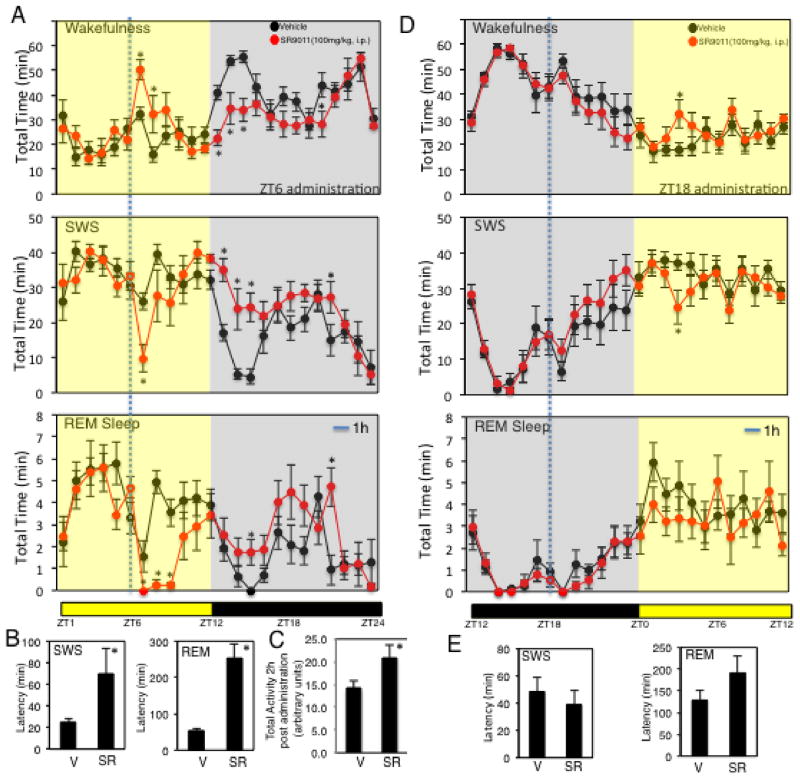
Figure 1
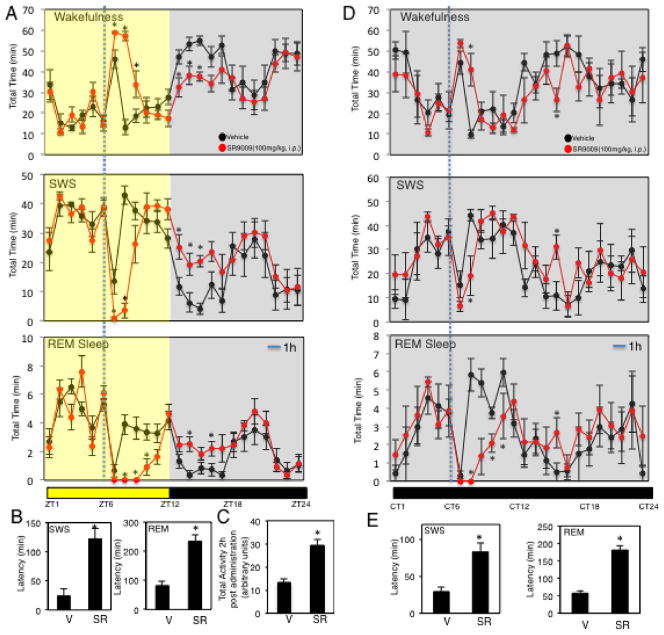
Figure 1. SR9011 Induces Wakefulness and Suppresses Sleep
A, Mice injected with The REV-ERB agonist SR9011 (i.p. 100 mg kg−1) at ZT6 display an increase in wakefulness as detected by EEG. B, SR9011 increases SWS and REM sleep latency. C, Locomotor telemetry data indicating an increase in movement during the period 2h after ZT6 injection of SR9011. D, Mice injected with SR9011 (i.p. 100 mg kg−1) at ZT18 fail to demonstrate increased wakefulness. E, SR9011 does not alter SWS and REM sleep latency (ZT18 injection). Data are expressed mean ± SEM. All EEG graphs are plotted per 1 h for a 24 h period. Values are mean ± SEM (n=8 for EEG studies (A,B,D,E) and n=6 for telemetry studies (C)). Within the EEG studies (wakefulness, SWS and REM sleep), potential differences between treatments were assessed by repeated measure two-way ANOVA followed by Bonferroni post hoc test. In panels examining latency and activity, differences between treatment groups (vehicle vs. SR) were assessed by a two tailed t test (Student’s) with significance *P < 0.05. In all experiments mice were maintained on a 12h:12h L:D cycle.
Figure 2
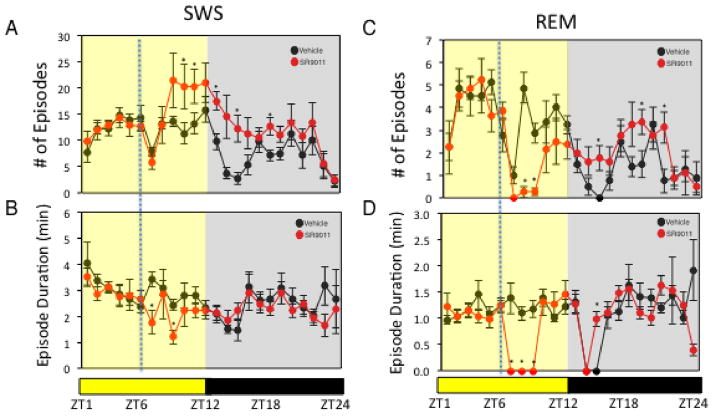
Figure 2. Administration of SR9011 Alters Sleep Architecture
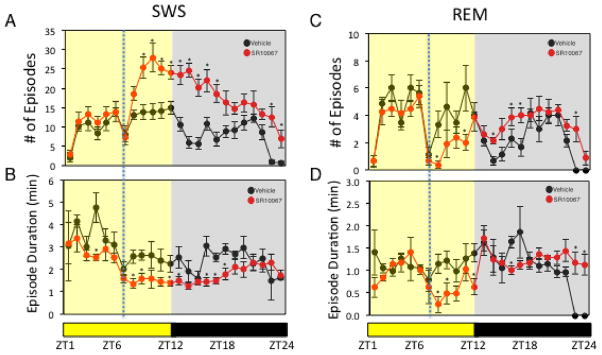
Effect of SR9011 administered at ZT6 (analysis of data from Figure 1A) on SWS (number of episodes (A) and episode duration (B)) and on REM sleep (number of episodes (C) and episode duration (D)). potential differences between treatments were assessed by repeated measure two-way ANOVA followed by Bonferroni post hoc test with significance *P < 0.05
Figure 3
Figure 3. SR9009 Induces Wakefulness and Suppresses Sleep
A, Mice injected with the REV-ERB agonist SR9009 (i.p. 100 mg kg−1) at ZT6 display an increase in wakefulness as detected by EEG. B, SR9009 increases SWS and REM sleep latency C, Locomotor telemetry data indicating an increase in movement during the period 2h after ZT6 injection of SR9011. Mice in A, B, and C were maintained under 12h:12h L:D conditions. D, Mice injected with SR9009 (i.p. 100 mg kg−1) at CT6 under constant dark conditions show increased wakefulness. E, SR9009 increases SWS and REM sleep latency when injected at CT6 under constant dark conditions. Data are expressed mean ± SEM. All EEG graphs are plotted per 1 h for a 24 h period. Values are mean ± SEM (n=8 for EEG studies and n=6 for telemetry studies). (C)). Within the EEG studies (wakefulness, SWS and REM sleep), potential differences between treatments were assessed by repeated measure two-way ANOVA followed by Bonferroni post hoc test. In panels examining latency and activity, differences between treatment groups (vehicle vs. SR) were assessed by a two tailed t test (Student’s) with significance *P < 0.05. Experiments were performed at least twice.
Figure 4
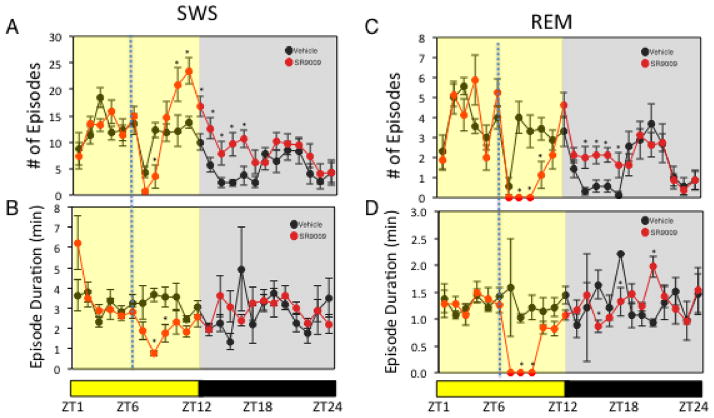
Figure 4. Administration of SR9009 Alters Sleep Architecture
Effect of SR9009 administered at ZT6 (analysis of data from Figure 3A) on SWS (number of episodes (A) and episode duration (B)) and on REM sleep (number of episodes (C) and episode duration (D)). potential differences between treatments were assessed by repeated measure two-way ANOVA followed by Bonferroni post hoc test with significance *P < 0.05
Figure 5
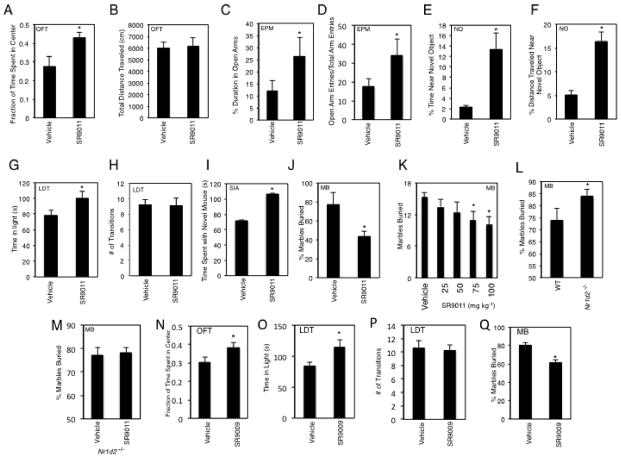
Figure 5. REV-ERB Regulates Anxiety-Like Behavior
SR9011 displays anxiolytic activity in a range of behavioral assays. A, Results from the open field assay demonstrating that mice administered SR9011 spend a significantly greater amount of time in the center field during the first 5 minutes after placing the animals in the apparatus than mice treated with vehicle. B, SR9011 treated mice display equivalent locomotor activity as vehicle treated mice in the open field assay. Results from elevated plus maze demonstrates that SR9011 treated mice spend a greater percentage of time exploring the open quadrants (C) and exhibit a greater frequency of open arm entries (D) than vehicle treated mice. Results from the novel object (neophobia) assay demonstrating that SR9011 treated mice spend more time near the novel object (E) and travel more distance near the novel object (F) than vehicle treated mice. Results from the light–dark box assay demonstrating that mice treated with SR9011 spend considerably more time in the light box than vehicle treated mice (G) while displaying no difference in the total number of transitions between the boxes (H). Results for the social interaction assay indicating that mice treated with SR9011 display greater social interaction with a novel mouse than mice treated with vehicle (I). Results from the marble burying assay demonstrate that SR9011 treated mice bury fewer marbles than vehicle treated mice (J). and this effect is dose-responsive (K). L, Rev-erbβ−/− mice display more anxiety in the marble burying assay consistent with data indicating that activation of REV-ERB leads to anxiolytic activity. M, The REV-ERB agonist, SR9011, does not display anxiolytic activity in Rev-erbβ null mice. Rev-erbβ null mice were treated with SR9011 in an identical manner as described in L and subjected the marble burying assay to examine the potential anxiolytic activity of SR9011. Consistent with the actions of SR9011, a distinct REV-ERB agonist, SR9009, also reduces anxiety-like behavior in the open field assay (N) the light-dark transition assay (O and P) and the marble burying assay (Q). Values are mean ± SEM, n=12 mice per group for all experiments except the marble burying test where n=8. With the exception of panel K differences between treatment groups (vehicle vs. SR) were assessed by a two-tailed t test (Student’s) with significance *P < 0.05. In panel K, differences between groups were assessed using one-way ANOVA followed by Tukey’s post hoc test with significance *P<0.05.
Figure 6
Figure 6. REV-ERB Activation Alters Reward Seeking Behavior
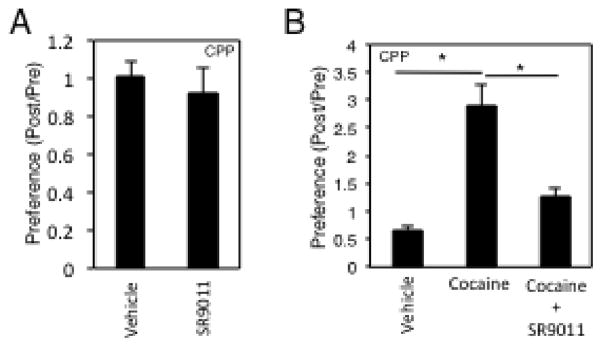
A, Results from a conditioned place preference (CPP) assay indicating lack of conditioned place preference or aversion activity of SR9011. Differences between treatment groups (vehicle vs. SR) were assessed by a two-tailed t test (Student’s) with significance *P < 0.05. B, Results of a CPP assay indicating that SR9011 coadministration inhibits the conditioned place preference displayed by cocaine. Differences between groups were assessed using one-way ANOVA followed by Tukey’s post hoc test with significance *P<0.05. Values are mean ± SEM, n=12 mice per group for all experiments.
Figure 7
Figure 7. The Activity of a REV-ERB Agonist is Suppressed by Treatment with Lithium
A, Treatment with lithium results in suppression of the wakefulness inducing effects of SR9009. Mice were maintained on either water or water with lithium chloride as described in the methods and vigilance states were monitored by EEG. Vehicle injection or SR9009 injection (100 mg kg−1, i.p.) is indicated. N=6 mice per group. B, Treatment with lithium suppresses the anxiolytic activity of SR9011 in a marble burying assay. Mice were maintained on either water or water with lithium chloride and treated with vehicle or SR9011 (100 mg kg−1 b.i.d., i.p.) as described in the methods. n=8 mice per group. Within the EEG studies (wakefulness, SWS and REM sleep), potential differences between treatments were assessed by repeated measure two-way ANOVA followed by Bonferroni post hoc test. In the marble burying assay differences between treatment groups were assessed by a two tailed t test (Student’s) with significance *,P < 0.05.
Figure 8
Figure 8. Identification of SR10067 as a highly potent synthetic REV-ERB agonist
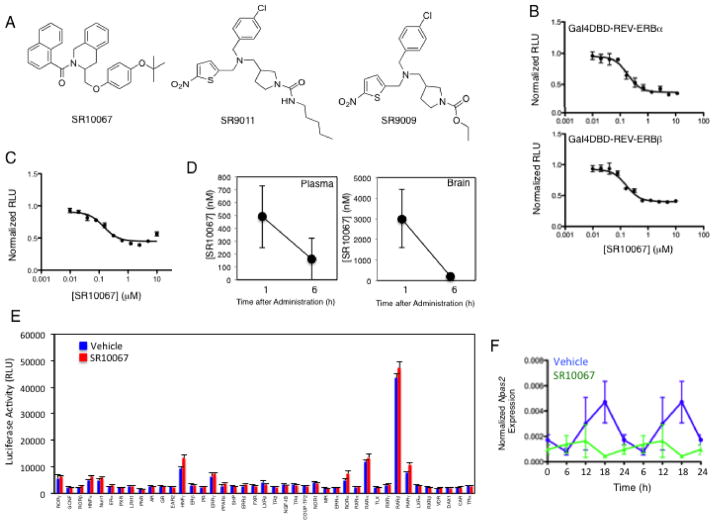
A, Chemical structure of the synthetic REV-ERB agonist SR10067 compared to SR9011 and SR9009. B, Results from a Gal4-REV-ERB/Gal4 UASX5 luciferase reporter cotransfection assay in HEK293 cells displaying the potent REV-ERB agonist activity of SR10067. C, Results from a cotransfection assay in HEK 293 cells with full-length REVERBα and a BMAL1 promoter driven luciferase reporter displaying the potent agonist activity of SR10067. D, Plasma and brain concentrations of SR10067 2h following i.p. injection of 30 mg kg−1 of the compound. The 6h value for SR10067 in the brain is 150 ± 20 nM. E, Nuclear receptor specificity assay illustrating lack of activity of SR10067 on a wide range of nuclear receptors. The format of the assay was a cotransfection assay with Gal4 DNA binding domain – nuclear receptor fusions in HEK293 cells as previously described (see Methods). SR10067 was tested at 20 μM. Error bars indicate mean ± s.e.m. and n=3. There were no statistical differences between vehicle and drug treatment in any of the assays shown as assessed by a Student’s t test (unpaired two-tailed). F, Normalized (to Gapdh) expression of Npas2 mRNA isolated from the hypothalamic of mice injected with 30 mg kg−1 of SR10067 (i.p. at ZT0) demonstrating a SR10067-dependent alteration in the circadian rhythm of expression. Expression was monitored over 24h and the results are double plotted. n=5. *P<0.05. Mean ± SEM.
Figure 9
Figure 9. SR10067 Alters Sleep Architecture and Anxiety-like Behavior
A, Actograms from wheel running cages demonstrating the effect of SR10067 injection (red bars, i.p. various concentrations) on wheel running activity in mice. B, Assessment of the dose-dependence of inhibition of wheel running activity in mice during the entire dark phase following administration of SR10067. n=6 to 8 mice per group. C, Assessment of the effect of SR10067 on wakefulness in mice. Wakefulness, SWS and REM sleep was monitored by EEG as indicated in Figs. 1 & 2. Mice were injected with SR10067 (30 mg kg−1, i.p.) or vehicle at ZT6. n=8 mice. D, Locomotor telemetry data indicating an increase in movement of mice during the period 2h after ZT6 injection of SR10067 (30 mg kg−1). n=6 mice. E, Results from the marble burying assay demonstrating that SR10067 dose-dependently reduces anxiety like behavior in the marble burying assay. n=8 mice. Values are mean ± SEM. In panel D differences between treatment groups (vehicle vs. SR) were assessed by a two tailed t test (Student’s) with significance *P < 0.05. In panels B and E, differences between groups were assessed using one-way ANOVA followed by Tukey’s post hoc test with significance *P<0.05. In panel C, potential differences between treatments were assessed by repeated measure two-way ANOVA followed by Bonferroni post hoc test with significance *P < 0.05.

Comment in

References

    1. Crumbley C, Burris TP. Direct regulation of CLOCK expression by REVERB. PLoS One. 2011;6:e17290. doi: 10.1371/journal.pone.0017290. - DOI - PMC - PubMed
    1. Crumbley C, Wang Y, Kojetin DJ, Burris TP. Characterization of the core mammalian clock component, NPAS2, as a REV-ERBalpha/RORalpha target gene. Journal of Biological Chemistry. 2010;285:35386–35392. doi: 10.1074/jbc.M110.129288. - DOI - PMC - PubMed
    1. Preitner N, et al. The orphan nuclear receptor REV-ERB alpha controls circadian transcription within the positive limb of the mammalian circadian oscillator. Cell. 2002;110:251–260. - PubMed
    1. Cho H, et al. Regulation of circadian behaviour and metabolism by REV-ERB-alpha and REV-ERB-beta. Nature. 2012;485:123–127. doi: 10.1038/nature11048. - DOI - PMC - PubMed
    1. Clayton JD, Kyriacou CP, Reppert SM. Keeping time with the human genome. Nature. 2001;409:829–831. - PubMed

Publication types

MeSH terms