


Fate of patients with newly diagnosed acute myeloid leukemia who fail primary induction therapy
- PMID: 25536215
- PMCID: PMC4386840
- DOI: 10.1016/j.bbmt.2014.10.025
Fate of patients with newly diagnosed acute myeloid leukemia who fail primary induction therapy
Abstract
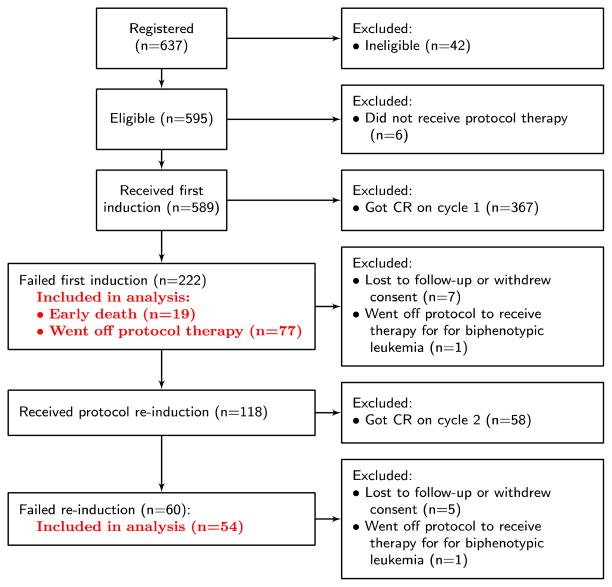
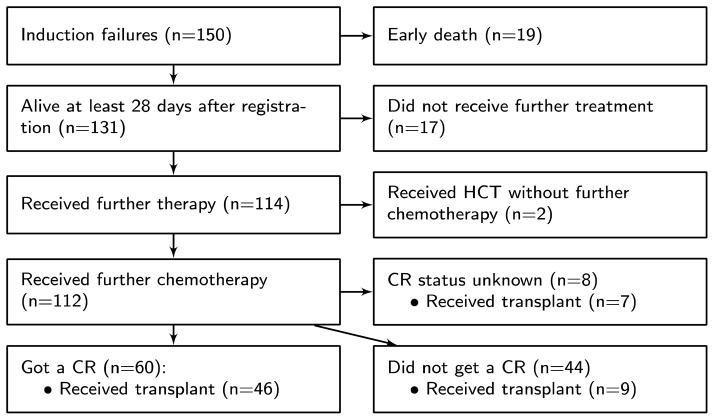
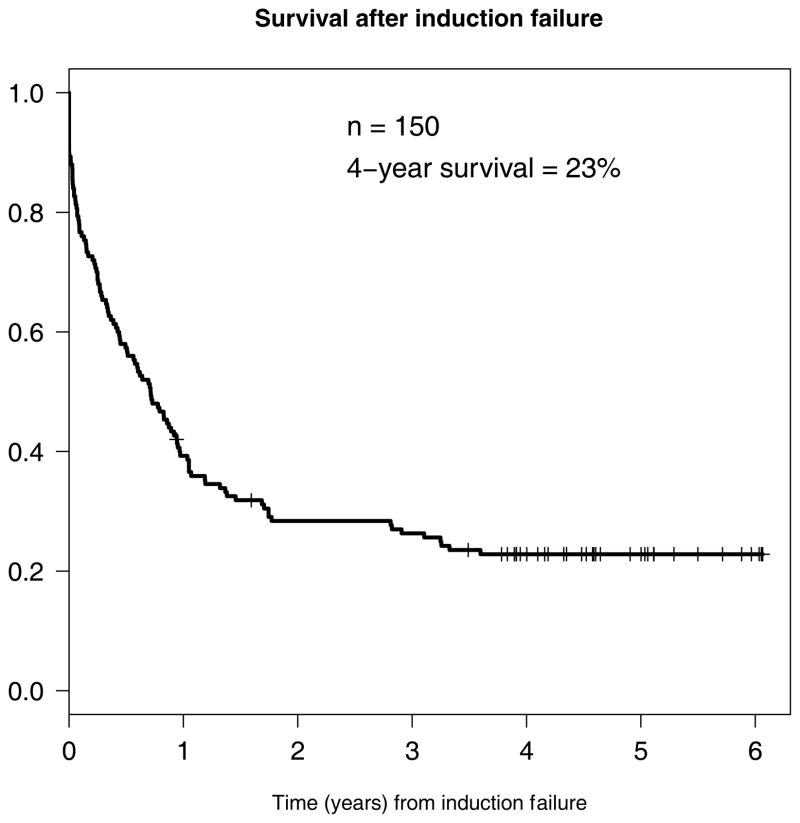
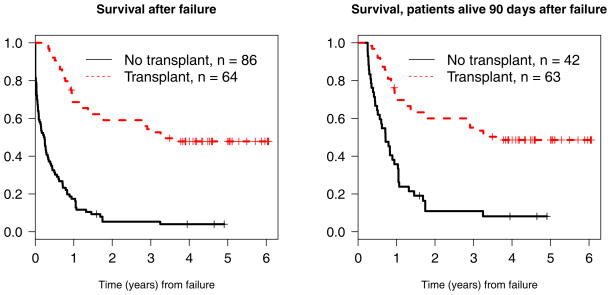
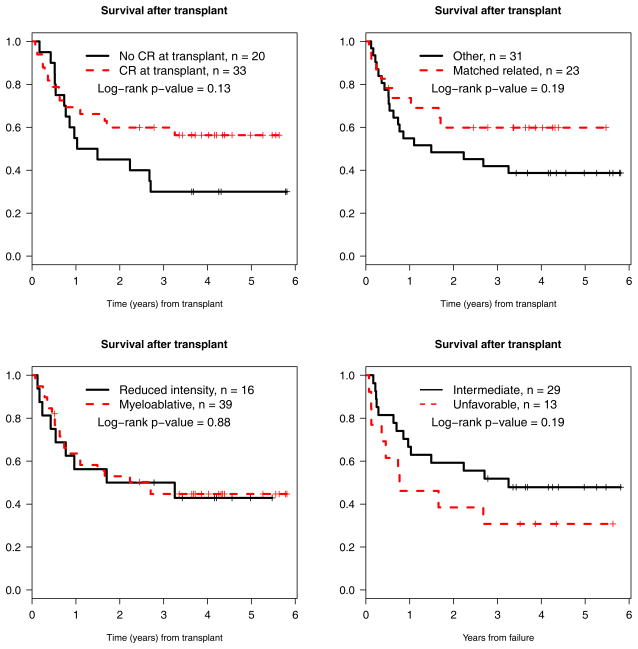
The aim of this study was to describe the fate of patients with newly diagnosed acute myeloid leukemia (AML) who did not achieve an initial remission while being treated on a contemporary cooperative group trial. We analyzed the outcome of patients entered into S0106, a recently reported cooperative group trial for patients with newly diagnosed AML. A total of 589 eligible patients was treated, of whom 150 (25%) did not achieve a remission while on study and were available for further analysis. The 4-year survival rate for the entire cohort of 150 patients was 23%. Among the 64 patients who received an allogeneic hematopoietic cell transplant, the 4-year survival rate was 48% compared with 4% for the 86 patients who did not undergo transplantation. Among those transplanted, we could not detect a difference in outcome according to remission status, donor source, type of preparative regimen, or cytogenetic risk category. More than 20% of patients with newly diagnosed AML who fail induction therapy can still be cured, particularly if they are able to receive an allogeneic hematopoietic cell transplant. These results suggest that early HLA typing and donor identification are important components of the initial therapy of AML.
Keywords: Acute myeloid leukemia; Hematopoietic cell transplantation; Induction failure.
Copyright © 2015 American Society for Blood and Marrow Transplantation. Published by Elsevier Inc. All rights reserved.
Figures
References
-
- Cheson BD, Bennett JM, Kopecky KJ, et al. Revised recommendations of the International Working Group for Diagnosis, Standardization of Response Criteria, Treatment Outcomes, and Reporting Standards for Therapeutic Trials in Acute Myeloid Leukemia [erratum appears in J Clin Oncol. 2004 Feb 1; 22(3):576 Note: LoCocco, Francesco [corrected to Lo-Coco, Francesco]] J Clin Oncol. 2003;21:4642–4649. - PubMed
-
- Döhner H, Estey EH, Amadori S, et al. Diagnosis and management of acute myeloid leukemia in adults: recommendations from an international expert panel, on behalf of the European LeukemiaNet. Blood. 2010;115:453–474. - PubMed
Publication types
MeSH terms
Grants and funding
- CA63848/CA/NCI NIH HHS/United States
- CA86780/CA/NCI NIH HHS/United States
- CA37981/CA/NCI NIH HHS/United States
- CA58416/CA/NCI NIH HHS/United States
- CA18029/CA/NCI NIH HHS/United States
- CA46136/CA/NCI NIH HHS/United States
- CA35178/CA/NCI NIH HHS/United States
- CA45807/CA/NCI NIH HHS/United States
- CA35128/CA/NCI NIH HHS/United States
- CA35261/CA/NCI NIH HHS/United States
- CA22433/CA/NCI NIH HHS/United States
- CA35431/CA/NCI NIH HHS/United States
- CA12644/CA/NCI NIH HHS/United States
- CA20319/CA/NCI NIH HHS/United States
- P01 CA018029/CA/NCI NIH HHS/United States
- CA41287/CA/NCI NIH HHS/United States
- CA077202/CA/NCI NIH HHS/United States
- CA58658/CA/NCI NIH HHS/United States
- CA128567/CA/NCI NIH HHS/United States
- CA63845/CA/NCI NIH HHS/United States
- CA45808/CA/NCI NIH HHS/United States
- CA14028/CA/NCI NIH HHS/United States
- CA58882/CA/NCI NIH HHS/United States
- CA11083/CA/NCI NIH HHS/United States
- CA58861/CA/NCI NIH HHS/United States
- CA35090/CA/NCI NIH HHS/United States
- CA46282/CA/NCI NIH HHS/United States
- CA76447/CA/NCI NIH HHS/United States
- CA15704/CA/NCI NIH HHS/United States
- CA46441/CA/NCI NIH HHS/United States
- CA35119/CA/NCI NIH HHS/United States
- CA32102/CA/NCI NIH HHS/United States
- CA38926/CA/NCI NIH HHS/United States
- U10 CA038926/CA/NCI NIH HHS/United States
- CA35176/CA/NCI NIH HHS/United States
- CA76448/CA/NCI NIH HHS/United States
- CA27057/CA/NCI NIH HHS/United States
- U10 CA180888/CA/NCI NIH HHS/United States
- CA04919/CA/NCI NIH HHS/United States
- U10 CA180819/CA/NCI NIH HHS/United States
- CA31946/CA/NCI NIH HHS/United States
- CA67575/CA/NCI NIH HHS/United States
LinkOut - more resources
Full Text Sources
Other Literature Sources
Medical
Research Materials
