


Greater absolute risk for all subtypes of breast cancer in the US than Malaysia
- PMID: 25537643
- PMCID: PMC6916248
- DOI: 10.1007/s10549-014-3243-9
Greater absolute risk for all subtypes of breast cancer in the US than Malaysia
Abstract
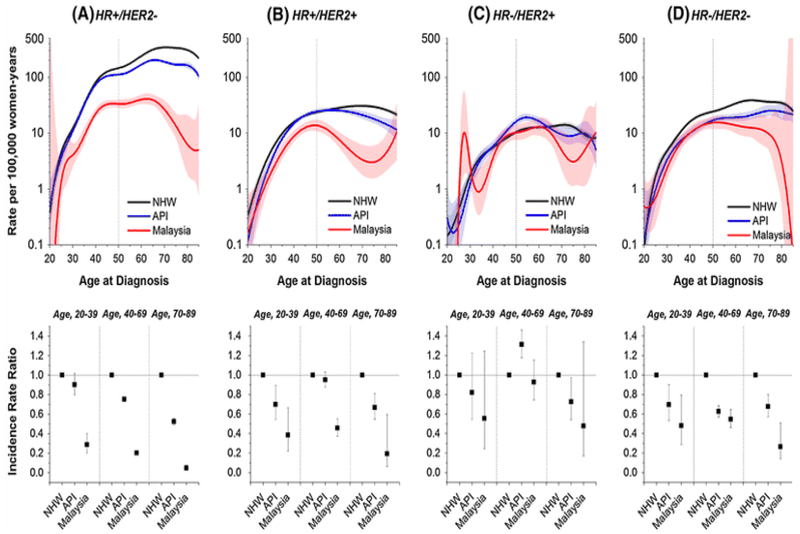
Hormone receptor (HR) negative breast cancers are relatively more common in low-risk than high-risk countries and/or populations. However, the absolute variations between these different populations are not well established given the limited number of cancer registries with incidence rate data by breast cancer subtype. We, therefore, used two unique population-based resources with molecular data to compare incidence rates for the 'intrinsic' breast cancer subtypes between a low-risk Asian population in Malaysia and high-risk non-Hispanic white population in the National Cancer Institute's surveillance, epidemiology, and end results 18 registries database (SEER 18). The intrinsic breast cancer subtypes were recapitulated with the joint expression of the HRs (estrogen receptor and progesterone receptor) and human epidermal growth factor receptor-2 (HER2). Invasive breast cancer incidence rates overall were fivefold greater in SEER 18 than in Malaysia. The majority of breast cancers were HR-positive in SEER 18 and HR-negative in Malaysia. Notwithstanding the greater relative distribution for HR-negative cancers in Malaysia, there was a greater absolute risk for all subtypes in SEER 18; incidence rates were nearly 7-fold higher for HR-positive and 2-fold higher for HR-negative cancers in SEER 18. Despite the well-established relative breast cancer differences between low-risk and high-risk countries and/or populations, there was a greater absolute risk for HR-positive and HR-negative subtypes in the US than Malaysia. Additional analytical studies are sorely needed to determine the factors responsible for the elevated risk of all subtypes of breast cancer in high-risk countries like the United States.
Conflict of interest statement
Conflict of interest
The authors declare that they have no conflict of interest.
Figures

References
-
- Kamangar F, Dores GM, Anderson WF (2006) Patterns of cancer incidence, mortality, and prevalence across five continents: defining priorities to reduce cancer rates in different geographic regions of the world. J Clin Oncol 24(14):2137–2150 - PubMed
-
- Huo D, Ikpatt F, Khramtsov A, Dangou JM, Nanda R, Dignam J, Zhang B, Grushko T, Zhang C, Oluwasola O, Malaka D, Malami S, Odetunde A, Adeoye AO, Iyare F, Falusi A, Perou CM, Olopade OI (2009) Population differences in breast cancer: survey in indigenous African women reveals over-representation of triple-negative breast cancer. J Clin Oncol 27(27):4515–4521. doi: 10.1200/JCO.2008.19.6873 - DOI - PMC - PubMed
Publication types
MeSH terms
Substances
Grants and funding
LinkOut - more resources
Full Text Sources
Other Literature Sources
Medical
Research Materials
Miscellaneous
