


Cocaine-induced behavioral sensitization is associated with changes in the expression of endocannabinoid and glutamatergic signaling systems in the mouse prefrontal cortex
- PMID: 25539508
- PMCID: PMC4368868
- DOI: 10.1093/ijnp/pyu024
Cocaine-induced behavioral sensitization is associated with changes in the expression of endocannabinoid and glutamatergic signaling systems in the mouse prefrontal cortex
Erratum in
-
Erratum.Int J Neuropsychopharmacol. 2016 Apr 27;19(10):pyw031. doi: 10.1093/ijnp/pyw031. Int J Neuropsychopharmacol. 2016. PMID: 27207904 Free PMC article. No abstract available.
Abstract
Background: Endocannabinoids modulate the glutamatergic excitatory transmission by acting as retrograde messengers. A growing body of studies has reported that both signaling systems in the mesocorticolimbic neural circuitry are involved in the neurobiological mechanisms underlying drug addiction.
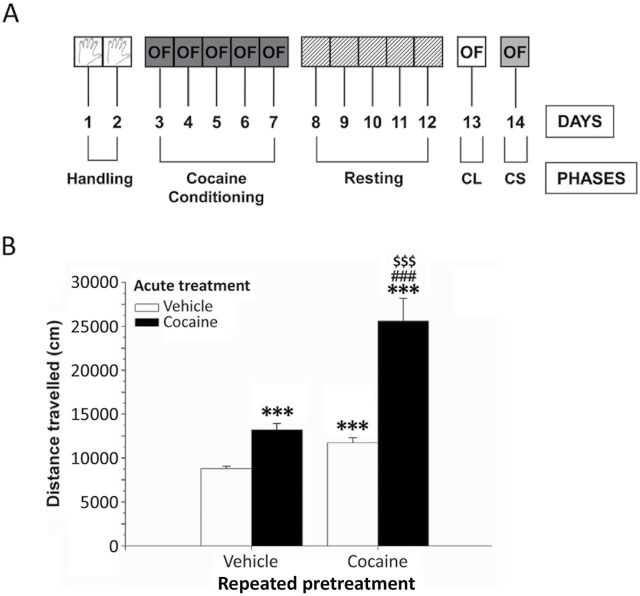
Methods: We investigated whether the expression of both endocannabinoid and glutamatergic systems in the prefrontal cortex (PFC) were altered by an acute and/or repeated cocaine administration schedule that resulted in behavioral sensitization. We measured the protein and mRNA expression of the main endocannabinoid metabolic enzymes and the cannabinoid receptor type 1 (CB1). We also analyzed the mRNA expression of relevant components of the glutamate-signaling system, including glutamate-synthesizing enzymes, metabotropic receptors, and ionotropic receptors.
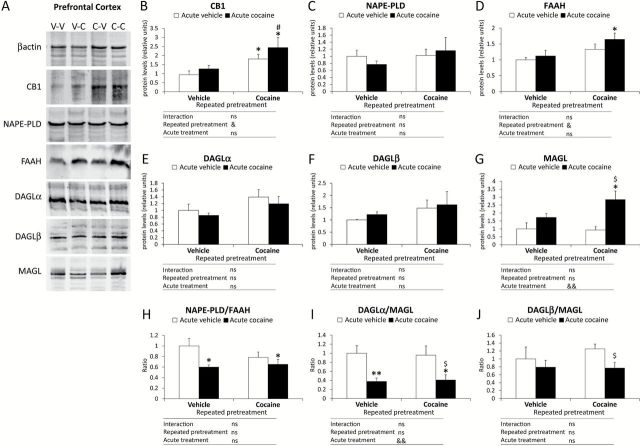
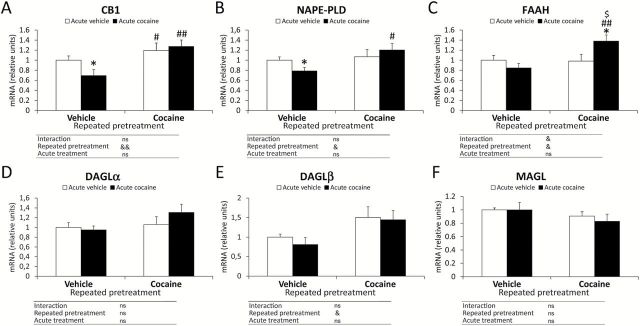
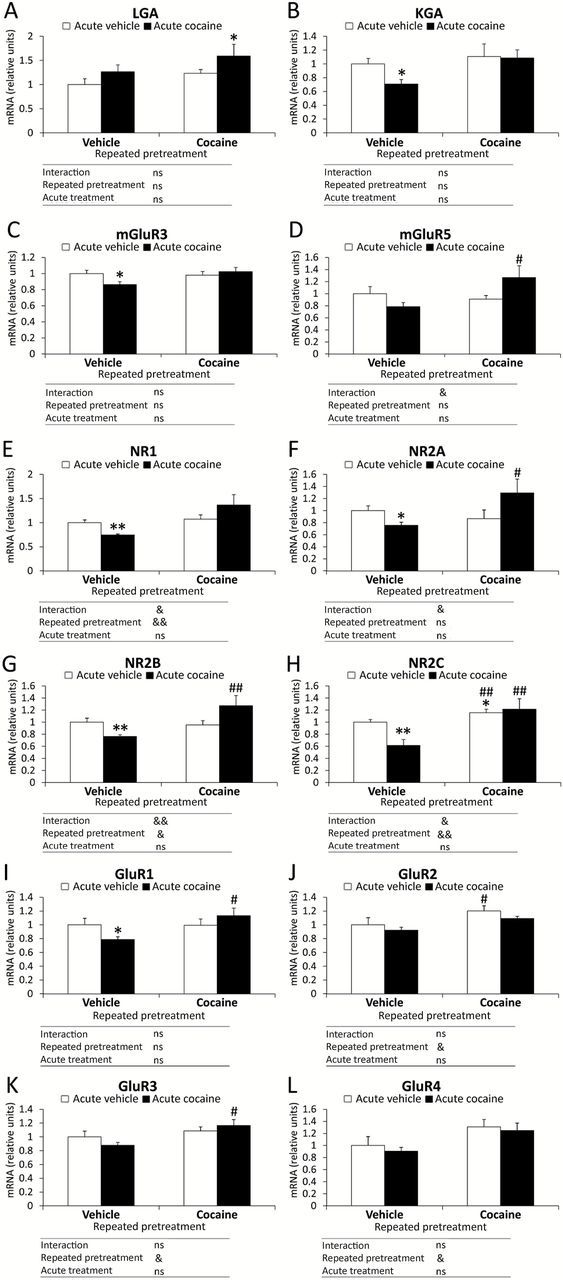
Results: Although acute cocaine (10 mg/kg) produced no significant changes in the endocannabinoid-related proteins, repeated cocaine administration (20 mg/kg daily) induced a pronounced increase in the CB1 receptor expression. In addition, acute cocaine administration (10 mg/kg) in cocaine-sensitized mice (referred to as cocaine priming) induced a selective increase in the endocannabinoid-degrading enzymes fatty acid amide hydrolase (FAAH) and monoacylglycerol lipase (MAGL). These protein changes were accompanied by an overall decrease in the ratios of endocannabinoid synthesis/degradation, especially the N-acyl phosphatidylethanolamine phospholipase D/FAAH and diacylglycerol lipase alpha/MAGL ratios. Regarding mRNA expression, while acute cocaine administration produced a decrease in CB1 receptors and N-acyl phosphatidylethanolamine phospholipase D, repeated cocaine treatment enhanced CB1 receptor expression. Cocaine-sensitized mice that were administered priming injections of cocaine mainly displayed an increased FAAH expression. These endocannabinoid changes were associated with modifications in glutamatergic transmission-related genes. An overall decrease was observed in the mRNA expression of the glutamate-synthesizing gene kidney-type glutaminase (KGA), the metabotropic glutamate receptors (mGluR3 and GluR), and subunits of NMDA ionotropic receptors (NR1, NR2A, NR2B and NR2C) after acute cocaine administration, while mice repeatedly exposed to cocaine only displayed an increase in NR2C. However, in cocaine-sensitized mice primed with cocaine, this inhibition was reversed and a strong increase was detected in the mGluR5, NR2 subunits, and both GluR1 and GluR3.
Conclusions: These findings indicate that cocaine sensitization is associated with an endocannabinoid downregulation and a hyperglutamatergic state in the PFC that, overall, contribute to an enhanced glutamatergic input into PFC-projecting areas.
Keywords: cannabinoid; cocaine; glutamate; prefrontal cortex.; sensitization.
© The Author 2014. Published by Oxford University Press. All rights reserved. For Permissions, please e-mail: journals.permissions@oup.com.
Figures
References
-
- Adamczyk P, McCreary AC, Przegalinski E, Mierzejewski P, Bienkowski P, Filip M. (2009). The effects of fatty acid amide hydrolase inhibitors on maintenance of cocaine and food self-administration and on reinstatement of cocaine-seeking and food-taking behavior in rats. J Physiol Pharmacol 60:119–125. - PubMed
-
- Aracil-Fernandez A, Trigo JM, Garcia-Gutierrez MS, Ortega-Alvaro A, Ternianov A, Navarro D, Robledo P, Berbel P, Maldonado R, Manzanares J. (2012). Decreased cocaine motor sensitization and self-administration in mice overexpressing cannabinoid CB(2) receptors. Neuropsychopharmacology 37:1749–1763. - PMC - PubMed
-
- Blanco E, Bilbao A, Luque-Rojas MJ, Palomino A, Bermudez-Silva FJ, Suarez J, Santin LJ, Estivill-Torrus G, Gutierrez A, Campos-Sandoval JA, Alonso-Carrion FJ, Marquez J, de Fonseca FR. (2012). Attenuation of cocaine-induced conditioned locomotion is associated with altered expression of hippocampal glutamate receptors in mice lacking LPA1 receptors. Psychopharmacology (Berl) 220:27–42. - PubMed
-
- Cardinal RN, Everitt BJ. (2004). Neural and psychological mechanisms underlying appetitive learning: links to drug addiction. Curr Opin Neurobiol 14:156–162. - PubMed
-
- Centonze D, Battista N, Rossi S, Mercuri NB, Finazzi-Agro A, Bernardi G, Calabresi P, Maccarrone M. (2004). A critical interaction between dopamine D2 receptors and endocannabinoids mediates the effects of cocaine on striatal gabaergic Transmission. Neuropsychopharmacology 29:1488–1497. - PubMed
Publication types
MeSH terms
Substances
LinkOut - more resources
Full Text Sources
Other Literature Sources
Molecular Biology Databases
Miscellaneous
