. 2014 Oct 31;18(1):pyu026.
doi: 10.1093/ijnp/pyu026.

PTSD-like memory generated through enhanced noradrenergic activity is mitigated by a dual step pharmacological intervention targeting its reconsolidation

Affiliations

PTSD-like memory generated through enhanced noradrenergic activity is mitigated by a dual step pharmacological intervention targeting its reconsolidation

Lucas Gazarini et al. Int J Neuropsychopharmacol. .

Erratum in

  • Erratum.
    [No authors listed] [No authors listed] Int J Neuropsychopharmacol. 2016 Apr 27;19(10):pyw031. doi: 10.1093/ijnp/pyw031. Int J Neuropsychopharmacol. 2016. PMID: 27207904 Free PMC article. No abstract available.

Abstract

Background: Traumatic memories have been resilient to therapeutic approaches targeting their permanent attenuation. One of the potentially promising pharmacological strategies under investigation is the search for safe reconsolidation blockers. However, preclinical studies focusing on this matter have scarcely addressed abnormal aversive memories and related outcomes.

Methods: By mimicking the enhanced noradrenergic activity reported after traumatic events in humans, here we sought to generate a suitable condition to establish whether some clinically approved drugs able to disrupt the reconsolidation of conditioned fear memories in rodents would still be effective.

Results: We report that the α2-adrenoceptor antagonist yohimbine was able to induce an inability to restrict behavioral (fear) and cardiovascular (increased systolic blood pressure) responses to the paired context when administered immediately after acquisition, but not 6h later, indicating the formation of a generalized fear memory, which endured for over 29 days and was less susceptible to suppression by extinction. It was also resistant to reconsolidation disruption by the α2-adrenoceptor agonist clonidine or cannabidiol, the major non-psychotomimetic component of Cannabis sativa. Since signaling at N-methyl-D-aspartate (NMDA) receptors is important for memory labilization and because a dysfunctional memory may be less labile than is necessary to trigger reconsolidation on its brief retrieval and reactivation, we then investigated and demonstrated that pre-retrieval administration of the partial NMDA agonist D-cycloserine allowed the disrupting effects of clonidine and cannabidiol on reconsolidation.

Conclusions: These findings highlight the effectiveness of a dual-step pharmacological intervention to mitigate an aberrant and enduring aversive memory similar to that underlying the post-traumatic stress disorder.

Keywords: PTSD; fear generalization; memory overconsolidation; norepinephrine.


Figures

Figure 1.
Figure 1.
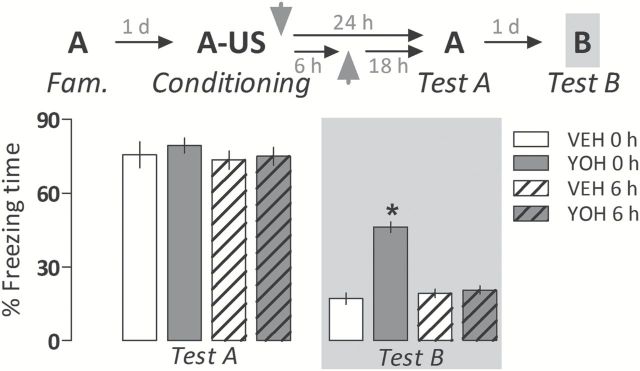
Yohimbine (YOH; 1.0mg/kg i.p.) induces a generalized fear expression when administered immediately after acquisition of a contextual fear memory in rats. This effect was no longer observed when it was given after the completion of the process of memory consolidation (6h post-acquisition). Animals were subjected to Tests A and B undrugged. The scheme above the graph represents the experimental design adopted. Arrowheads indicate the moment of drug administration. Bars represent the percentage of total time spent freezing. Values are expressed as mean ± SEM (n = 8–10/group). *p < 0.05 from the respective control group (VEH).
Figure 2.
Figure 2.
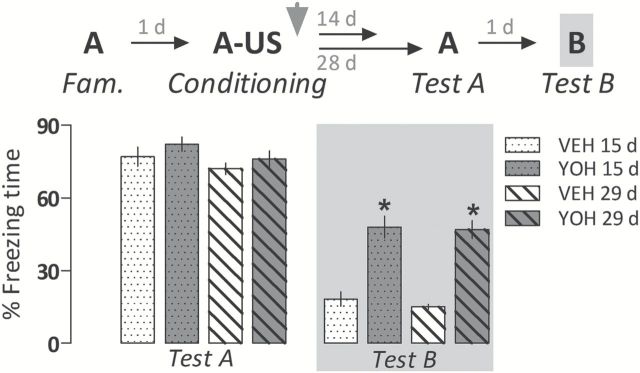
Generalized fear expression induced by yohimbine (YOH; 1.0mg/kg i.p.) persists over 29 days. Animals were subjected to Tests A and B undrugged. The scheme above the graph represents the experimental design adopted. The arrowhead indicates the moment of drug administration. Bars represent the percentage of total time spent freezing. Values are expressed as mean ± SEM (n = 9–10/group). *p < 0.05 from the respective control group (VEH).
Figure 3.
Figure 3.
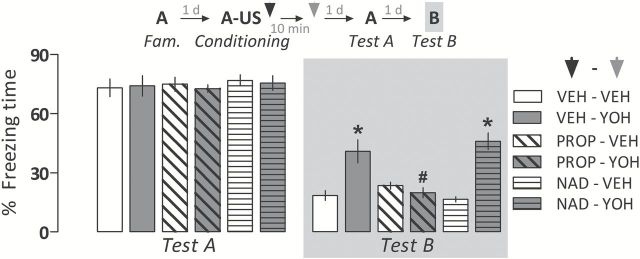
Pretreatment with the central β-adrenoceptor antagonist propranolol (PROP; 10mg/kg), but not the peripheral β-adrenoceptor antagonist nadolol (NAD; 10mg/kg), prevents the generalized fear expression induced by yohimbine (YOH; 1.0mg/kg i.p.) two days later. Animals were subjected to Tests A and B undrugged. The scheme above the graph represents the experimental design adopted. Arrowheads indicate the moment of drug administration. Bars represent the percentage of total time spent freezing. Values are expressed as mean ± SEM (n = 8–10/group). *p < 0.05 from controls (VEH-VEH and NAD-VEH, respectively); # Significant difference from the VEH-YOH group.
Figure 4.
Figure 4.
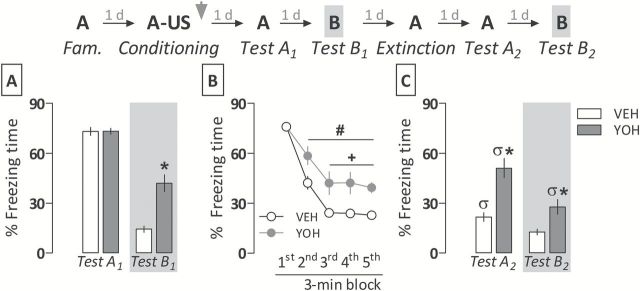
Evidence of a relative resistance to extinction of a contextual fear memory consolidated under the yohimbine (YOH) influence. (A) YOH (1.0mg/kg i.p.) induces generalized fear expression when given immediately after the conditioning session, as demonstrated in Experiment 1. (B) In YOH-treated animals, fear memory extinction was acquired more slowly than in controls (VEH). (C) YOH-treated animals did not retain extinction learning as well as controls. They also displayed higher levels of generalized fear two days following a 15min fear extinction session. Animals were subjected to Tests A1, A2, B1, B2, and the extinction session undrugged. The scheme above the graph represents the experimental design adopted. The arrowhead indicates the moment of drug administration. Bars represent the percentage of total time spent freezing. Values are expressed as mean ± SEM (n = 11/group). *p < 0.05 from the respective control group; #significant difference from the first 3min extinction session block in the same group; +significant difference from controls in the same session block; σsignificant difference from respective Test A1 or Test B1.
Figure 5.
Figure 5.
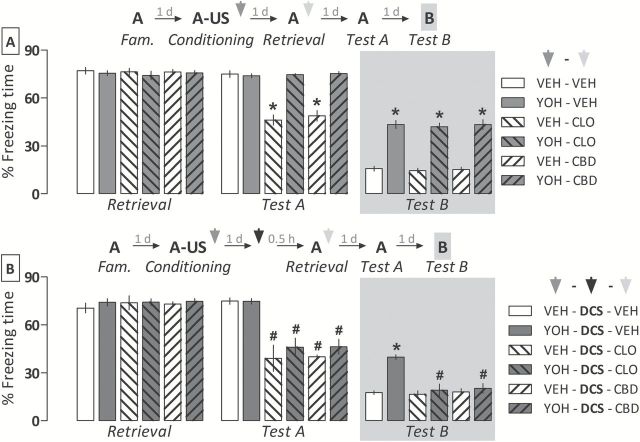
Comparative effects of clonidine (CLO; 0.3mg/kg) and cannabidiol (CBD; 10mg/kg) given alone or associated with D-cycloserine (DCS; 15mg/kg) on the reconsolidation of a fear memory consolidated under the influence of yohimbine (YOH; 1.0mg/kg). (A) In comparison with the control group (VEH-VEH), both VEH-CLO and VEH-CBD groups expressed less fear when re-exposed to the paired context (Test A). However, the disruptive effect of CLO and CBD on memory reconsolidation was no longer observed in YOH-treated animals, which also expressed fear generalization to an unpaired context (Test B). (B) Administrating DCS 30min prior to memory retrieval allows the memory reconsolidation-disrupting effects of CLO and CBD and prevents the generalized fear expression in YOH-treated animals. Animals were subjected to Tests A and B undrugged. Schemes above graphs represent the experimental design of each one of the experiments. Arrowheads indicate the moments of drug administration. Bars represent the percentage of total time spent freezing. Values are expressed as mean ± SEM (n = 7–10/group). *p < 0.05 from the respective controls; #significant difference from the YOH-DCS-VEH group.
Figure 6.
Figure 6.
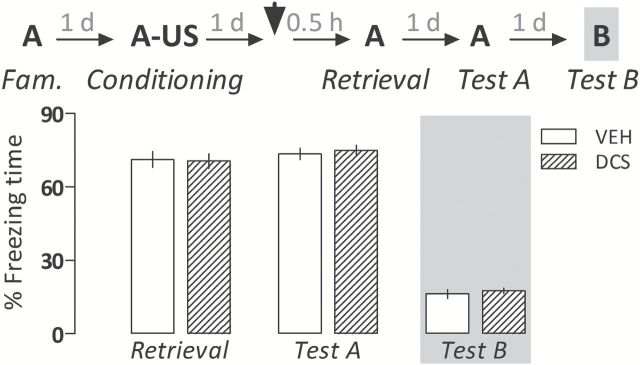
D-cycloserine (DCS; 15mg/kg) does not change the amount of freezing time expressed during re-exposures to the paired Context A (retrieval and Test A sessions) or exposure to the unpaired Context B (Test B) relative to controls (VEH) when given 30min before briefly retrieving a contextual fear memory. Animals were subjected to Tests A and B undrugged. The scheme above the graph represents the experimental design adopted. The arrowhead indicates the moment of drug administration. Bars represent the percentage of total time spent freezing. Values are expressed as mean ± SEM (n = 9/group).

References

    1. Adamec R, Muir C, Grimes M, Pearcey K. (2007). Involvement of noradrenergic and corticoid receptors in the consolidation of the lasting anxiogenic effects of predator stress. Behav Brain Res 179:192–207. - PubMed
    1. Alberini CM. (2011). The role of reconsolidation and the dynamic process of long-term memory formation and storage. Front Behav Neurosci 5:12. - PMC - PubMed
    1. Anisman H. (2011). Sensitization in relation to posttraumatic stress disorder. Biol Psychiatry 70:404–405. - PubMed
    1. Bhuvaneswar CG, Ruskin JN, Katzman AR, Wood N, Pitman RK. (2014). Pilot study of the effect of lipophilic vs. hydrophilic beta-adrenergic blockers being taken at time of intracardiac defibrillator discharge on subsequent PTSD symptoms. Neurobiol Learn Mem. 112:248–252. - PMC - PubMed
    1. Bustos SG, Giachero M, Maldonado H, Molina VA. (2010). Previous stress attenuates the susceptibility to Midazolam’s disruptive effect on fear memory reconsolidation: influence of pre-reactivation D-cycloserine administration. Neuropsychopharmacology 35:1097–1108. - PMC - PubMed

Publication types

MeSH terms