


The Dutch Obesity Intervention in Teenagers (DOiT) cluster controlled implementation trial: intervention effects and mediators and moderators of adiposity and energy balance-related behaviours
- PMID: 25539582
- PMCID: PMC4304621
- DOI: 10.1186/s12966-014-0158-0
The Dutch Obesity Intervention in Teenagers (DOiT) cluster controlled implementation trial: intervention effects and mediators and moderators of adiposity and energy balance-related behaviours
Abstract
Background: The Dutch Obesity Intervention in Teenagers (DOiT) programme is an evidence-based obesity prevention programme tailored to adolescents attending the first two years of prevocational education in the Netherlands. The initial programme showed promising results during an effectiveness trial. The programme was adapted and prepared for nationwide dissemination. To gain more insight into the process of translating evidence-based approaches into 'real world' (i.e., 'natural') conditions, our research aims were to evaluate the impact of the DOiT-implementation programme on adolescents' adiposity and energy balance-related behaviours during natural dissemination and to explore the mediating and moderating factors underlying the DOiT intervention effects.
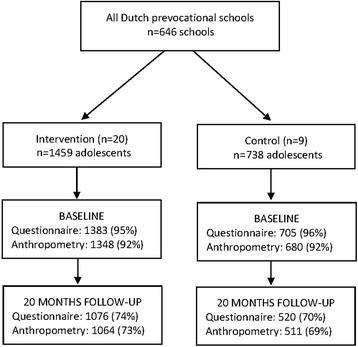
Methods: We conducted a cluster-controlled implementation trial with 20 voluntary intervention schools (n=1002 adolescents) and 9 comparable control schools (n = 484 adolescents). We measured adolescents' body height and weight, skinfold thicknesses, and waist circumference. We assessed adolescents' dietary and physical activity behaviours by means of self-report. Data were collected at baseline and at 20-months follow-up. We used multivariable multilevel linear or logistic regression analyses to evaluate the intervention effects and to test the hypothesised behavioural mediating factors. We checked for potential effect modification by gender, ethnicity and education level.
Results: We found no significant intervention effects on any of the adiposity measures or behavioural outcomes. Furthermore, we found no mediating effects by any of the hypothesised behavioural mediators. Stratified analyses for gender showed that the intervention was effective in reducing sugar-containing beverage consumption in girls (B = -188.2 ml/day; 95% CI = -344.0; -32.3). In boys, we found a significant positive intervention effect on breakfast frequency (B = 0.29 days/week; 95% CI = 0.01; 0.58). Stratified analyses for education level showed an adverse intervention effect (B = 0.09; 95% CI = 0.02; 0.16) on BMI z-scores for adolescents attending the vocational education track.
Conclusions: Although not successful in changing adolescents' adiposity, the DOiT-implementation programme had some beneficial effects on specific obesity-related behaviours in subgroups. This study underlines the difficulty of translating intervention effectiveness in controlled settings to real world contexts. Adaptations to the implementation strategy are needed in order to promote implementation as intended by the teachers.
Trial registration: Current Controlled Trials ISRCTN92755979.
Figures
References
-
- Waters E, de Silva-Sanigorski A, Hall BJ, Brown T, Campbell KJ, Gao Y, Armstrong R, Prosser L, Summerbell CD: Interventions for preventing obesity in children.Cochrane Database Syst Rev 2011, 7(12):CD001871. - PubMed
Publication types
MeSH terms
Associated data
LinkOut - more resources
Full Text Sources
Other Literature Sources
Medical
