. 2014 Dec 24:15:136.
doi: 10.1186/s12868-014-0136-0.

Noise alters guinea pig's blood-labyrinth barrier ultrastructure and permeability along with a decrease of cochlear Claudin-5 and Occludin

Affiliations

Noise alters guinea pig's blood-labyrinth barrier ultrastructure and permeability along with a decrease of cochlear Claudin-5 and Occludin

Yong-Xiang Wu et al. BMC Neurosci. .

Abstract

Background: Noise exposure (NE) is a severe modern health hazard that induces hearing impairment. However, the noise-induced ultrastructural changes of blood-labyrinth barrier (BLB) and the potential involvements of tight junction proteins (TJP) remain inconclusive. We investigated the effects of NE on not only the ultrastructure of cochlea and permeability of BLB but also the expression of TJP within the guinea pig cochlea.

Results: Male albino guinea pigs were exposed to white noise for 4 h or 2 consecutive days (115 dB sound pressure level, 6 hours per day) and the hearing impairments and light microscopic change of BLB were evaluated with auditory brainstem responses (ABR) and the cochlear sensory epithelia surface preparation, respectively. The cochlear ultrastructure and BLB permeability after NE 2d were revealed with transmission electron microscope (TEM) and lanthanum nitrate-tracing techniques, respectively. The potential alterations of TJPs Claudin-5 and Occludin were quantified with immunohistochemistry and western blot. NE induced significant hearing impairment and NE 2d contributed to significant outer hair cell (OHC) loss that is most severe in the first row of outer hair cells. Furthermore, the loosen TJ and an obvious leakage of lanthanum nitrate particles beneath the basal lamina were revealed with TEM. Moreover, a dose-dependent decrease of Claudin-5 and Occludin was observed in the cochlea after NE.

Conclusions: All these findings suggest that both decrease of Claudin-5 and Occludin and increased BLB permeability are involved in the pathologic process of noise-induced hearing impairment; however, the causal relationship and underlying mechanisms should be further investigated.


Figures
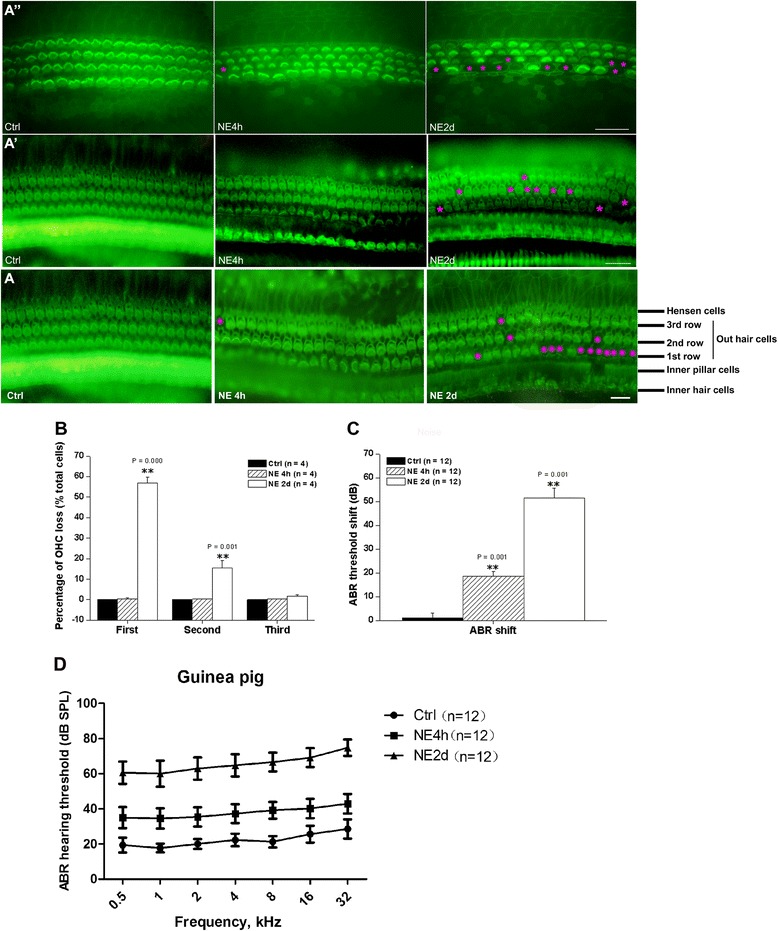
Figure 1
Figure 1
Morphological alteration and functional impairment after NE. A) Representative cochlear sensory epithelia surface preparation in the bottom basilar membrane structure from Ctrl, NE 4 h and NE 2d groups. A’) Morphological alteration of cochlear sensory epithelia surface preparation in the middle membrane structure from Ctrl, NE 4 h and NE 2d groups. A”) Morphological alteration of cochlear sensory epithelia surface preparation in the apex membrane structure from Ctrl, NE 4 h and NE 2d groups. B) Percentage of OHC loss in each row. The loss was observed mainly in the first row and the posterior second row. C) Mean ABR threshold shifts in Ctrl, NE 4 h and NE 2d groups. D) ABR hearing threshold to pure tone frequencies in Ctrl, NE 4 h and NE 2d groups. Scale bar = 20 μm in A, A’ and A”. **P < 0.01, vs Ctrl, data were expressed as mean ± SEM. formula image and formula image indicate Hair Cell loss.
Figure 2
Figure 2
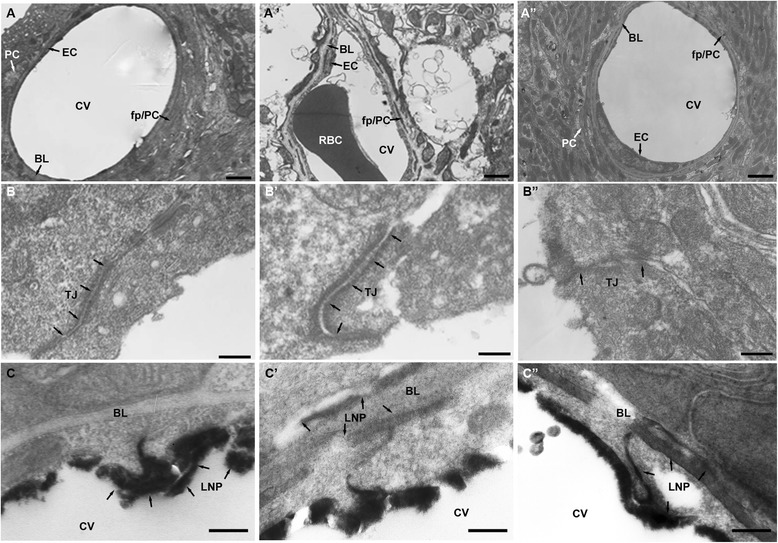
The ultrastructure of cochlea from control (A,B), NE 2d (A’,B’) and NE 4 h (A”,B”) groups as well as the distribution of lanthanum nitrate particles from Control (C), NE 2d (C’) and NE 4 h (C”) groups examined with TEM. A) Normal ultrastructure of BLB showing PC, EC and fp/PC. B) Normal ultrastructure of TJ. C) LNPs were restrained inside the cochlear vessels from a control animal. A’) Ultrastructure of BLB showing PC, EC and fp/PC after NE 2d. B’) Ultrastructure of TJ after NE 2d. C’) LNPs entered into the tissue after NE 2d. A”) Ultrastructure of BLB showing PC, EC and fp/PC after NE 4 h. B”) Ultrastructure of TJ after NE 4 h. C”) LNPs entered into the tissue after NE 4 h. Arrows in B, B’ and B” indicate TJ. BL, basal lamina; CV, capillary vessel; EC, endothelial cells; fp, pericyte foot; LNPs, lanthanum nitrate particles; PC, pericytes; RBC, red blood cells. Scale bar in A, A’ and A” = 500 nm; in the other panels = 100 nm.
Figure 3
Figure 3
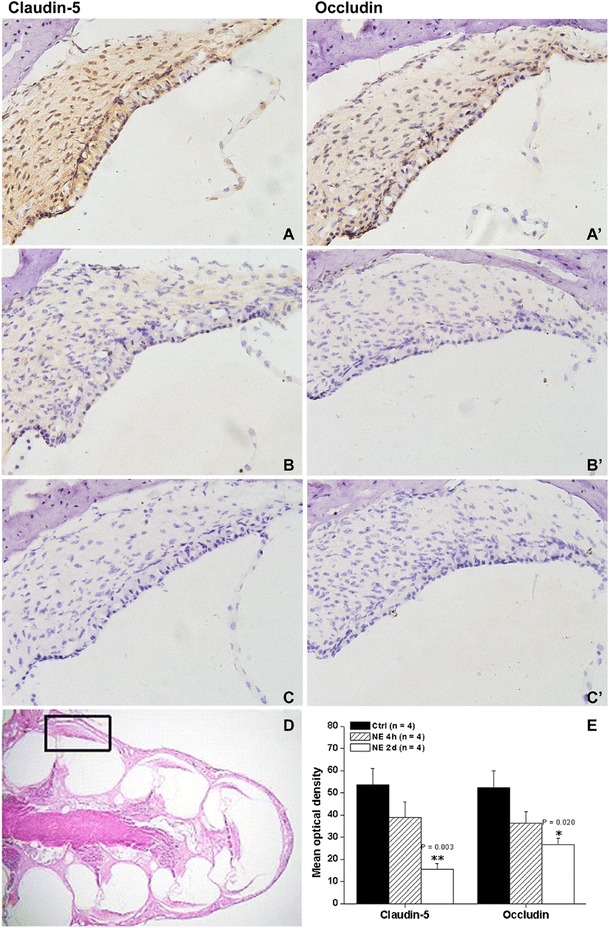
The expressions of Claudin-5 (A,B,C) and Occludin (A’,B’,C’) in cochleae after NE 4 h or NE 2d were analyzed with immunohistochemistry. A) Normal expression of Claudin-5 in cochlea. A') Normal expression of Occludin in cochlea. B) The decreased expression of Claudin-5 in cochlea after NE 4h. B') The decreased expression of Occludin in cochlea after NE 4h. C) The decreased expression of Claudin-5 in cochlea after NE 2d. C') The decreased expression of Occludin in cochlea after NE 2d. D) Normal structure of cochlea stained by HE. E) The expression of Claudin-5 and Occludin in cochleae were analyzed by optical density. The regions used for analysis was shown in D. The relative expression levels for Claudin-5 and Occludin were shown in E. Scale bar = 100 μm. *P < 0.05, **P < 0.05.
Figure 4
Figure 4
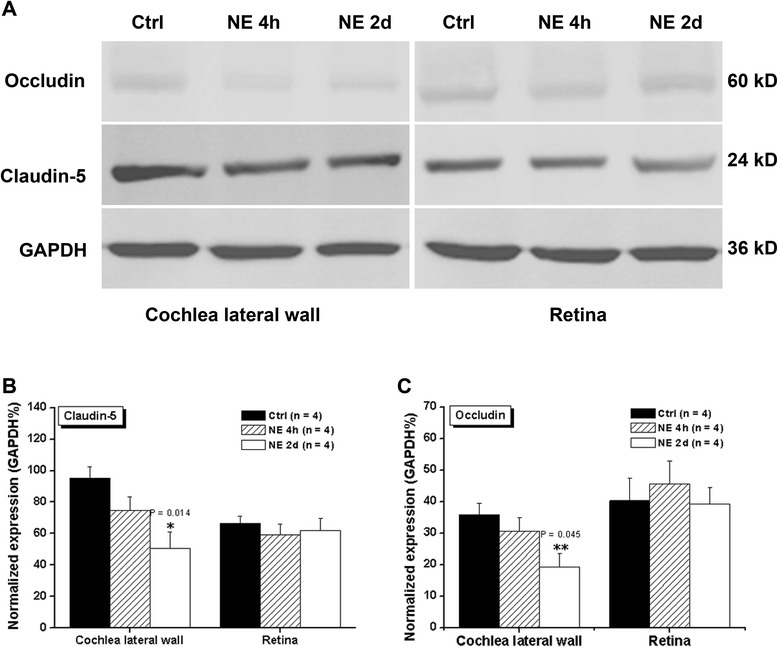
The protein expressions of Claudin-5 (A,B) and Occludin (A,C) in cochlear after NE 4 h or NE 2d were analyzed with western blot. The protein expressions in retina were utilized for negtive control. The intensities of GAPDH bands were used for normalization. *P < 0.05, **P < 0.05.

References

    1. Lim DJ. Effects of noise and ototoxic drugs at the cellular level in the cochlea: a review. Am J Otolaryngol. 1986;7(2):73–99. doi: 10.1016/S0196-0709(86)80037-0. - DOI - PubMed
    1. Fridberger A, Flock A, Ulfendahl M, Flock B. Acoustic overstimulation increases outer hair cell Ca2+ concentrations and causes dynamic contractions of the hearing organ. Proc Natl Acad Sci U S A. 1998;95(12):7127–7132. doi: 10.1073/pnas.95.12.7127. - DOI - PMC - PubMed
    1. Henderson DHB, Bielefeld EC. Patterns and mechanisms of noise induced cochlear pathology. In: Schacht JPA, Fay RR, editors. Auditory trauma, protection, and repair. New York: Springer; 2008. p. 22.
    1. Goldwyn BG, Quirk WS. Calcium channel blockade reduces noise-induced vascular permeability in cochlear stria vascularis. Laryngoscope. 1997;107(8):1112–1116. doi: 10.1097/00005537-199708000-00019. - DOI - PubMed
    1. Ohlemiller KK, Wright JS, Dugan LL. Early elevation of cochlear reactive oxygen species following noise exposure. Audiol Neurootol. 1999;4(5):229–236. doi: 10.1159/000013846. - DOI - PubMed

Publication types