


Correlation between sequence divergence and polymorphism reveals similar evolutionary mechanisms acting across multiple timescales in a rapidly evolving plastid genome
- PMID: 25539645
- PMCID: PMC4300152
- DOI: 10.1186/s12862-014-0268-y
Correlation between sequence divergence and polymorphism reveals similar evolutionary mechanisms acting across multiple timescales in a rapidly evolving plastid genome
Abstract
Background: Although the plastid genome is highly conserved across most angiosperms, multiple lineages have increased rates of structural rearrangement and nucleotide substitution. These lineages exhibit an excess of nonsynonymous substitutions (i.e., elevated dN/dS ratios) in similar subsets of plastid genes, suggesting that similar mechanisms may be leading to relaxed and/or positive selection on these genes. However, little is known regarding whether these mechanisms continue to shape sequence diversity at the intraspecific level.
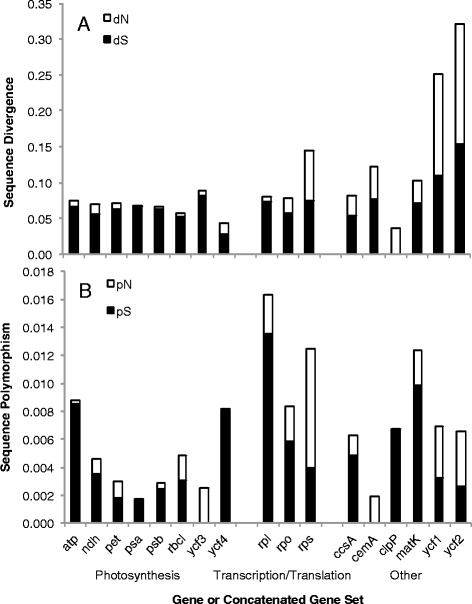
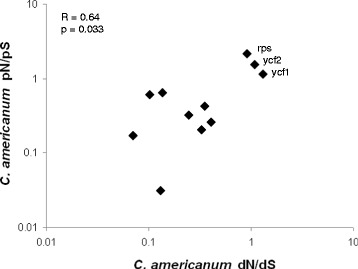
Results: We examined patterns of interspecific divergence and intraspecific polymorphism in the plastid genome of Campanulastrum americanum, and across plastid genes found a significant correlation between dN/dS and pN/pS (i.e., the within-species equivalent of dN/dS). A number of genes including ycf1, ycf2, clpP, and ribosomal protein genes exhibited high dN/dS ratios. McDonald-Kreitman tests detected little evidence for positive selection acting on these genes, likely due to the presence of substantial intraspecific divergence.
Conclusions: These results suggest that mechanisms leading to increased nucleotide substitution rates in the plastid genome are continuing to act at the intraspecific level. Accelerated plastid genome evolution may increase the likelihood of intraspecific cytonuclear genetic incompatibilities, and thereby contribute to the early stages of the speciation process.
Figures
References
-
- Jansen R, Ruhlman T. Plastid genomes of seed plants. In: Bock R, Knoop V, editors. Genomics of Chloroplasts and Mitochondria. Netherlands: pringer; 2012. pp. 103–126.
-
- Jansen RK, Cai Z, Raubeson LA, Daniell H, Depamphilis CW, Leebens-Mack J, Muller KF, Guisinger-Bellian M, Haberle RC, Hansen AK, Chumley TW, Lee SB, Peery R, McNeal JR, Kuehl JV, Boore JL. Analysis of 81 genes from 64 plastid genomes resolves relationships in angiosperms and identifies genome-scale evolutionary patterns. Proc Natl Acad Sci U S A. 2007;104(49):19369–19374. doi: 10.1073/pnas.0709121104. - DOI - PMC - PubMed
Publication types
MeSH terms
Substances
Associated data
LinkOut - more resources
Full Text Sources
Other Literature Sources
Molecular Biology Databases
