


Gender differences in the prevalence, severity, and composition of coronary artery disease in the young: a study of 1635 individuals undergoing coronary CT angiography from the prospective, multinational confirm registry
- PMID: 25539786
- PMCID: PMC4447773
- DOI: 10.1093/ehjci/jeu281
Gender differences in the prevalence, severity, and composition of coronary artery disease in the young: a study of 1635 individuals undergoing coronary CT angiography from the prospective, multinational confirm registry
Abstract
Objective: Prior studies examining coronary atherosclerosis in the young have been limited by retrospective analyses in small cohorts. We examined the relationship between cardiovascular risk factors (RFs) and prevalence and severity of coronary atherosclerosis in a large, prospective, multinational registry of consecutive young individuals undergoing coronary computerized tomographic angiography (CCTA).
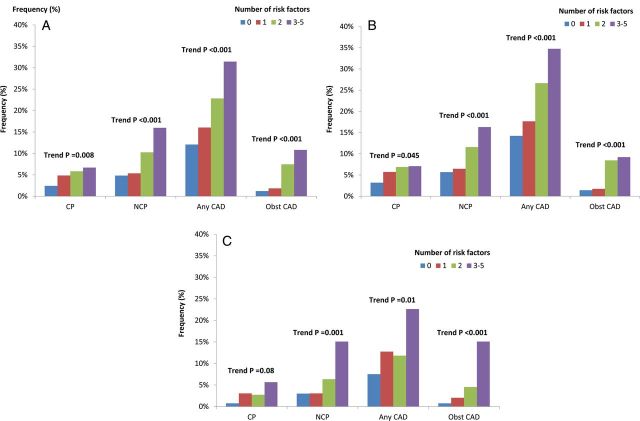
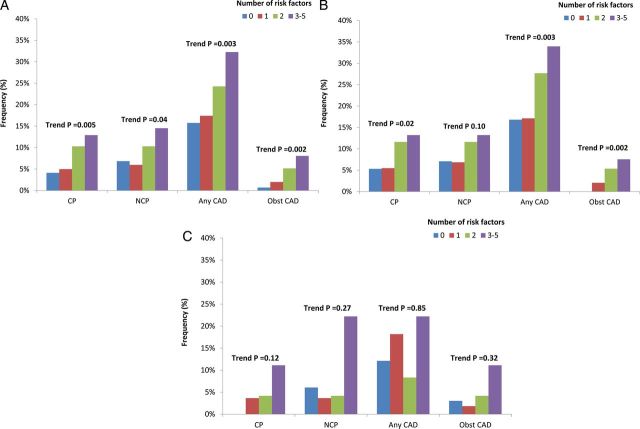
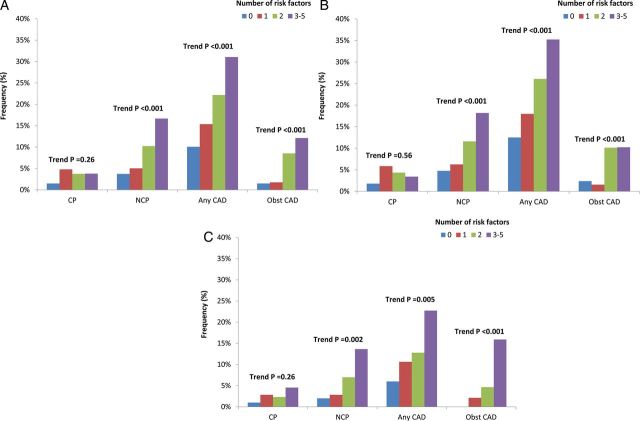
Method and results: Of 27 125 patients undergoing CCTA, 1635 young (<45 years) individuals without known coronary artery disease (CAD) or coronary anomalies were identified. Coronary plaque was assessed for any CAD, obstructive CAD (≥50% stenosis), and presence of calcified plaque (CP) and non-calcified plaque (NCP). Among 1635 subjects (70% men, age 38 ± 6 years), any CAD, obstructive CAD, CP, and NCP were observed in 19, 4, 5, and 8%, respectively. Compared with women, men demonstrated higher rates of any CAD (21 vs. 12%, P < 0.001), CP (6 vs. 3%, P = 0.01), and NCP (9 vs. 5%, P = 0.008), although no difference was observed for rates of obstructive CAD (5 vs. 4%, P = 0.46). Any CAD, obstructive CAD, and NCP were higher for young individuals with diabetes, hypertension, dyslipidaemia, current smoking, or family history of CAD; while only diabetes and dyslipidaemia were associated with CP. Increasing cardiovascular RFs was associated with a greater prevalence and extent and severity of CAD, with individuals with 0, 1, 2, ≥3 RFs manifesting a dose-response increase in any CAD (P < 0.001, for trend), obstructive CAD (P < 0.001, for trend), NCP (P < 0.001, for trend), and CP (P < 0.001, for trend). In multivariable analysis adjusting for sex and cardiovascular RFs, male sex was the strongest predictor for any CAD (odds ratio [OR] = 1.95, 95% confidence interval [CI] = 1.43-2.66, P < 0.001), CP (OR = 1.46, 95% CI = 1.08-1.98, P = 0.01), and NCP (OR = 1.33, 95% CI = 1.06-1.67, P = 0.01); family history of CAD was the strongest predictor for obstructive CAD (OR = 2.71, 95% CI = 1.65-4.45, P < 0.001).
Conclusion: Any and obstructive CAD is present in 1 in 5 and 1 in 20 young individuals, respectively, with family history associated with the greatest risk of obstructive CAD.
Keywords: coronary CT angiography; coronary artery disease; coronary risk factors; young adults.
Published on behalf of the European Society of Cardiology. All rights reserved. © The Author 2014. For permissions please email: journals.permissions@oup.com.
Figures
References
-
- Arzamendi D, Benito B, Tizon-Marcos H, Flores J, Tanguay JF, Ly H, et al. Increase in sudden death from coronary artery disease in young adults. Am Heart J 2011;161:574–80. - PubMed
-
- Drory Y, Turetz Y, Hiss Y, Lev B, Fisman EZ, Pines A, et al. Sudden unexpected death in persons less than 40 years of age. Am J Cardiol 1991;68:1388–92. - PubMed
-
- Rubin JB, Borden WB. Coronary heart disease in young adults. Curr Atheroscler Rep 2012;14:140–9. - PubMed
-
- Berenson GS, Srinivasan SR, Bao W, Newman WP, 3rd, Tracy RE, Wattigney WA. Association between multiple cardiovascular risk factors and atherosclerosis in children and young adults. The Bogalusa Heart Study. N Engl J Med 1998;338:1650–6. - PubMed
-
- Enos WF, Jr, Beyer JC, Holmes RH. Pathogenesis of coronary disease in American soldiers killed in Korea. J Am Med Assoc 1955;158:912–4. - PubMed
Publication types
MeSH terms
Grants and funding
LinkOut - more resources
Full Text Sources
Other Literature Sources
Medical
Miscellaneous
