


Comorbidity increases the risk of hospitalizations in multiple sclerosis
- PMID: 25540309
- PMCID: PMC4336005
- DOI: 10.1212/WNL.0000000000001187
Comorbidity increases the risk of hospitalizations in multiple sclerosis
Abstract
Objective: We aimed to evaluate the association between comorbidity and rates of hospitalization in the multiple sclerosis (MS) population as compared to a matched cohort from the general population.
Methods: Using population-based administrative data from the Canadian province of Manitoba, we identified 4,875 persons with MS and a matched general population cohort of 24,533 persons. We identified all acute care hospitalizations in the period 2007-2011. Using general linear models, we evaluated the association between comorbidity status and hospitalization rates (all-cause, non-MS-related, MS-related) in the 2 populations, adjusting for age, sex, and socioeconomic status.
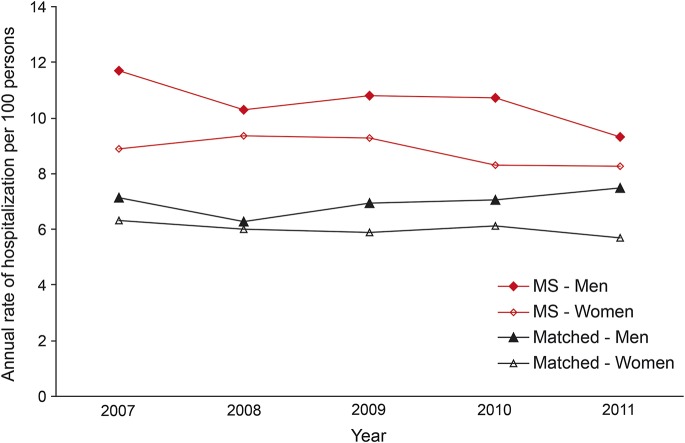
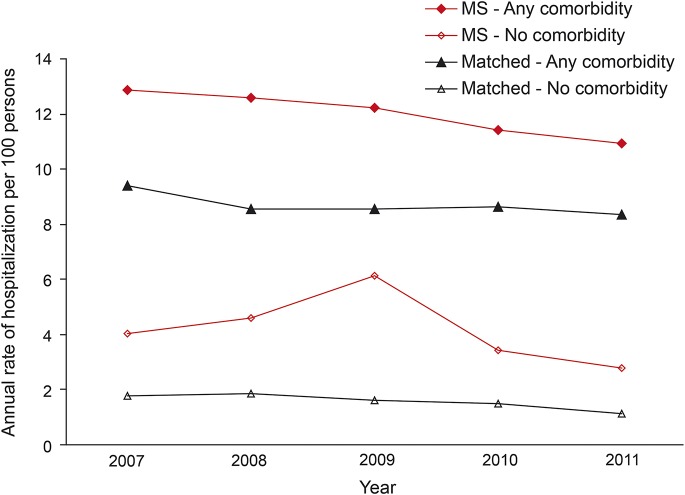
Results: Comorbidity was common in both cohorts. Over the 5-year study period, the MS population had a 1.5-fold higher hospitalization rate (adjusted rate ratio [aRR] 1.56; 95% confidence interval [CI] 1.44-1.68) than the matched population. Any comorbidity was associated with a 2-fold increased risk of non-MS-related hospitalization rates (aRR 2.21; 95% CI 1.73-2.82) in the MS population, but a nearly 4-fold increase in hospitalization rates in the matched population (aRR 3.85; 95% CI 3.40-4.35). Comorbidity was not associated with rates of hospitalization for MS-related reasons, regardless of how comorbidity status was defined.
Conclusions: In the MS population, comorbidity is associated with an increased risk of all-cause hospitalizations, suggesting that the prevention and management of comorbidity may reduce hospitalizations.
© 2014 American Academy of Neurology.
Figures
Comment in
-
Comorbidity increases the risk of hospitalizations in MS: prevention opportunities.Neurology. 2015 Jan 27;84(4):335-6. doi: 10.1212/WNL.0000000000001194. Epub 2014 Dec 24. Neurology. 2015. PMID: 25540316 No abstract available.
References
-
- Marrie RA, Horwitz R, Cutter G, Tyry T, Campagnolo D, Vollmer T. Comorbidity, socioeconomic status, and multiple sclerosis. Mult Scler 2008;14:1091–1098. - PubMed
-
- Goldman Consensus Group. The Goldman Consensus statement on depression in multiple sclerosis. Mult Scler 2005;11:328–337. - PubMed
-
- Warren SA, Turpin KV, Pohar SL, Jones CA, Warren KG. Comorbidity and health-related quality of life in people with multiple sclerosis. Int J MS Care 2009;11:6–16.
-
- Canadian Institute for Health Information. The Burden of Neurological Diseases, Disorders and Injuries in Canada. Ottawa: Canadian Institute for Health Information; 2007.
Publication types
MeSH terms
LinkOut - more resources
Full Text Sources
Other Literature Sources
Medical
