. 2015 Mar;89(6):3008-25.
doi: 10.1128/JVI.02884-14. Epub 2014 Dec 24.

The genome of the nucleopolyhedrosis-causing virus from Tipula oleracea sheds new light on the Nudiviridae family

Affiliations

The genome of the nucleopolyhedrosis-causing virus from Tipula oleracea sheds new light on the Nudiviridae family

Annie Bézier et al. J Virol. 2015 Mar.

Abstract

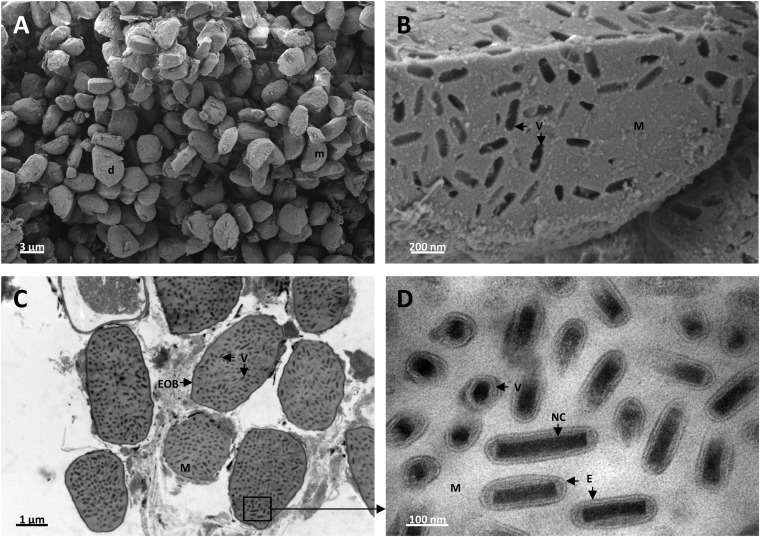
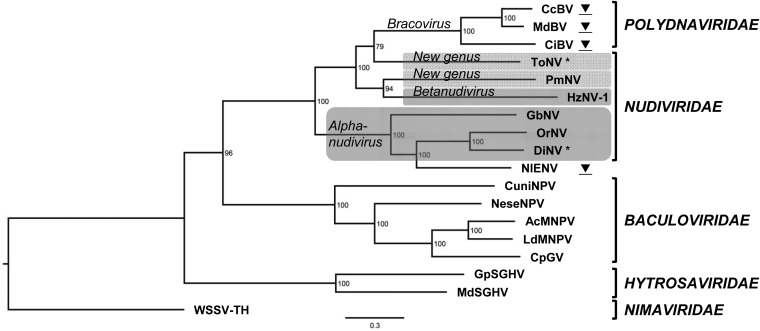
A large double-stranded DNA (dsDNA) virus that produces occlusion bodies, typical of baculoviruses, has been described to infect crane fly larvae of the genus Tipula (Diptera, Tipulidae). Because of a lack of genomic data, this virus has remained unclassified. Electron microscopy of an archival virus isolated from Tipula oleracea, T. oleracea nudivirus (ToNV), showed irregularly shaped occlusion bodies measuring from 2 to 5 μm in length and 2 μm in middiameter, filled with rod-shape virions containing single nucleocapsids within a bilayer envelope. Whole-genome amplification and Roche 454 sequencing revealed a complete circular genome sequence of 145.7 kb, containing five direct repeat regions. We predicted 131 open reading frames, including a homolog of the polyhedrin gene encoding the major occlusion body protein of T. paludosa nucleopolyhedrovirus (NPV). BLAST searches demonstrated that ToNV had 21 of the 37 baculovirus core genes but shared 52 genes with nudiviruses (NVs). Phylogenomic analyses indicated that ToNV clearly belongs to the Nudiviridae family but should probably be assigned to a new genus. Among nudiviruses, ToNV was most closely related to the Penaeus monodon NV and Heliothis zea NV clade but distantly related to Drosophila innubia NV, the other nudivirus infecting a Diptera. Lastly, ToNV was found to be most closely related to the nuvidirus ancestor of bracoviruses. This was also reflected in terms of gene content, as ToNV was the only known exogenous virus harboring homologs of the Cc50C22.6 and 27b (Cc50C22.7) genes found in the nudiviral genomic cluster involved in bracovirus particle production.

Importance: The Nudiviridae is a family of arthropod dsDNA viruses from which striking cases of endogenization have been reported (i.e., symbiotic bracoviruses deriving from a nudivirus and the endogenous nudivirus of the brown planthopper). Although related to baculoviruses, relatively little is known about the genomic diversity of exogenous nudiviruses. Here, we characterized, morphologically and genetically, an archival sample of the Tipula oleracea nudivirus (ToNV), which has the particularity of forming occlusion bodies. Comparative genomic and phylogenomic analyses showed ToNV to be to date the closest known relative of the exogenous ancestor of bracoviruses and that ToNV should be assigned to a new genus. Moreover, we revised the homology relationships of nudiviral genes and identified a new set of 32 core genes for the Nudiviridae, of which 21 were also baculovirus core genes. These findings provide important insights into the evolutionary history of large arthropod dsDNA viruses.


Figures

FIG 1
FIG 1
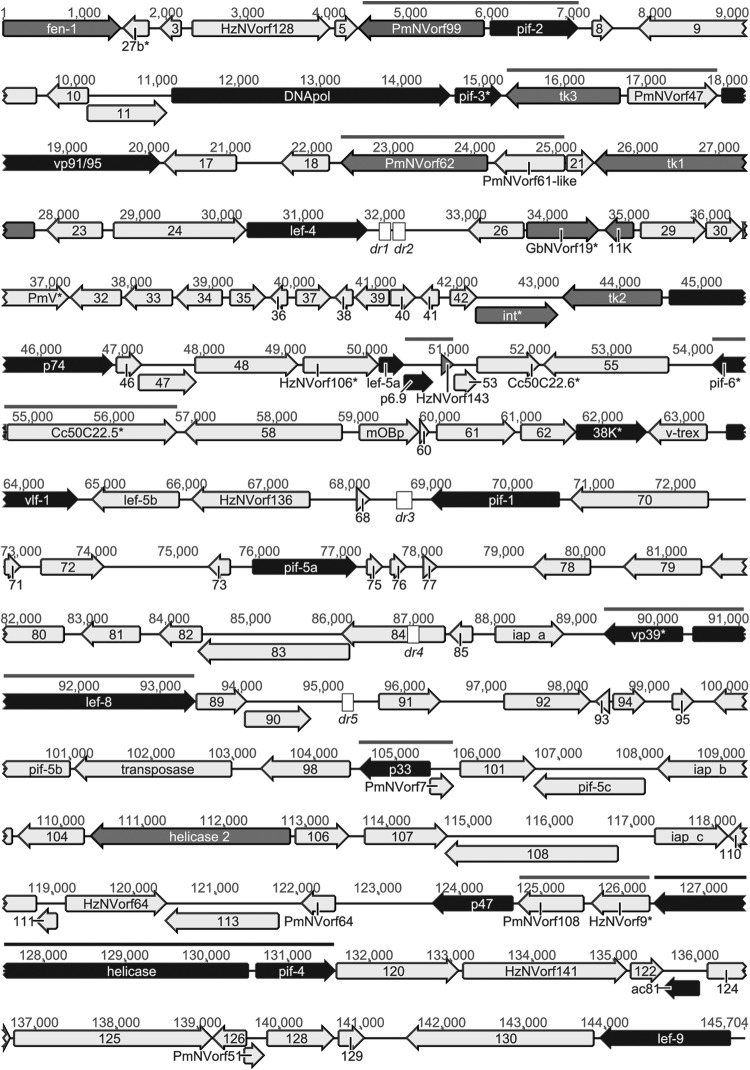
Linear map of the ToNV genome. Genes and their transcriptional directions are indicated as arrows. Black arrows, baculovirus and nudivirus shared core genes; gray arrows, nudivirus core genes. When a core gene belonged to a gene family (i.e., lef-5), only one gene was displayed in accentuated color. Thick black line, gene cluster conserved between baculoviruses and nudiviruses; thick gray lines, gene clusters conserved among several nudiviruses. Conserved genes were named based on their homologs in other virus genomes, but to simplify annotation, all “like” gene name extensions have been removed. ToNV ORFs with unknown function have been designated by their position in the genome (Table 2). *, genes belonging to the nudiviral cluster identified within C. congregata or M. demolitor wasp genomes (37, 38, 67). Direct repeat (dr) region position and name are indicated as boxes (see also Fig. 5 and Tables 3 and 4 for details).
FIG 2
FIG 2
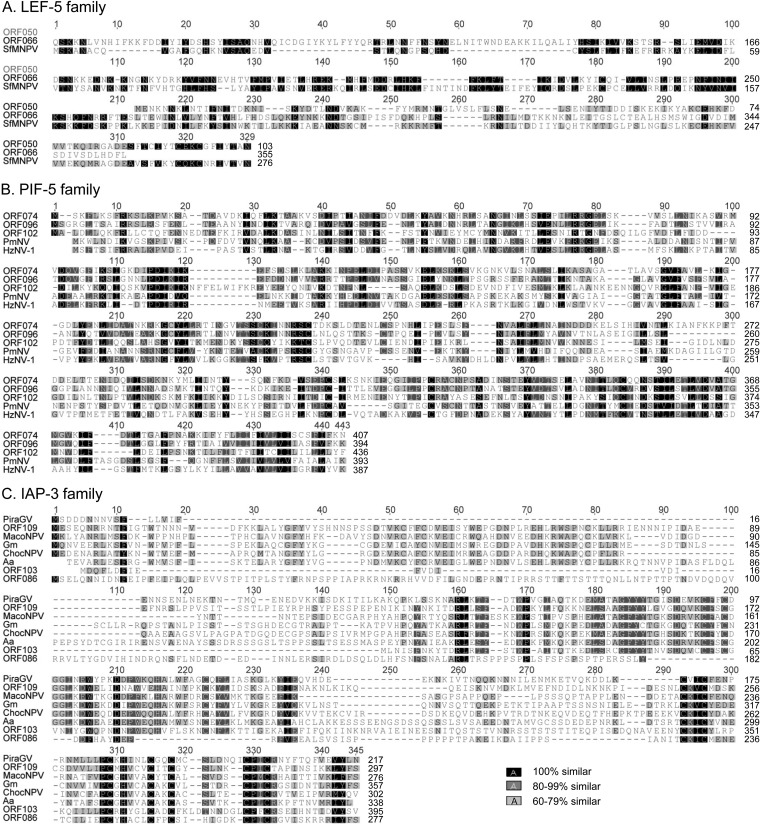
Amino acid sequence alignments of ToNV LEF-5 (ORF050 and ORF066), PIF-5 (ORF074, ORF096, and ORF102), and IAP-3 (ORF086, ORF103, and ORF109) multigenic family members with viral or insect homologs. (A) LEF-5 family; SfMNPV, Spodoptera frugiperda MNPV (YP_001036358); (B) PIF-5 family; HzNV-1, Heliothis zea NV-1 (AAN04370), and PmNV, Penaeus monodon NV (YP_009051848); (C) IAP-3 family; PiraGV, Pieris rapae GV (AGS18838); MacoNPV, Mamestra configurata NPV (NP_613222); Gm, Galleria mellonella (ACV04797); ChocNPV, Choristoneura occidentalis NPV (YP_008378620); Aa, Aedes aegypti (EAT39096). Alignments were generated using the MAFFT alignment plugin under Geneious and then eventually manually refined. Each multiple alignment is presented with a global numbering located above the aligned sequences and a specific numbering located on the right side of each considered sequence. The similarity color code shown on the bottom right applies to all parts of the figure.
FIG 3
FIG 3
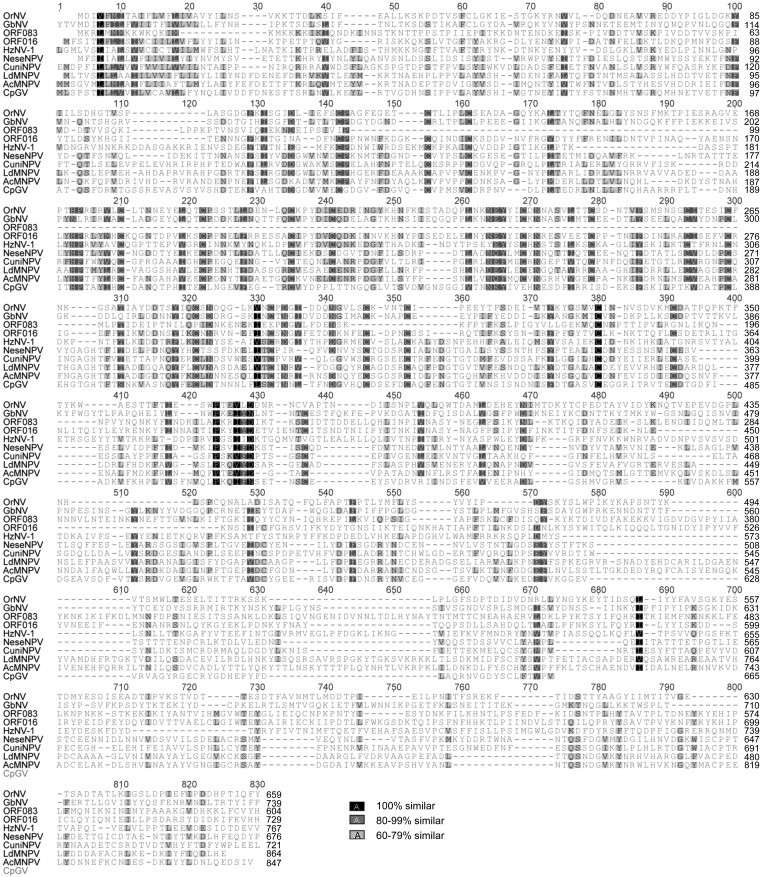
Amino acid sequence alignment of ToNV VP91 (ORF016 and ORF083) multigenic family members with baculovirus and nudivirus homologs (see the legend of Fig. 2 for details). Accession numbers: AcMNPV, NP_054113; LdMNPV, NP_047728; OrNV, YP_002321417; GbNV, YP_001111269; NeseNPV, YP_025191; HzNV-1, AAM45759; CuniNPV, NP_203339; CpGV, NP_148885 (see Table 1 for definitions of virus name abbreviations).
FIG 4
FIG 4
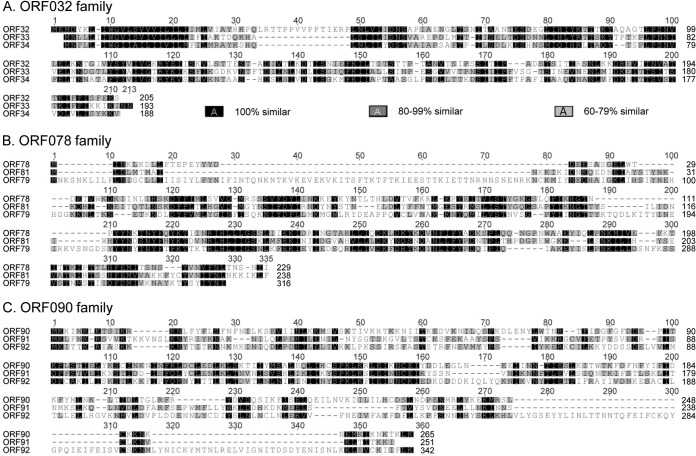
Amino acid sequence alignments of ToNV multigenic families with unknown function. (A) ORF032 family (ORF032, ORF033, and ORF034); (B) ORF078 family (ORF078, ORF079, and ORF081); (C) ORF090 family (ORF090, ORF091, and ORF092) (see legend of Fig. 2 for details).
FIG 5
FIG 5
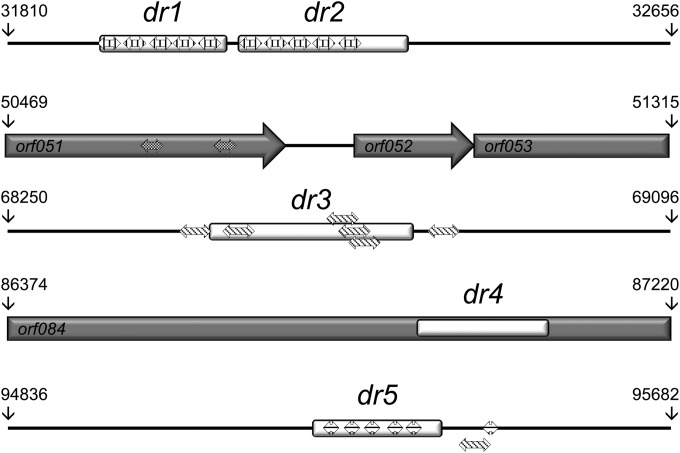
Direct repeat (dr) structures and imperfect palindromic motif (IPM) positions within the ToNV genome. The five regions including dr sequences are presented to scale. Positions within the genome are indicated (see Table 3 for details). dr sequences are represented by white boxes (see Table 3 for sequence details). IPMs are represented by small striped double arrows (IPM1, oblique lines; IPM2, vertical lines; IPM3, oblique grid; IPM4, horizontal lines; see Table 4 for details). Genes are represented by gray arrows or boxes, with their ORF numbers inside.
FIG 6
FIG 6
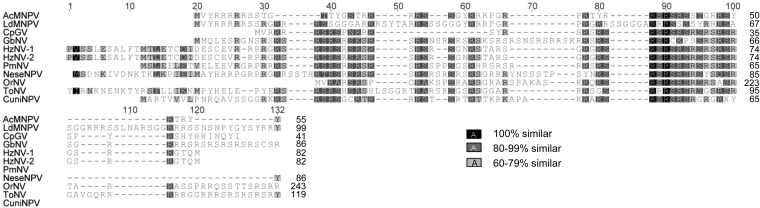
Amino acid sequence alignment of ToNV P6.9 (ORF051) with baculovirus and nudivirus homologs (see legend of Fig. 2 for details). Accession numbers: AcMNPV, NP_054130; LdMNPV, NP_047738; CpGV, NP_148870; GbNV, YP_001111340; HzNV-1, AAN04434; HzNV-2 (new prediction from positions 24,375 to 24,127), JN418988; PmNV (new prediction from positions 64,881 to 65,078), KJ184318; NeseNPV, YP_025143; OrNV, YP_002321333; CuniNPV, NP_203327 (see Table 1 for definitions of virus name abbreviations).
FIG 7
FIG 7
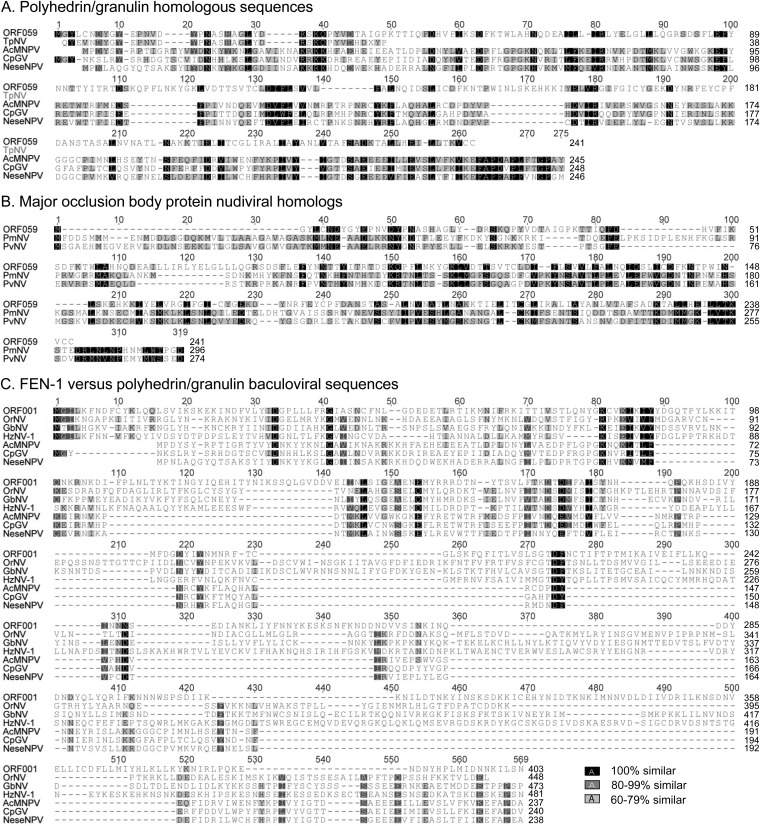
Amino acid sequence alignments of baculovirus polyhedrin/granulin sequences and presumed nudivirus homologs (see legend of Fig. 2 for details). (A) Alignment of ToNV ORF059 with TpNPV N-terminal sequence previously determined (24) and AcMNPV, CpGV, and NeseNPV polyhedrin/granulin sequences. (B) Alignment of ToNV ORF059 with Penaeus species nudiviruses major OB protein sequences. (C) Alignment of ToNV ORF001 with OrNV, GbNV, and HzNV-1 nudivirus FEN-1 homologs and AcMNPV, CpGV, and NeseNPV polyhedrin/granulin sequences. Accession numbers: AcMNPV, NP_054037; CpGV, NP_148785; NeseNPV, YP_025108; PmNV, ABY75164; PvNV, DQ496179; OrNV, YP_002321327; GbNV, YP_001111332; HzNV-1, AAN04362. TpNPV, Tipula paludosa NPV (24) (see Table 1 for definitions of other virus name abbreviations).
FIG 8
FIG 8
Occlusion bodies, virions, and nucleocapsids from T. oleracea purified nudivirus visualized by scanning (A and B) and transmission (C and D) electron microscopies. (A) Purified ToNV OBs shaped irregularly from droplet (d) to moon (m) by way of all conceivable ovoid and ellipsoid forms. (B) Section of typical OB enlarged image showing rod-shaped virion (V) prints inside the protein matrix (M). (C) Thin cross-section of enveloped occlusion bodies (EOB) filled with numerous virions (V) and protein matrix (M). (D) Enlarged image of protein matrix (M)-embedded virions (V) displaying, mainly in cross-sectional and longitudinal views, nucleocapsids (NC) surrounded by single bilayer membranes forming the envelopes (E).
FIG 9
FIG 9
Arthropod large dsDNA virus phylogeny including ToNV. The tree was obtained by ML inference analysis of concatenated amino acid multiple alignments of 37 nudivirus-related genes (Table 5). Numbers on the nodes indicate ML nonparametric bootstrap supports (100 replicates). The white spot syndrome virus (WSSV-TH) was defined as an outgroup based on genome content. Virus families and genera are those approved by the International Committee on Taxonomy of Viruses (ICTV). The newly proposed and already approved nudivirus genera are shaded in gray. , endogenous viral element derived from two independent nudivirus integration events, which led either to the bracovirus symbiosis or to the Nilaparvata lugens endogenous NV. *, diptera-infecting nudiviruses. Virus abbreviations, sequences, and accession numbers are those defined in Tables 1 and 5.

References

    1. Blackshaw RP, Coll C. 1999. Economically important leatherjackets of grassland and cereals: biology, impact and control. Integr Pest Manage Rev 4:143–160. doi:10.1023/A:1009625724013. - DOI
    1. Taschereau E, Simard L, Brodeur J, Gelhaus J, Bélair G, Dionne J. 2009. Seasonal ecology of the European crane fly (Tipula paludosa) and species diversity of the family Tipulidae on golf courses in Québec, Canada. ITS Res J 11:681–693.
    1. Becnel JJ, White SE, Moser BA, Fukuda T, Rotstein MJ, Undeen AH, Cockburn A. 2001. Epizootiology and transmission of a newly discovered baculovirus from the mosquitoes Culex nigripalpus and C. quinquefasciatus. J Gen Virol 82:275–282. - PubMed
    1. Moser BA, Becnel JJ, White SE, Afonso C, Gerald K, Shanker S, Almira E. 2001. Morphological and molecular evidence that Culex nigripalpus baculovirus is an unusual member of the family Baculoviridae. J Gen Virol 82:283–297. - PubMed
    1. Andreadis TG, Becnel JJ, White SE. 2003. Infectivity and pathogenicity of a novel baculovirus, CuniNPV from Culex nigripalpus (Diptera: Culicidae) for thirteen species and four genera of mosquitoes. J Med Entomol 40:512–517. doi:10.1603/0022-2585-40.4.512. - DOI - PubMed

Publication types

Associated data