. 2015 Jan 13;112(2):E214-9.
doi: 10.1073/pnas.1410130112. Epub 2014 Dec 24.

Differential roles of delay-period neural activity in the monkey dorsolateral prefrontal cortex in visual-haptic crossmodal working memory

Affiliations

Differential roles of delay-period neural activity in the monkey dorsolateral prefrontal cortex in visual-haptic crossmodal working memory

Liping Wang et al. Proc Natl Acad Sci U S A. .

Abstract

Previous studies have shown that neurons of monkey dorsolateral prefrontal cortex (DLPFC) integrate information across modalities and maintain it throughout the delay period of working-memory (WM) tasks. However, the mechanisms of this temporal integration in the DLPFC are still poorly understood. In the present study, to further elucidate the role of the DLPFC in crossmodal WM, we trained monkeys to perform visuo-haptic (VH) crossmodal and haptic-haptic (HH) unimodal WM tasks. The neuronal activity recorded in the DLPFC in the delay period of both tasks indicates that the early-delay differential activity probably is related to the encoding of sample information with different strengths depending on task modality, that the late-delay differential activity reflects the associated (modality-independent) action component of haptic choice in both tasks (that is, the anticipation of the behavioral choice and/or active recall and maintenance of sample information for subsequent action), and that the sustained whole-delay differential activity likely bridges and integrates the sensory and action components. In addition, the VH late-delay differential activity was significantly diminished when the haptic choice was not required. Taken together, the results show that, in addition to the whole-delay differential activity, DLPFC neurons also show early- and late-delay differential activities. These previously unidentified findings indicate that DLPFC is capable of (i) holding the coded sample information (e.g., visual or tactile information) in the early-delay activity, (ii) retrieving the abstract information (orientations) of the sample (whether the sample has been haptic or visual) and holding it in the late-delay activity, and (iii) preparing for behavioral choice acting on that abstract information.

Keywords: cross-modal working memory; delay activity; monkey; prefrontal; single unit.


Conflict of interest statement

The authors declare no conflict of interest.

Figures
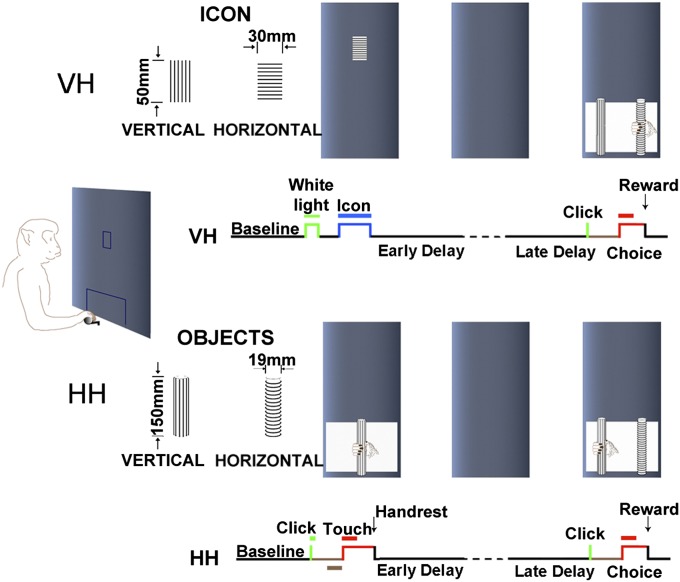
Fig. 1.
Fig. 1.
Schematic diagram of behavioral tasks. (Upper) The visual–haptic (VH) task. A trial starts with a presentation of a white rectangular light (duration of 0.5 s) at the center of a computer screen. Two seconds after the offset of the white light, a visual cue (an icon, duration of 2 s) is presented at the same position. A pair of black and white icons is used. The offset of the visual cue signals the beginning of the delay, which varies between 15 and 17 s (randomized duration). At the end of the delay, a click signals the accessibility of a pair of objects for the choice. The animal then extends his operating hand toward the objects for exploring, palpating and pulling the one that matches the visual cue to get a reward. (Lower) The haptic–haptic (HH) task. A trial begins with a click signaling that the sample object is accessible to touch. The animal extends his operating hand toward the object and briefly palpates it, and, after the palpation, the hand returns to its resting place, signaling the beginning of the delay (15–17 s). A second click signals the start of the choice period (see details in Materials and Methods).
Fig. 2.
Fig. 2.
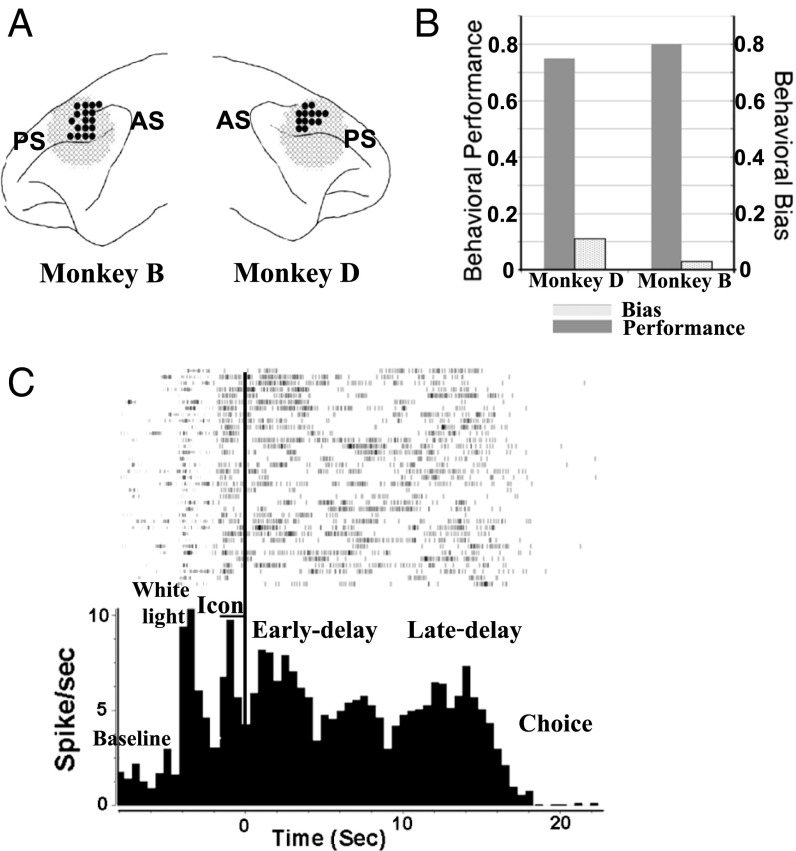
(A) Anatomical locations of recording sites. PS, principal sulcus; AS, arcuate sulcus. The recording sites cover areas 9/46d and 8b in the DLPFC (on the surface of the DLPFC slightly dorsal to the posterior principal sulcus). (B) Behavioral performance and spatial bias in the VH task of two monkeys. Behavioral performance is calculated as correct trials per total trials. Behavioral bias is calculated as the absolute value of (XY)/(X + Y), where X is the number of left choices, and Y is the number of right choices. (C) A histogram and rasters of a cell in the VH task show average neuronal activities in different task periods (bin size = 500 ms). The time-locking event for the histogram is the offset of the visual cue (Icon-off), the beginning of the delay period.
Fig. 3.
Fig. 3.
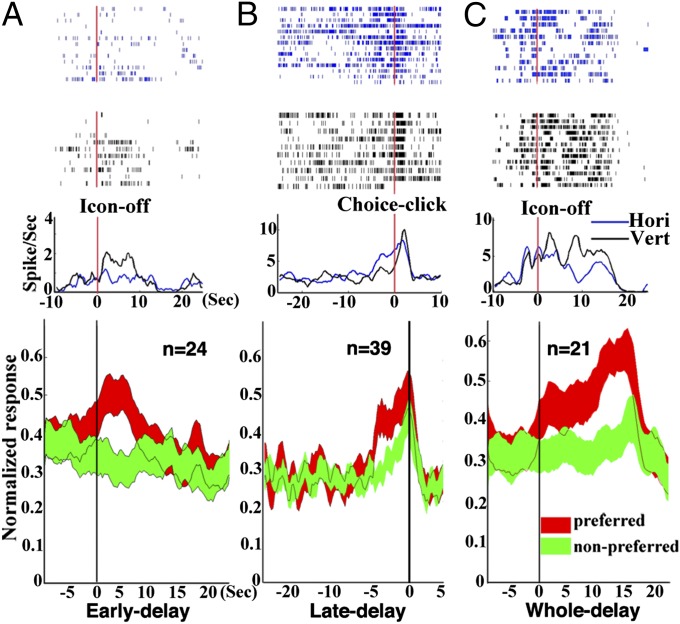
Delay-period differential activity and grand average firing rate in the VH task. (A, Upper) Rasters and histograms (bin size = 50 ms) of a cell showing early-delay (0–5 s) differential activity. The time-locking event for histograms is Icon-off (the beginning of the delay period). The cell shows a significantly higher firing rate (P < 0.01) in vertical trials. (Lower) The grand average firing frequency calculated from 24 early-delay differential cells (P < 0.001). The grand average firing frequency (±1 SEM) of cells for preferred objects (preference determined by significant higher firing frequency of either object) is indicated by the histogram in red, and for nonpreferred object is indicated by the histogram in green. (B) Rasters and histograms of a cell (P < 0.001) (Upper) and the grand average firing rate (Lower) showing late-delay differential activity of 39 cells (P < 0.001). The time-locking event for the histograms is Choice-click (the end of the delay period). (C) Rasters and histograms of a cell (P < 0.001) (Upper) and the grand average firing rate (Lower) showing whole-time delay differential activity of 21 cells (P < 0.001). The time 0 is the offset of the visual cue.
Fig. 4.
Fig. 4.
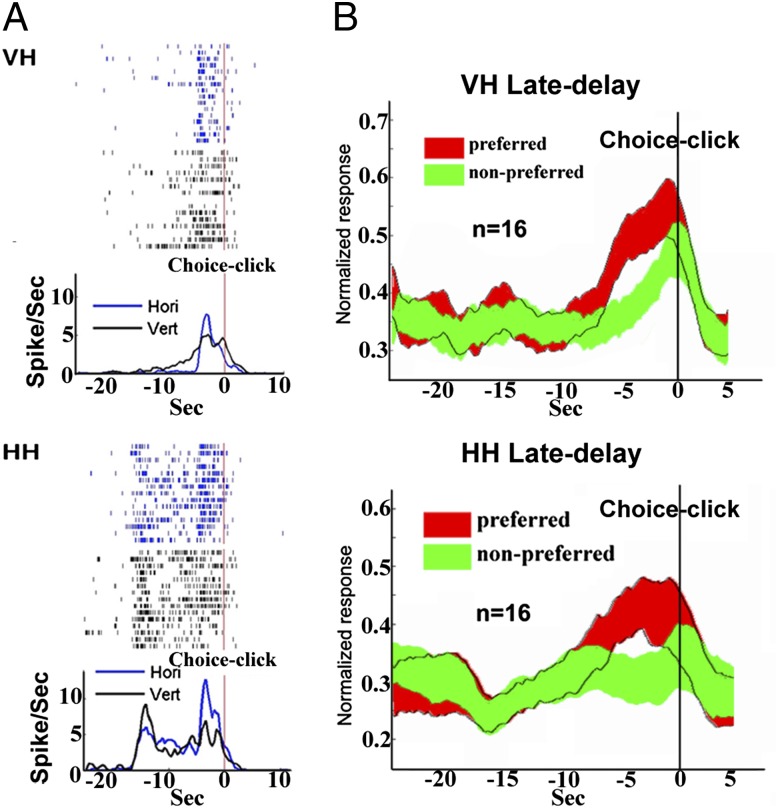
(A) Rasters and histograms (bin size = 50 ms) of a cell showing activity in the late-delay period recorded in both VH (Upper, P < 0.001) and HH (Lower, P < 0.001) tasks. The time-locking event for histograms in these two tasks is the choice click (the end of the delay period). (B) The grand average firing rate of late-delay differential activity of 16 cells recorded in both VH (P < 0.01) and HH (P < 0.01) tasks.
Fig. 5.
Fig. 5.
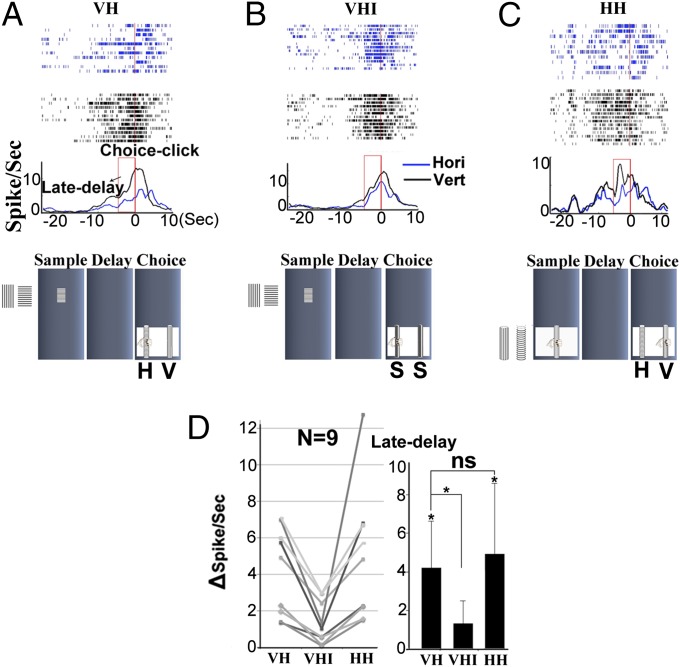
Late-delay activity and choice response in VH (A), VHI (B), and HH (C) tasks. The neuron recorded in the three tasks shows significant late-delay differential activity in the VH (P < 0.001) and HH (P < 0.001) tasks, but not in the VHI task (P > 0.3). Note that the late-delay period is indicated by the red box in the histogram. (D) The difference in firing rate (delta-spike per s) of the late-delay period between preferred and nonpreferred trials from nine neurons in the three tasks. The difference in both VH and HH tasks is significantly larger than that in the VHI (P < 0.01) task. There is no significant difference (ns) in firing rate between the VH and HH (P > 0.1) tasks.

References

    1. Funahashi S. Prefrontal cortex and working memory processes. Neuroscience. 2006;139(1):251–261. - PubMed
    1. Goldman-Rakic PS. Architecture of the prefrontal cortex and the central executive. Ann N Y Acad Sci. 1995;769:71–83. - PubMed
    1. Fuster JM. The prefrontal cortex—an update: Time is of the essence. Neuron. 2001;30(2):319–333. - PubMed
    1. Constantinidis C, Procyk E. The primate working memory networks. Cogn Affect Behav Neurosci. 2004;4(4):444–465. - PMC - PubMed
    1. Miller EK. The prefrontal cortex and cognitive control. Nat Rev Neurosci. 2000;1(1):59–65. - PubMed

Publication types

LinkOut - more resources