Review
. 2015 Apr;25(4):198-213.
doi: 10.1016/j.tcb.2014.11.006. Epub 2014 Dec 22.

Microenvironmental regulation of therapeutic response in cancer

Affiliations
Review

Microenvironmental regulation of therapeutic response in cancer

Florian Klemm et al. Trends Cell Biol. 2015 Apr.

Abstract

The tumor microenvironment (TME) not only plays a pivotal role during cancer progression and metastasis but also has profound effects on therapeutic efficacy. In the case of microenvironment-mediated resistance this can involve an intrinsic response, including the co-option of pre-existing structural elements and signaling networks, or an acquired response of the tumor stroma following the therapeutic insult. Alternatively, in other contexts, the TME has a multifaceted ability to enhance therapeutic efficacy. This review examines recent advances in our understanding of the contribution of the TME during cancer therapy and discusses key concepts that may be amenable to therapeutic intervention.

Keywords: chemotherapy; immunotherapy; radiotherapy; stroma; therapeutic resistance; tumor microenvironment.


Figures

Figure I
Figure I
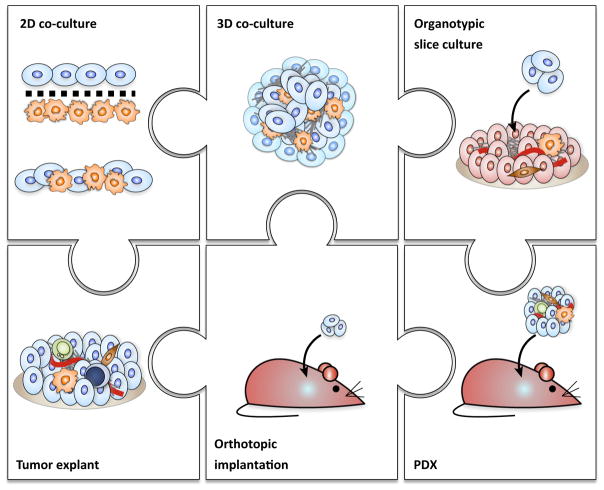
Commonly used indirect and direct coculture techniques have yielded valuable information about the role of stromal cells during therapeutic interventions. These cocultures can be further extended to a 3D system to account for spatial relations within the tumor microenvironment (TME). Organotypic slice cultures allow recapitulation of the microenvironment of different organs in vitro, while ex vivo explants of tumors retain the original TME. For preclinical in vivo studies, orthotopic implantation of tumor cells permits the investigation of tumor cells within the appropriate organ-specific TME. The correlation between therapeutic response in the mouse model and clinical efficacy can potentially be increased when patient-derived xenografts (PDXs) are used. It is important to note that the experimental strategies presented here are neither exhaustive nor in a hierarchical order. They rather represent complementary approaches to investigate the role of the stroma in therapeutic response.
Figure 1
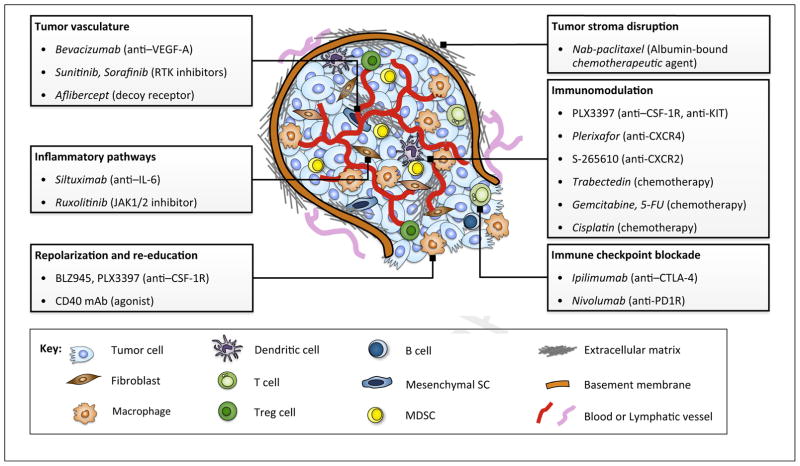
Figure 1. Major constituents of the tumor microenvironment (TME) and TME-targeted therapies
The TME comprises various cell types that modulate treatment response and are putative candidates for therapeutic intervention. The tumor vasculature can be targeted with various drugs such as the vascular endothelial growth factor (VEGF)-A antibody bevacizumab, the multitarget receptor tyrosine kinase (RTK) inhibitors sunitinib and sorafenib, and the decoy VEGF receptor aflibercept. Inflammatory pathway activation can be inhibited by the interleukin-6 (IL-6) antibody siltuximab [79] or the pan-JAK inhibitor ruxolitinib [166]. Cancer-associated fibroblasts are activated by multiple growth factors and cytokines within the TME and in turn acquire a proinflammatory phenotype and become a major source of soluble mediators that drive angiogenesis and enhance tumor cell survival. The immune cell compartment within the TME exhibits extraordinary plasticity: tumor-associated macrophages (TAMs) and myeloid derived suppressor cells (MDSCs) orchestrate an immunosuppressive and protective phenotype that extends to T cells, T regulatory (Treg) cells and B cells. Repolarization or re-education of macrophages or other myeloid cells can be achieved by colony-stimulating factor 1 receptor (CSF-1R) inhibition (for example, BLZ945) [162] or agonistic CD40 antibodies that activate antigen-presenting cells (e.g., dendritic cells) to process and present tumor-associated antigens to local cytotoxic T lymphocytes [158,167]. This immune landscape within the tumor can be sculpted by inhibition of critical cytokine axes such as CSF-1R and/or KIT (PLX3397) [168], chemokine (C-X-C motif) receptor (CXCR) 4 (plerixafor), and CXCR2 (S-265610) [169]. The chemotherapeutic agent trabectedin has been proposed to selectively deplete monocytes and/or macrophages [170]. Both gemcitabine and 5-fluorourocil (5-FU) have been shown to deplete MDSCs [171,172]. Platinum-based cytostatic drugs can not only alter macrophage polarization but also induce increased antigen-presenting ability of dendritic cells. The blockade of immune checkpoints is another promising avenue of therapeutic intervention. This can be achieved through blockade of cytotoxic T lymphocyte-associated antigen 4 (CTLA-4) (ipilimumab) or the programmed death 1 (PD1) receptor (nivolumab). Finally, several extracellular properties also shape the therapeutic response, such as high interstitial fluid pressure and changes in the composition of the extracellular matrix (ECM). Albumin-bound nab-paclitaxel has been postulated to disrupt the stromal composition [173]. FDA-approved drugs are indicated in italics while agents in preclinical or clinical trials are non-italicized.
Figure 2
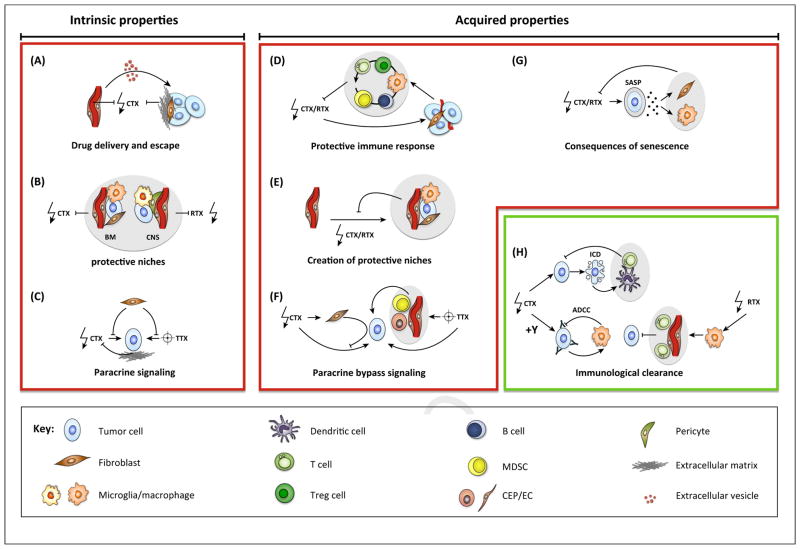
Figure 2. Intrinsic and acquired contributions of the tumor microenvironment (TME) to therapeutic response
The TME alters therapeutic efficacy through both intrinsic traits and properties acquired after exposure to therapy. This applies to chemotherapy (CTX), radiotherapy (RTX), and targeted therapies (TTX). The intrinsic properties of the TME that modulate therapeutic response include: (A) the alteration of drug delivery and clearance; (B) the utilization of pre-existing protective niches within the bone marrow (BM) and central nervous system (CNS) to shield malignant cells from therapeutic insult; and (C) the co-option of prewired paracrine signaling loops within the stroma to counteract therapeutic interventions. (D) In response to therapy the TME can orchestrate a protective immune response that is defined by a plethora of multidirectional interactions between different immune cell populations. (E) Furthermore, therapeutic interventions can lead to the emergence of newly created protective niches within the TME that function as safe havens. (F) In addition, paracrine bypass signaling pathways can override the effects of both conventional and targeted therapies, while (G) the senescence-associated secretory phenotype (SASP) can dramatically change the signaling equilibrium within the TME toward a therapy-attenuating state. (H) However, the TME can also substantially augment therapeutic efficacy by several mechanisms that ultimately result in an increased immunological response. This can result from immunogenic cell death (ICD) of tumor cells that activates antigen-presenting dendritic cells and cytotoxic T cells, promotion of increased antibody-dependent cell-mediated cytotoxicity (ADCC) by macrophages through cyclophosphamide, and the reprogramming of macrophages by low-dose radiation to facilitate normalization of the tumor vasculature and recruitment of cytotoxic T cells. Mechanisms that attenuate the therapeutic response are highlighted in red; therapy-ameliorating effects are marked in green. Arrow-headed lines indicate a positive or activating connection and bar-headed lines illustrate an antagonizing function.

References

    1. Hanahan D, Weinberg RA. Hallmarks of cancer: the next generation. Cell. 2011;144:646–674. - PubMed
    1. Hanahan D, Coussens LM. Accessories to the crime: functions of cells recruited to the tumor microenvironment. Cancer Cell. 2012;21:309–322. - PubMed
    1. Quail DF, Joyce JA. Microenvironmental regulation of tumor progression and metastasis. Nat Med. 2013;19:1423–1437. - PMC - PubMed
    1. Campbell I, et al. Clonal mutations in the cancer-associated fibroblasts: the case against genetic coevolution. Cancer Res. 2009;69:6765–6769. - PubMed
    1. Egeblad M, et al. Tumors as organs: complex tissues that interface with the entire organism. Dev Cell. 2010;18:884–901. - PMC - PubMed

Publication types