Review
. 2015 Feb:20:109-15.
doi: 10.1016/j.coph.2014.12.004. Epub 2014 Dec 23.

The NMDA receptor 'glycine modulatory site' in schizophrenia: D-serine, glycine, and beyond

Affiliations
Review

The NMDA receptor 'glycine modulatory site' in schizophrenia: D-serine, glycine, and beyond

Darrick T Balu et al. Curr Opin Pharmacol. 2015 Feb.

Abstract

Schizophrenia is a severe psychiatric illness that is characterized by reduced cortical connectivity, for which the underlying biological and genetic causes are not well understood. Although the currently approved antipsychotic drug treatments, which primarily modulate dopaminergic function, are effective at reducing positive symptoms (i.e. delusions and hallucinations), they do little to improve the disabling cognitive and negative (i.e. anhedonia) symptoms of patients with schizophrenia. This review details the recent genetic and neurobiological findings that link N-methyl-D-aspartate receptor (NMDAR) hypofunction to the etiology of schizophrenia. It also highlights potential treatment strategies that augment NMDA receptor function to treat the synaptic deficits and cognitive impairments.


Figures

Figure 1
Figure 1
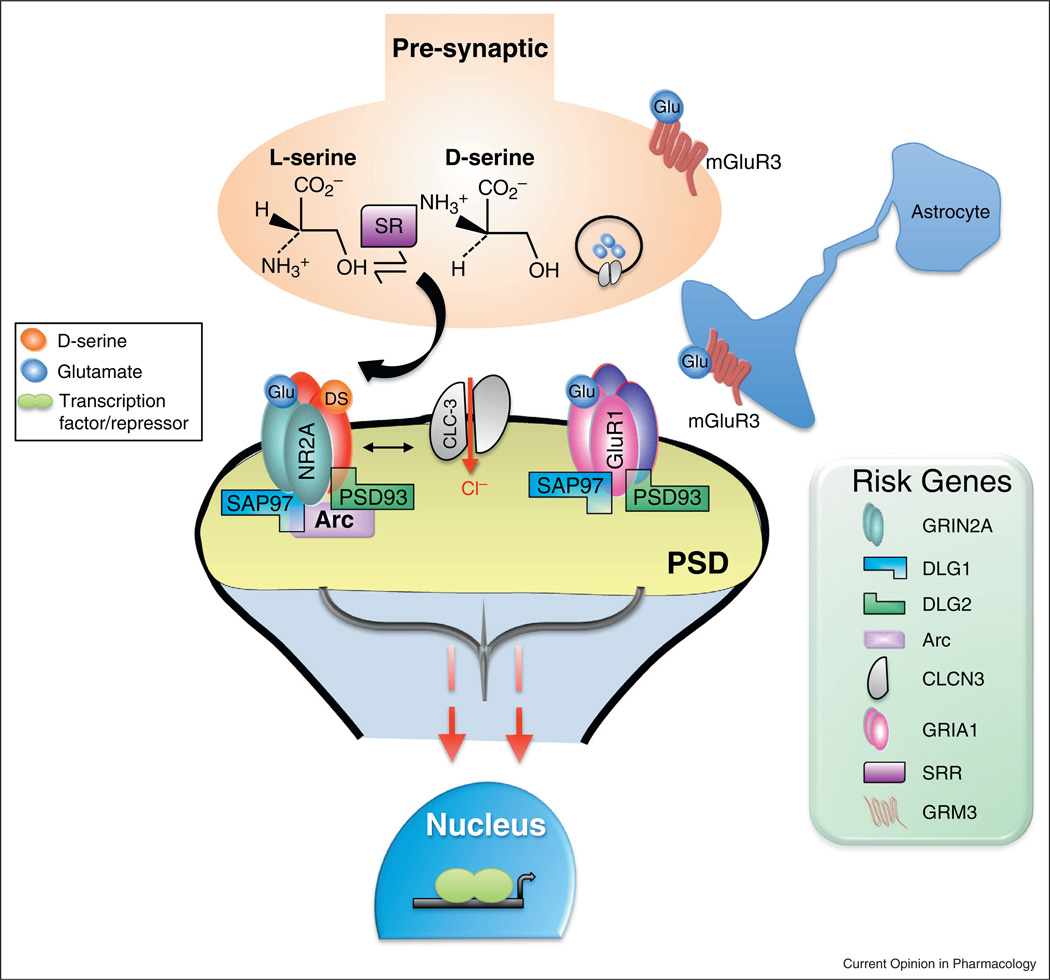
Numerous schizophrenia risk genes are involved in glutamatergic transmission. Recent large-scale schizophrenia GWAS [3••] and exome sequencing [31] studies have identified over 108 genetic loci and de novo mutations, respectively, associated with increased risk for schizophrenia. Many of the genes code for proteins that participate in excitatory transmission, particularly those that interact with the NMDAR. The NMDAR subunit 2A (GRIN2A; NR2A) is an important mediator of synaptic plasticity, with de novo mutations reported in schizophrenia. Discs, large homolog 1 (DLG1; SAP97) and 2 (DLG2; PSD93) belong to the membrane-associated guanylate kinases (MAGUKs) family of scaffolding proteins that regulate NMDAR and AMPAR trafficking, as well as postsynaptic density (PSD) organization [61]. The immediate early gene activity-regulated cytoskeleton-associated protein (ARC; Arc) is expressed almost exclusively in glutamatergic neurons, where it is enriched in the PSD and co-localizes with the NMDAR. Chloride channel, voltage-sensitive 3 (CLC-3; CLCN-3) is a voltage-gated chloride channel that co-localizes with the NMDAR postsynaptically to regulate neuronal excitability [62], and is localized to synaptic vesicles presynaptically where it regulates their size, glutamate content, and release probability [63]. The a-amino-3-hydroxy-5-methyl-4-isoxazolepropionic acid receptor 1 (GRIA1; GluR1) is a subunit of the ionotropic glutamate AMPAR that is a critical mediator of fast synaptic transmission. Serine racemase (SRR; SR) is the enzyme that converts l-serine to d-serine, one of the two NMDAR co-agonists. The metabotropic glutamate-3 receptor (GRM3; mGluR3), which is located presynaptically and on astrocytes, provides feedback inhibition of glutamate release from presynaptic terminals. The risk loci and mutations identified in recent genetic studies point to a convergence of perturbations in the PSD complex that would potentially lead to altered intracellular signaling, changes in the transcription of genes important for neuroplasticity, and ultimately impaired connectivity.

References

    1. Perala J, Suvisaari J, Saarni SI, Kuoppasalmi K, Isometsa E, Pirkola S, Partonen T, Tuulio-Henriksson A, Hintikka J, Kieseppa T, et al. Lifetime prevalence of psychotic and bipolar I disorders in a general population. Arch Gen Psychiatry. 2007;64:19–28. - PubMed
    1. DeLisi LE, Szulc KU, Bertisch HC, Majcher M, Brown K. Understanding structural brain changes in schizophrenia. Dialogues Clin Neurosci. 2006;8:71–78. - PMC - PubMed
    1. Schizophrenia Working Group of the Psychiatric Genomics C. Biological insights from 108 schizophrenia-associated genetic loci. Nature. 2014;511:421–427. The largest schizophrenia genome-wide association study to date (36,989 cases and 113,075 controls), identified 128 independent associations that meet genome-wide significance. The associations were enriched among genes expressed in brain, and included genes involved in glutamatergic signaling, the dopamine 2 receptor, and immunity.

    1. Bergeron R, Meyer TM, Coyle JT, Greene RW. Modulation of N-methyl-d-aspartate receptor function by glycine transport. Proc Natl Acad Sci U S A. 1998;95:15730–15734. - PMC - PubMed
    1. Wolosker H, Blackshaw S, Snyder SH. Serine racemase: a glial enzyme synthesizing d-serine to regulate glutamate-N-methyl-d-aspartate neurotransmission. Proc Natl Acad Sci U S A. 1999;96:13409–13414. - PMC - PubMed

Publication types

MeSH terms