Estradiol, dopamine and motivation
- PMID: 25540977
- PMCID: PMC4793919
- DOI: 10.2174/1871524914666141226103135
Estradiol, dopamine and motivation
Abstract
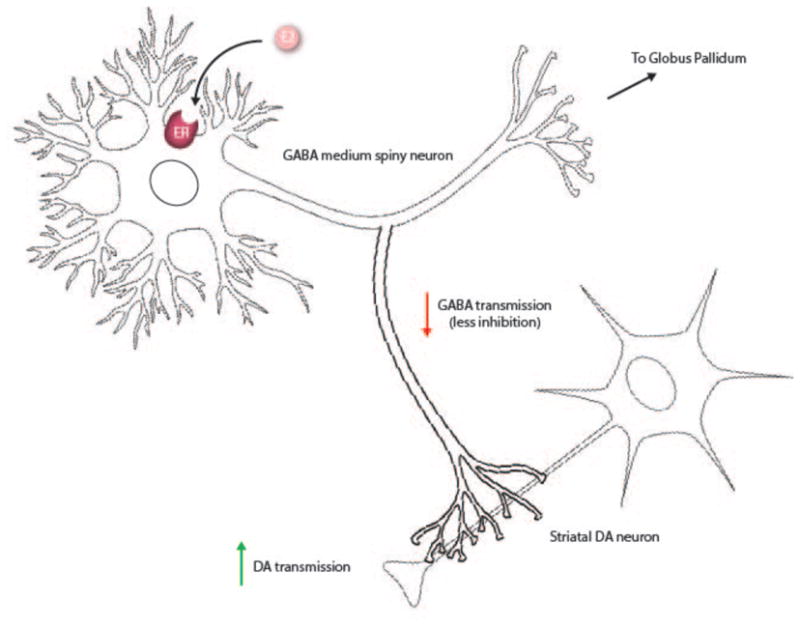
The gonadal hormone estradiol modulates mesolimbic dopamine systems in the female rat. This modulatory effect is thought to be responsible for the observed effects of estradiol on motivated behaviors. Dopamine acting in the nucleus accumbens is thought to be important for the attribution of incentive motivational properties to cues that predict reward delivery, while dopamine in the striatum is associated with the expression of repetitive or stereotyped behaviors. Elevated concentrations of estradiol are associated with increased motivation for sex or cues associated with access to a mate, while simultaneously attenuating motivation for food. This shift in motivational salience is important for adaptive choice behavior in the natural environment. Additionally, estradiol's adaptive effects on motivation can be maladaptive when increasing motivation for non-natural reinforcers, such as drugs of abuse. Here we discuss the effect of estradiol on mesotelencephalic dopamine transmission and subsequent effects on motivated behaviors.
Figures
References
-
- Morissette M, Le Saux M, D’Astous M, Jourdain S, Al Sweidi S, Morin N, Estrada-Camarena E, Mendez P, Garcia-Segura LM, Di Paolo T. Contribution of estrogen receptors alpha and beta to the effects of estradiol in the brain. The Journal of Steroid Biochemistry and Molecular Biology. 2008;108:327–338. - PubMed
-
- Becker JB. Rapid effects of estradiol on motivated behaviors. In: Kordon C, Gaillard RC, Christen Y, editors. Hormones and the Brain. Berlin/Heidelberg: Springer-Verlag; 2004. pp. 155–172.
Publication types
MeSH terms
Substances
Grants and funding
LinkOut - more resources
Full Text Sources
Medical