. 2014 Dec 26;9(12):e115752.
doi: 10.1371/journal.pone.0115752. eCollection 2014.

Genome-wide identification of hsp40 genes in channel catfish and their regulated expression after bacterial infection

Affiliations

Genome-wide identification of hsp40 genes in channel catfish and their regulated expression after bacterial infection

Lin Song et al. PLoS One. .

Abstract

Heat shock proteins (HSPs) consist of a large group of chaperones whose expression is induced by high temperature, hypoxia, infection and a number of other stresses. Among all the HSPs, Hsp40 is the largest HSP family, which bind to Hsp70 ATPase domain in assisting protein folding. In this study, we identified 57 hsp40s in channel catfish (Ictalurus punctatus) through in silico analysis using RNA-Seq and genome databases. These genes can be classified into three different types, Type I, II and III, based on their structural similarities. Phylogenetic and syntenic analyses provided strong evidence in supporting the orthologies of these HSPs. Meta-analyses of RNA-Seq datasets were conducted to analyze expression profile of Hsp40s following bacterial infection. Twenty seven hsp40s were found to be significantly up- or down-regulated in the liver after infection with E. ictaluri; 19 hsp40s were found to be significantly regulated in the intestine after infection with E. ictaluri; and 19 hsp40s were found to be significantly regulated in the gill following infection with F. columnare. Altogether, a total of 42 Hsp40 genes were regulated under disease situations involving three tissues and two bacterial infections. The significant regulated expression of Hsp40 genes after bacterial infection suggested their involvement in disease defenses in catfish.


Conflict of interest statement

Competing Interests: The co-author Zhanjiang Liu is a PLOS ONE Editorial Board member, but this does not alter the authors' adherence to PLOS ONE Editorial policies and criteria.

Figures

Figure 1
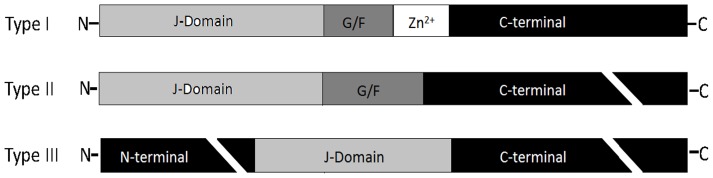
Figure 1. Schematic presentation of three sub-types of HSP40 family.
Type I DnaJ proteins have full domain conservation with Escherichia coli DnaJ, type II DnaJ proteins have a J domain and G/F (Gly/Phe-rich region) motif at N-terminus, type III DnaJ proteins only have a J domain anywhere in the protein.
Figure 2
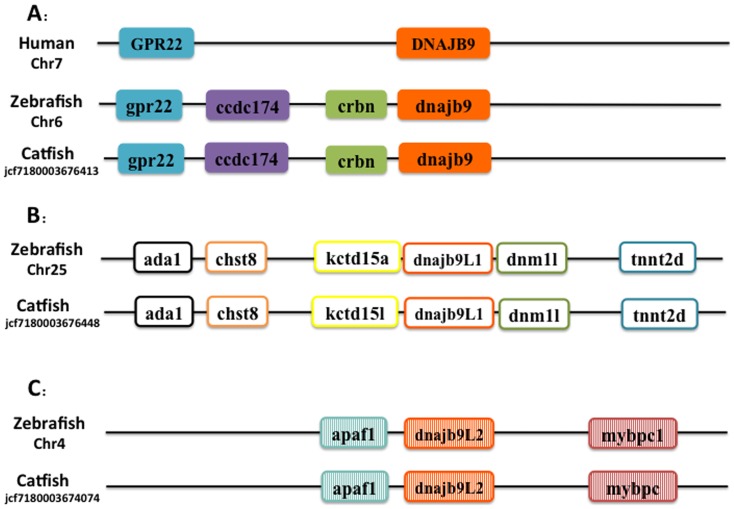
Figure 2. Schematic presentation of the conserved synteny blocks neighboring Dnajb9 gene (A) Dnajb9-like1 gene (B) and Dnajb9-like2 gene (C).
Note that in each case, the gene order and orientation was relatively conserved. Abbreviations: (A) GPR22, G Protein Receptor 22; Dnajb9, Dnaj (Hsp40) homolog, subfamily B, member 9; ccdc174, Coiled-Coil Domain Containing 174; crbn, cereblon. (B) ada1, Adenosine Deaminase; chst8, carbohydrate (N-acetylgalactosamine 4–0) sulfotransferase 8; kctd15a, potassium channel tetramerisation domain containing 15a; dnajb9L1 DnaJ (Hsp40) homolog, subfamily B, member 9 like 1; dnm1l, dynamin 1-like; tnnt2d, troponin T2d, cardiac. (C) apaf1, apoptotic protease activating factor 1; dnajb9l2 DnaJ (Hsp40) homolog, subfamily B, member 9 like 2; mybpc, myosin binding protein C.
Figure 3
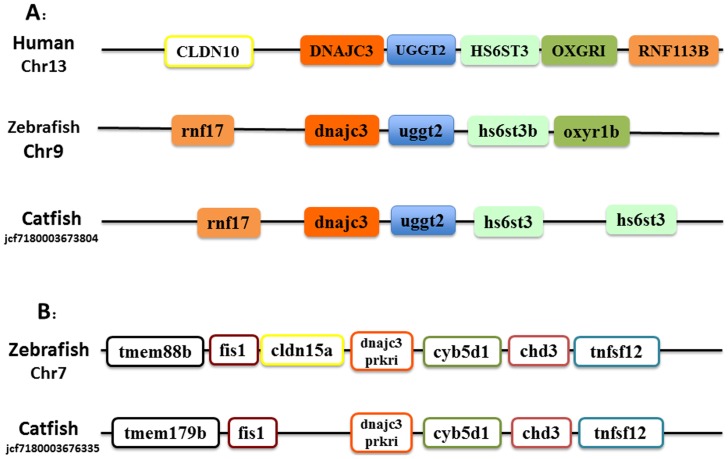
Figure 3. Schematic presentation of the conserved synteny blocks neighboring DnaJc3 (A) and DnaJc3-prkri gene (B).
Note that in each case, the gene order and orientation was relatively conserved. Abbreviations: (A) CLDN10, claudin 10; rnf17, ring finger protein 17; DnaJc3, DnaJ (Hsp40) homolog, subfamily C, member 3; uggt2, UDP-glucose glycoprotein glucosyltransferase 2; hs6st3b, heparan sulfate 6-O-sulfotransferase 3b; oxyr1b, oxoglutarate (alpha-ketoglutarate) receptor 1b; RNF113B, ring finger protein 113B. (B) tmem88b, transmembrane protein 88 b; fis1, fission 1 (mitochondrial outer membrane) homolog (S. cerevisiae); cldn15a, claudin 15a; dnajc3 prkri, protein-kinase, interferon-inducible double stranded RNA dependent inhibitor; cyb5d1, cytochrome b5 domain containing 1; chd3, chromodomain helicase DNA binding protein 3; tnfsf12, tumor necrosis factor (ligand) superfamily, member 12.
Figure 4
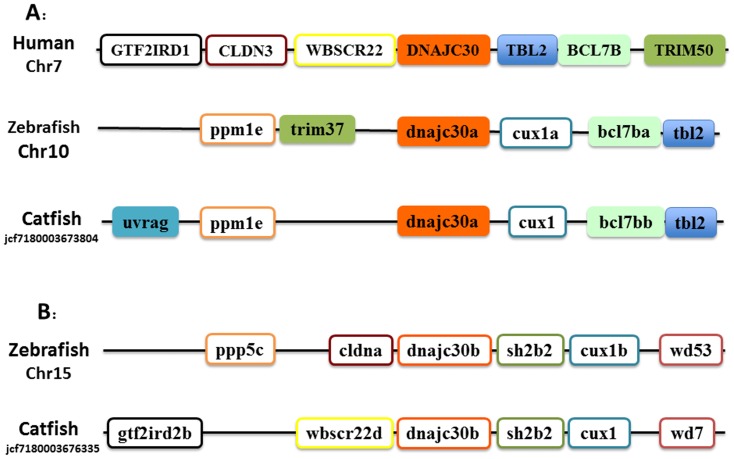
Figure 4. Schematic presentation of the conserved synteny blocks neighboring DnaJc30a (A) and DnaJc30b gene (B).
Note that in each case, the gene order and orientation was relatively conserved.Abbreviations: (A) GTF2IRD1, GTF2I repeat domain containing 1; CLDN3, claudin 3; WBSCR22, Williams Beuren syndrome chromosome region 22; DnaJc30, DnaJ (Hsp40) homolog, subfamily C, member 30; TBL2, transducin (beta)-like 2; BCL7B, B-cell CLL/lymphoma 7B; TRIM50, tripartite motif containing 50; ppm1e, protein phosphatase 1E (PP2C domain containing); trim37, tripartite motif containing 37; cux1a, cut-like homeobox 1a; uvrag, UV radiation resistance associated. (B) ppp5c, protein phosphatase 5, catalytic subunit; cldna, claudin a; dnajc30b, DnaJ (Hsp40) homolog, subfamily C, member 30; sh2b2, fission 1 (mitochondrial outer membrane) homolog (S. cerevisiae); wd53, WD repeat domain 53; wd7, WD repeat domain 7; gtf2ird2b, GTF2I repeat domain containing 2b.
Figure 5
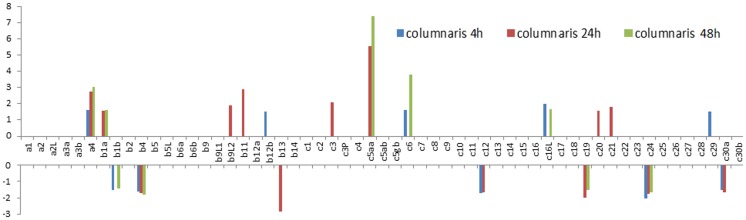
Figure 5. Column bar chart showing the fold change of Hsp40s expression in F. Columnare challenge experiments.
Vertical axis shows the value of fold change. Gene names are shown as clipped name without “dnaj”. For instance, a1 means “dnaja1”. “c3P” represents “dnajc3_prkri”.
Figure 6
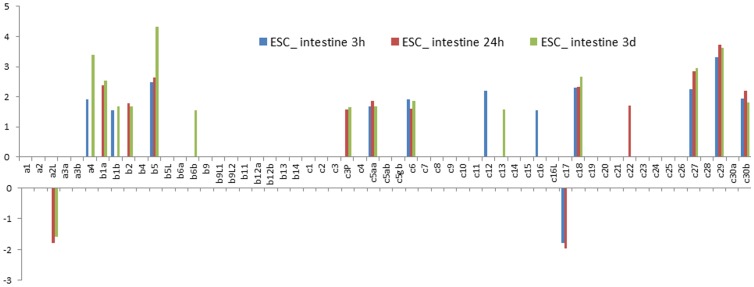
Figure 6. Column bar chart shows the fold change of Hsp40s expression in intestine after E. ictaluri challenge experiments.
Vertical axis shows the value of fold change. Gene names are shown as clipped name without “dnaj”. For instance, a1 means “dnaja1”. “c3P” represents “dnajc3_prkri”.
Figure 7
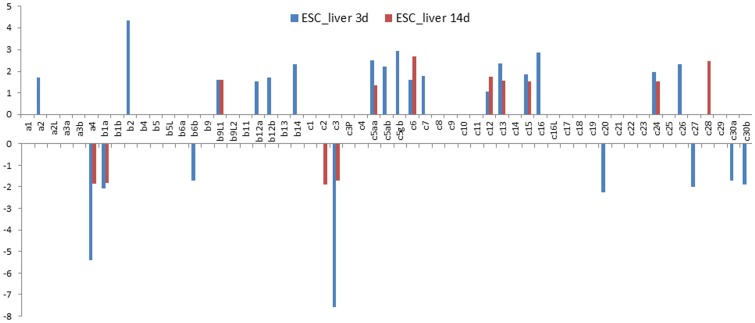
Figure 7. Column bar chart shows the fold change of Hsp40s expression in liver after E. ictaluri challenge experiments.
Vertical axis shows the value of fold change. Gene names are shown as clipped name without “dnaj”. For instance, a1 means “dnaja1”. “c3P” represents “dnajc3_prkri”.
Figure 8
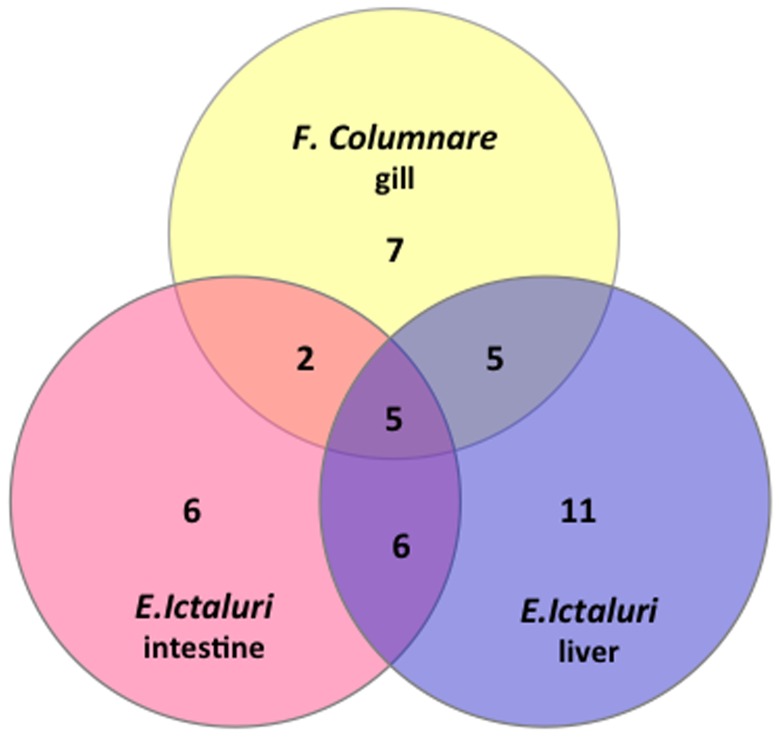
Figure 8. Venn diagram of catfish Hsp40 gene expression showing overlapped pattern of induced expression under various challenge conditions.

References

    1. Ellis J (1987) Proteins as molecular chaperones. Nature 328:378–379. - PubMed
    1. Welch WJ (1993) How cells respond to stress: during emergencies, cells produce stress proteins that repair damage, inquiry into how they work offers promise for coping with infection, autoimmune disease and even cancer. Scientific American 268:56–56. - PubMed
    1. Pockley AG (2003) Heat shock proteins as regulators of the immune response. The lancet 362:469–476. - PubMed
    1. Srivastava P (2002) Roles of heat-shock proteins in innate and adaptive immunity. Nature Reviews Immunology 2:185–194. - PubMed
    1. Feder ME, Hofmann GE (1999) Heat-shock proteins, molecular chaperones, and the stress response: Evolutionary and Ecological Physiology. Annual Review of Physiology 61:243–282. - PubMed

Publication types

MeSH terms