


Ipsilateral olecranon and distal radius fracture: A case report
- PMID: 25544490
- PMCID: PMC4334880
- DOI: 10.1016/j.ijscr.2014.12.020
Ipsilateral olecranon and distal radius fracture: A case report
Abstract
Introduction: Concomitant ipsilateral olecranon and distal radius fracture are rare injuries. Their clinical presentation is unusual and investigation and management is poorly described.
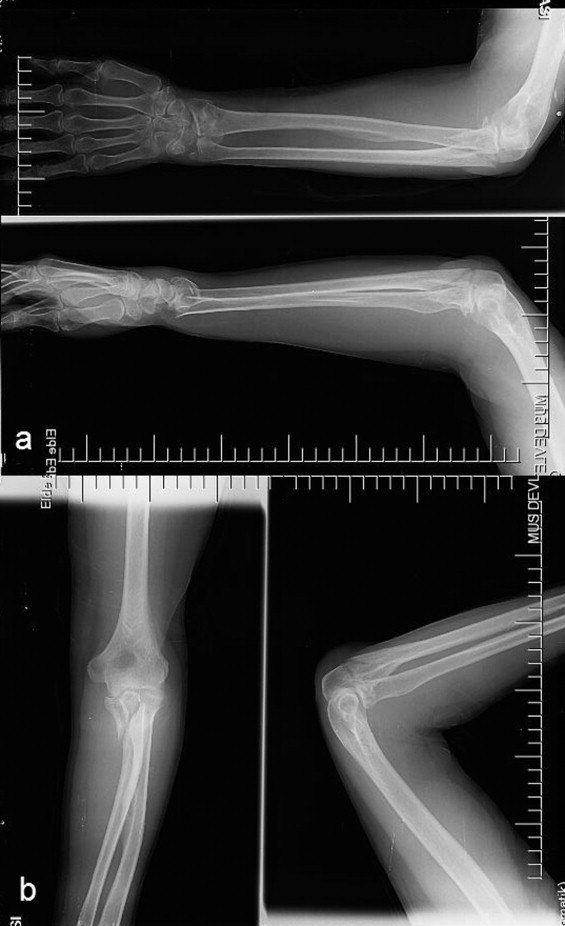
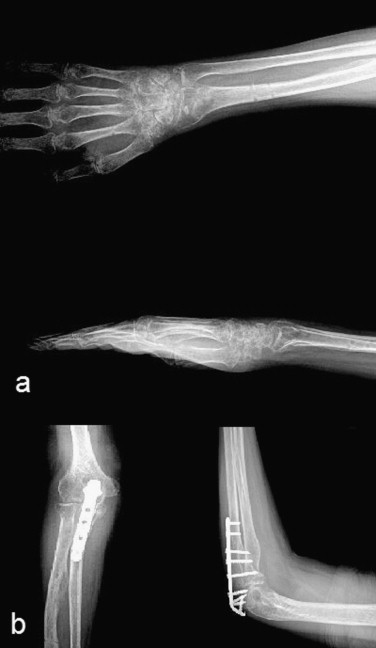
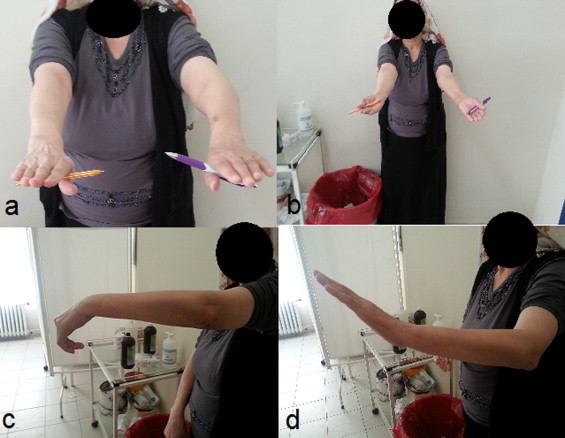
Presentation of case: We present a 55-year-old woman patient who fell off sustaining a concomitant distal radius and olecranon fracture in the same extremity. On examination, there was gross swelling of the proximal and distal forearm and no neurovascular deficit. Radiographs confirmed distal radius and olecranon fracture. Patient was treated with open reduction and anatomic locking plate for olecranon and a closed reduction percuteneous K wire fixation with penning fixator for distal radius fracture. After physical therapy program, functional results were good and DASH score was 60.
Discussion: Several different combinations of fracture with dislocation have been described, but, to our knowledge, concurrent ipsilateral olecranon and distal radius fracture has not been reported before. In the literature review there are two similar cases in the English literature.
Conclusion: Ipsilateral olecranon and distal radius fracture is a very rare injury due to different trauma mechanisms. However we should keep in mind that there may be adjacent joints and structures for concomitant injuries.
Keywords: Concomitant; Distal; Fracture; Ipsilateral; Olecranon; Radius.
Copyright © 2014 The Authors. Published by Elsevier Ltd.. All rights reserved.
Figures
References
-
- Karlsson M.K., Hasserius R., Karlsson C., Besjakov J., Josefsson P.O. Fractures of the olecranon: a 15–25-year followup of 73 patients. Clin. Orthop. Relat. Res. 2002;403:205–212. - PubMed
-
- Stanitski Carl L., Micheli Lyle J. Simultaneous ipsilateral fractures of the arm and forearm in children. Clin. Orthop. Relat. Res. 1980;153:218–222. - PubMed
-
- Edward Perez A. Fractures, dislocations, and fracture-dislocations of the elbow. In: Terry Canale S., James Campbell H., editors. Operative Orthopaedics. 12th ed. Elsevier; Philadelphia: 2013. pp. 2873–2876.
-
- Clare D.J., Corley F.G., Wirth M.A. Ipsilateral combination Monteggia and Galeazzi injuries in an adult patient: a case report. J. Orthop. Trauma. 2002;16(2):130–134. - PubMed
LinkOut - more resources
Full Text Sources
Other Literature Sources
Research Materials
