Review
. 2014 Sep;10(9):1918-36.
doi: 10.1166/jbn.2014.1963.

Functionalized fullerenes in photodynamic therapy

Review

Functionalized fullerenes in photodynamic therapy

Ying-Ying Huang et al. J Biomed Nanotechnol. 2014 Sep.

Abstract

Since the discovery of C60 fullerene in 1985, scientists have been searching for biomedical applications of this most fascinating of molecules. The unique photophysical and photochemical properties of C60 suggested that the molecule would function well as a photosensitizer in photodynamic therapy (PDT). PDT uses the combination of non-toxic dyes and harmless visible light to produce reactive oxygen species that kill unwanted cells. However the extreme insolubility and hydrophobicity of pristine CO60, mandated that the cage be functionalized with chemical groups that provided water solubility and biological targeting ability. It has been found that cationic quaternary ammonium groups provide both these features, and this review covers work on the use of cationic fullerenes to mediate destruction of cancer cells and pathogenic microorganisms in vitro and describes the treatment of tumors and microbial infections in mouse models. The design, synthesis, and use of simple pyrrolidinium salts, more complex decacationic chains, and light-harvesting antennae that can be attached to C60, C70 and C84 cages are covered. In the case of bacterial wound infections mice can be saved from certain death by fullerene-mediated PDT.


Figures
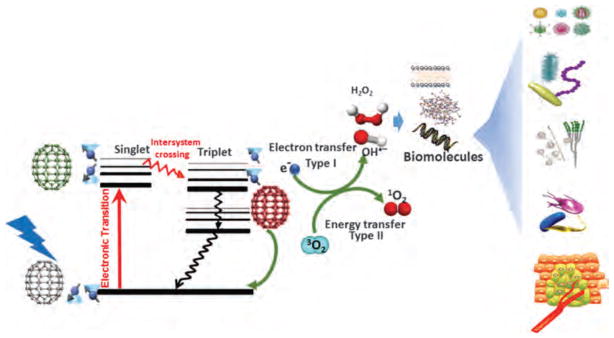
Figure 1
Figure 1
Schematic of PDT mediated by fullerenes.
Figure 2
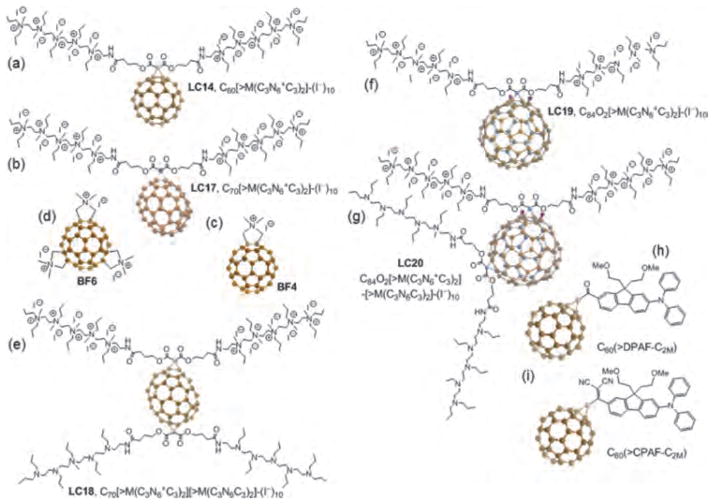
Figure 2
The chemical structure of fullerene derivatives applied in PDT studies.
Figure 3
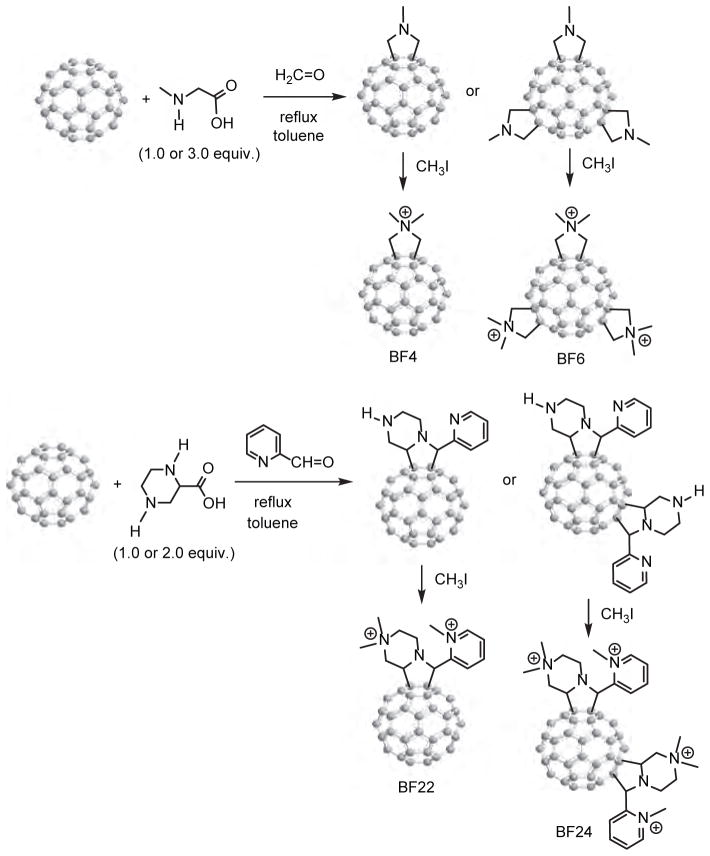
Figure 3
Synthesis of monocationic and tricationic dimethylpyrrolidinium [60]fullerenes BF4 and BF6, respectively, and mono- and bis(piperazinopyrrolidinium) [60]fullerenes BF22 and BF24, respectively.
Figure 4
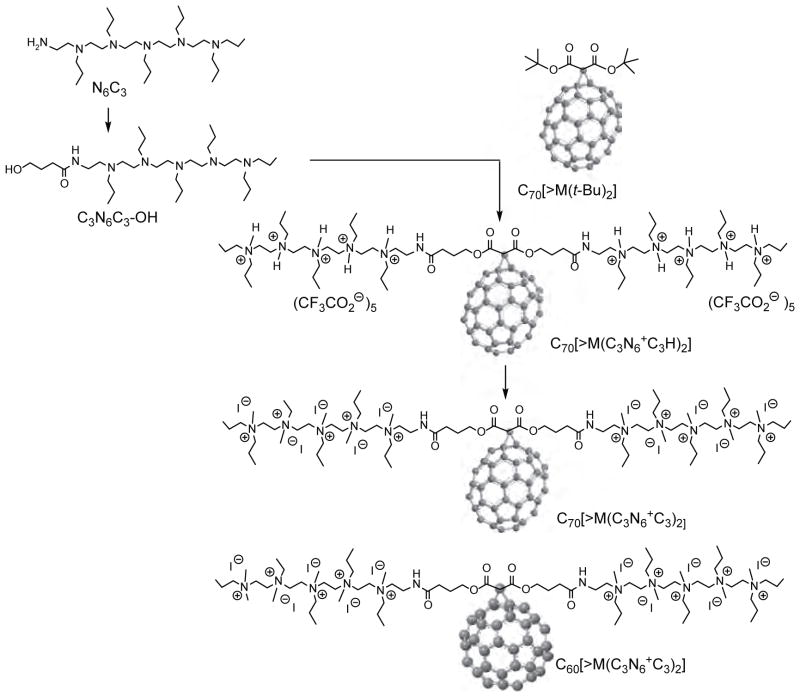
Figure 4
Synthetic scheme for the preparation of C60[>M(C3N6+C3)2] and C70[>M(C3N6+C3)2].
Figure 5
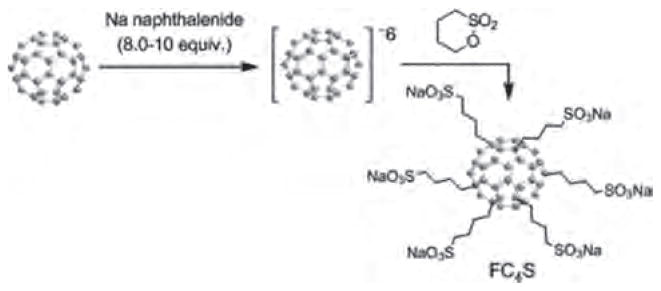
Figure 5
Synthesis of hexaanionic hexa(sulfo-n-butyl)-C60 (FC4S).
Figure 6
Figure 6
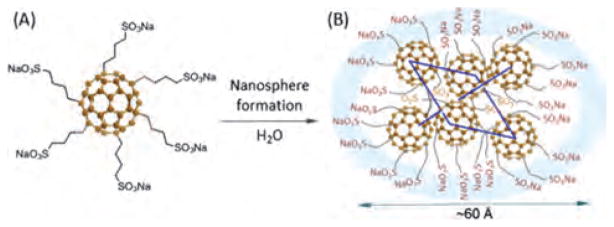
(A) Structure of hexa(sulfo-n-butyl) [60]fullerene (FC4S) and (B) a characterized FC4S-derived nanosphere formed in H2O discussed by Yu.
Figure 7
Figure 7
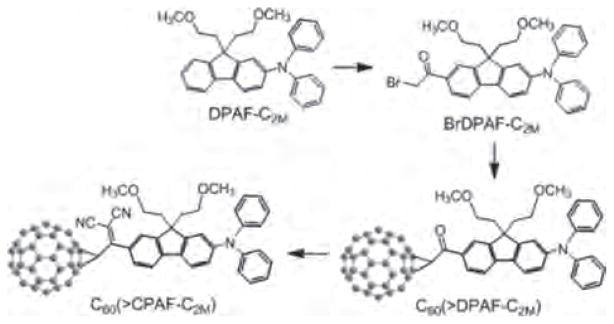
Synthetic method of C60(>CPAF-C2M) discussed by Chiang.
Figure 8
Figure 8
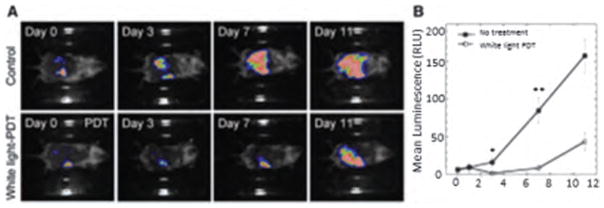
(A) Bioluminescence imaging of CT26-Luc tumors growing in a representative control mouse (upper panel) and a representative IPPDT treated mouse (lower panel). (B) Quantitative analysis of bioluminescence dynamics in control and white light treated mice (n = 10 per group). Reprinted with permission from [102], P. Mroz, et al., Intraperitoneal photodynamic therapy mediated by a fullerene in a mouse model of abdominal dissemination of colon adenocarcinoma. Nanomedicine 7, 965 (2011). © 2011, Future Science.
Figure 9
Figure 9
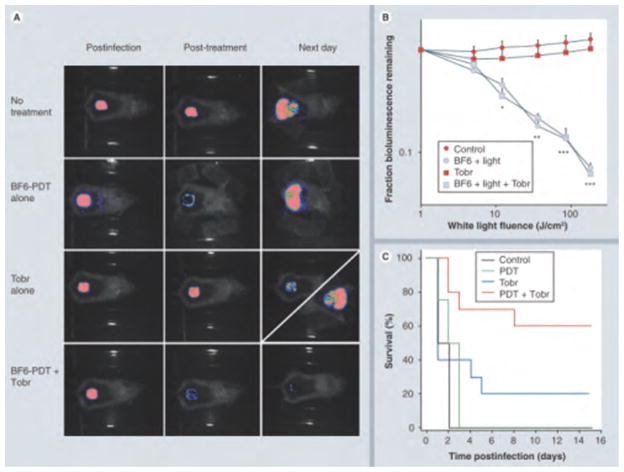
BF6-PDT and tobramycin treatment of Pseudomona aeruginosa wound-infected mice. (A) Representative bioluminescence images of P. aeruginosa-infected mice (captured immediately postinfection, immediately post-treatment and 24 h post-treatment), receiving: no treatment (top row); treated with BF6-PDT alone (180 J/cm2; second row); treated with Tobr alone (6 mg/kg for 1 day; third row, diagonal panel 24 h post-treatment shows two possible outcomes); and treated with a combination of BF6-PDT and 1 day Tobr (bottom row). (B) Quantification of luminescence values from bioluminescence images (not shown) obtained during the PDT process, or at equivalent times for non-PDT mice. *p < 0.05; **p < 0.01; ***p < 0.001; BF6 plus light (with and without Tobr) versus BF6 in dark and versus Tobr alone. (C) Kaplan–Meier survival curves for the groups of mice in Figure 4(A); no treatment control (n = 10); PDT alone (n = 12); Tobr alone (n = 2); PDT plus Tobr (n = 10). PDT: Photodynamic therapy; Tobr: Tobramycin. Reprinted with permission from [81], Z. Lu, et al., Photodynamic therapy with a cationic functionalized fullerene rescues mice from fatal wound infections. Nanomedicine (Lond.), 5, 1525 (2010). © 2010, Future Science.
Figure 10
Figure 10
Representative bioluminescence images from mice with Escherichia coli burn infections (day 0) and treated with successive fluences of photodynamic therapy or UVA light alone. (A) UVA control; (B) LC17 + UVA light; and (C) LC18+UVA light. There was no significant reduction in bioluminescence after application of either LC17 or LC18 without light exposure as a dark control. Reprinted with permission from [119], L. Huang, et al., Antimicrobial photodynamic therapy with decacationic monoadducts and bisadducts of [70]fullerene: In vitro and in vivo studies. Nanomedicine (Lond.) (2013). © 2013, Future Science.
Figure 11
Figure 11
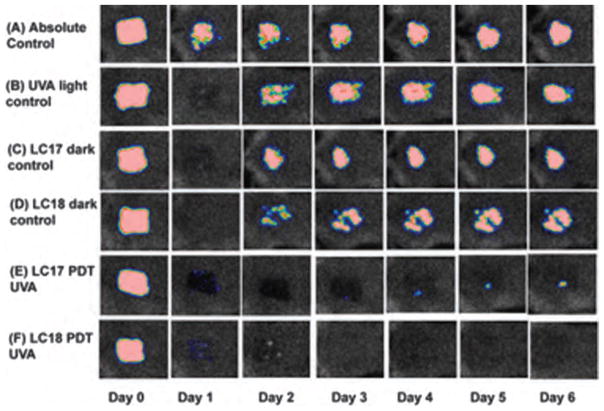
Representative bioluminescence images from mice with Acinetobacter baumannii burn infections and treated with photodynamic therapy, UVA light alone or absolute control, captured day 0 (before photodynamic therapy) and then daily for 6 days. (A) Absolute control; (B) UVA control+15% DMA; (C) LC17+15% DMA; (D) LC18+15% DMA; (E) LC17+15% DMA+UVA light; and (F) LC18+15% DMA+UVA light. Reprinted with permission from [119], L. Huang, et al., Antimicrobial photodynamic therapy with decacationic monoadducts and bisadducts of [70]fullerene: In vitro and in vivo studies. Nanomedicine (Lond.) (2013). © 2013, Future Science.

References

    1. Henderson BW, Dougherty TJ. How does photodynamic therapy work? Photochem Photobiol. 1992;55:145. - PubMed
    1. Agostinis P, Berg K, Cengel KA, Foster TH, Girotti AW, Gollnick SO, Hahn SM, Hamblin MR, Juzeniene A, Kessel D, Korbelik M, Moan J, Mroz P, Nowis D, Piette J, Wilson BC, Golab J. Photodynamic therapy of cancer: An update. CA Cancer J Clin. 2011;61:250. - PMC - PubMed
    1. Boyle RW, Dolphin D. Structure and biodistribution relationships of photodynamic sensitizers. Photochem Photobiol. 1996;64:469. - PubMed
    1. Sternberg ED, Dolphin D, Brückner C. Porphyrin-based photosensitizers for use in photodynamic therapy. Tetrahedron. 1998;54:4151.
    1. Ravindra K, Pandey RK, Zheng G. In: Porphyrins as photosensitizers in photodynamic therapy, The Porphyrin Handbook. Kadish K, Guilard R, Smiths KM, editors. Vol. 6. Elsevier; San Diego: 2000. pp. 157–161.

Publication types

MeSH terms

LinkOut - more resources