


Trauma Exposure and Axis I Psychopathology: A Co-twin Control Analysis in Norwegian Young Adults
- PMID: 25544868
- PMCID: PMC4276315
- DOI: 10.1037/a0034326
Trauma Exposure and Axis I Psychopathology: A Co-twin Control Analysis in Norwegian Young Adults
Abstract
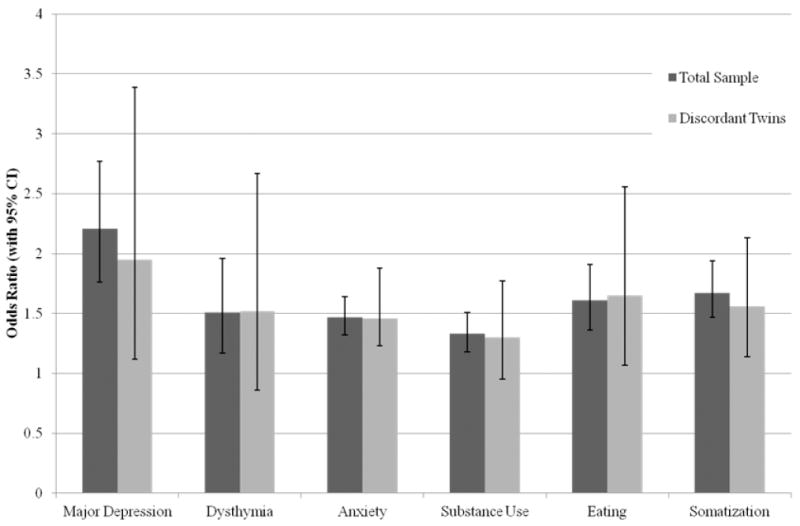
Broad associations between trauma exposure (TE) and Axis I psychopathology have been noted in the literature. However, it is not clear if TE is directly associated with Axis I disorders or if the relationship is better accounted for by familial factors (i.e., early environment and/or genetic factors). The current investigation used the co-twin control method in a large sample of adult twin pairs from the Norwegian Twin Registry (N = 2,776), including 449 twin pairs discordant for DSM-IV Criterion A TE. History of TE and Axis I psychopathology was assessed using DSM-IV based clinical interview. Results suggested that TE was significantly associated with greater likelihood of meeting criteria for major depression, dysthymia, anxiety, substance abuse, eating disorders, and somatization disorder in the general population (odds ratios [OR] ranging from 1.33 to 2.21). Among twins discordant for TE, results suggested that TE may exert a direct influence on major depression, dysthymia, anxiety, substance abuse, eating disorders, and somatization disorder. Shared familial effects may also account for at least some of the relationship between TE and major depression. TE may play an important role in the development of a wide range of Axis I psychopathology above and beyond familial factors. Research and clinical implications are discussed.
Keywords: co-twin control design; lifetime trauma exposure; psychiatric genetics; psychopathology.
Figures
References
-
- American Psychiatric Association. Diagnostic and Statistical Manual of Mental Disorders. Fourth Edition. Washington, D.C: Author; 1994.
-
- Amstadter AB, Aggen SH, Knudsen GP, Reichborn-Kjennerud T, Kendler KS. A population-based study of familial and individual-specific environmental contributions to traumatic event exposure and posttraumatic stress disorder symptoms in a Norwegian twin sample. Twin Research and Human Genetics. 2012;15(5):656–662. - PMC - PubMed
-
- Amstadter AB, Aggen SH, Knudsen GP, Reichborn-Kjennerud T, Kendler KS. Potentially traumatic event exposure, posttraumatic stress disorder, and Axis I and II comorbidity in a population-based study of Norwegian young adults. Social Psychiatry and Psychiatric Epidemiology. 2013;48(2):215–223. - PMC - PubMed
-
- Amstadter AB, Acierno R, Richardson LK, Kilpatrick DG, Gros DF, Gaboury MT, Galea S. Posttyphoon prevalence of posttraumatic stress disorder, major depressive disorder, panic disorder, and generalized anxiety disorder in a Vietnamese sample. Journal of Traumatic Stress. 2009;22(3):180–188. - PMC - PubMed
-
- Archambeau OG, Frueh BC, Deliramich AN, Elhai JD, Grubaugh AL, Herman S, Kim BSK. Interpersonal violence and mental health outcomes among Asian American and Native Hawaiian/other Pacific Islander college students. Psychological Trauma: Theory, Research, Practice, and Policy. 2010;2(4):273. - PMC - PubMed
Grants and funding
LinkOut - more resources
Full Text Sources
Other Literature Sources