


Vitamin D from different sources is inversely associated with Parkinson disease
- PMID: 25545356
- PMCID: PMC4390412
- DOI: 10.1002/mds.26117
Vitamin D from different sources is inversely associated with Parkinson disease
Abstract
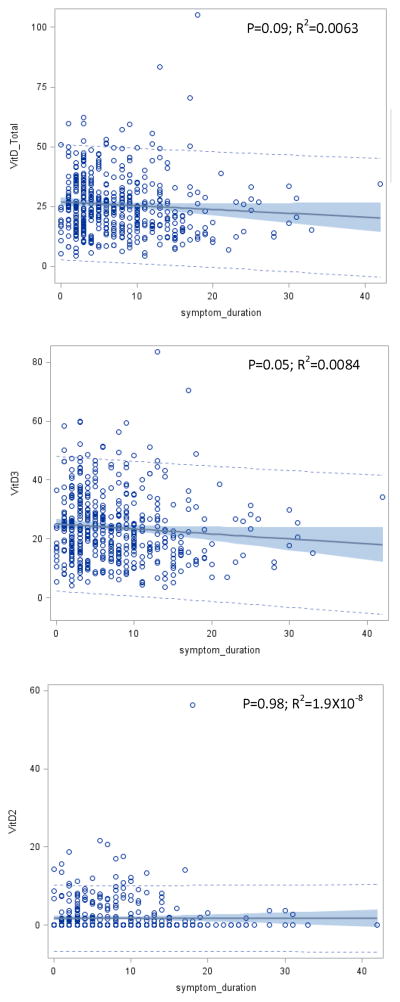
An inverse association between Parkinson disease (PD) and total vitamin D levels has been reported, but whether vitamin D from different sources, that is, 25(OH)D2 (from diet and supplements) and 25(OH)D3 (mainly from sunlight exposure), all contribute to the association is unknown. Plasma total 25(OH)D, 25(OH)D2, and 25(OH)D3 levels were measured by liquid chromatography-tandem mass spectrometry in PD patients (n = 478) and controls (n = 431). Total 25(OH)D was categorized by clinical insufficiency or deficiency; 25(OH)D2 and 25(OH)D3 were analyzed in quartiles. Vitamin D deficiency (total 25[OH]D < 20 ng/mL) and vitamin D insufficiency (total 25[OH]D < 30 ng/mL) are associated with PD risk (odds ratio [OR] = 2.6 [deficiency] and 2.1 [insufficiency]; P < 0.0001), adjusting for age, sex, and sampling season. Both 25(OH)D2 and 25(OH)D3 levels are inversely associated with PD (P(trend) < 0.0001). The association between 25(OH)D2 and PD risk is largely confined to individuals with low 25(OH)D3 levels (P(trend) = 0.0008 and 0.12 in individuals with 25[OH]D3 < 20 ng/mL and 25[OH]D3 ≥ 20 ng/mL, respectively). Our data confirm the association between vitamin D deficiency and PD, and for the first time demonstrate an inverse association of 25(OH)D2 with PD. Given that 25(OH)D2 concentration is independent of sunlight exposure, this new finding suggests that the inverse association between vitamin D levels and PD is not simply attributable to lack of sunlight exposure in PD patients with impaired mobility. The current study, however, cannot exclude the possibility that gastrointestinal dysfunction, a non-motor PD symptom, contributes to the lower vitamin D2 levels in PD patients.
Keywords: Parkinson's disease; diet; vitamin D; vitamin D2.
© 2014 International Parkinson and Movement Disorder Society.
Conflict of interest statement
All authors concur with the submission of the work and there are no conflicts of interest.
Figures
Comment in
-
Parkinson disease. Reduced level of dietary vitamin D is associated with PD.Nat Rev Neurol. 2015 Feb;11(2):68. doi: 10.1038/nrneurol.2014.265. Epub 2015 Jan 13. Nat Rev Neurol. 2015. PMID: 25582446 No abstract available.
References
-
- Lesage S, Brice A. Parkinson’s disease: from monogenic forms to genetic susceptibility factors. Hum Mol Genet. 2009;R1:R48–59. - PubMed
-
- Elbaz A, Clavel J, Rathouz PJ, et al. Professional exposure to pesticides and Parkinson disease. Ann Neurol. 2009;4:494–504. - PubMed
-
- Chen H, Jacobs E, Schwarzschild MA, McCullough ML, Calle EE, Thun MJ, Ascherio A. Nonsteroidal antiinflammatory drug use and the risk for Parkinson’s disease. Ann Neurol. 2005;6:963–967. - PubMed
-
- Hernan MA, Takkouche B, Caamano-Isorna F, Gestal-Otero JJ. A meta-analysis of coffee drinking, cigarette smoking, and the risk of Parkinson’s disease. Ann Neurol. 2002:276–284. - PubMed
Publication types
MeSH terms
Substances
Grants and funding
LinkOut - more resources
Full Text Sources
Other Literature Sources
Medical
