


doi: 10.1111/cei.12516.
Subclinical infection and dosing in primary immunodeficiencies
Affiliations
- PMID: 25546767
- PMCID: PMC4285496
- DOI: 10.1111/cei.12516
Item in Clipboard
Subclinical infection and dosing in primary immunodeficiencies
Clin Exp Immunol.
2014 Dec.
No abstract available
Figures
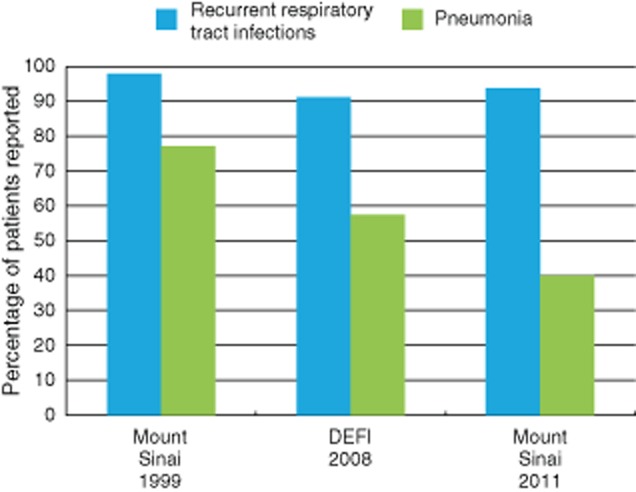
A combined analysis of data on the percentage of patients experiencing pneumonia and recurrent respiratory tract infections is shown in three large series of common variable immunodeficiency (CVID) patients in 1999, 2008 and 2011 [two from the same cohort in the United States 12 years apart (248 and 252 patients) and one from a French cohort (473 patients)]. Accepting the potential difficulties in the interpretation of combined data from several sources, there is a decline in the percentage of patients' pneumonia over time, perhaps representing a change in immunoglobulin (Ig) dosing or greater use of prophylactic antibiotics. In contrast the percentage of patients with recurrent respiratory tract infections has remained high at more than 90% in all of the studies. This term will include infections of the sinuses, throat, upper and lower respiratory tract which do not fulfil criteria for pneumonia.
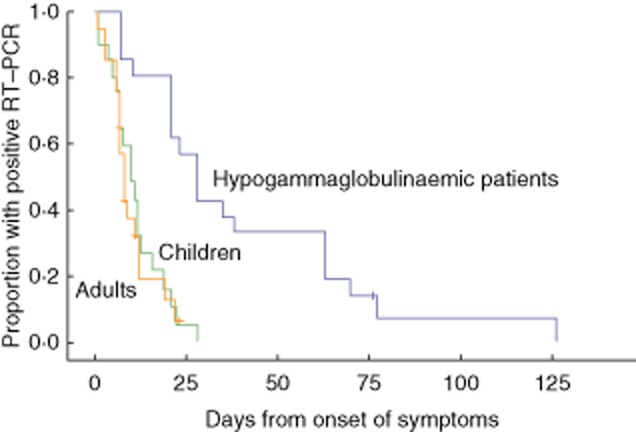
Virus shedding after human rhinovirus (HRV) infection (reproduced from , copyright 2013 European Society of Clinical Microbiology and Infectious Diseases, with permission from John Wiley and Sons). The striking difference in the prolongation of duration of shedding of rhinovirus between immunocompetent children and adults alongside primary antibody-deficient patients on immunoglobulin (Ig) replacement therapy is shown.
References
-
- Cunningham-Rundles C, Bodian C. Common variable immunodeficiency: clinical and immunological features of 248 patients. Clin Immunol. 1999;92:34–48. - PubMed
-
- Jolles S. The variable in common variable immunodeficiency: a disease of complex phenotypes. J Allergy Clin Immunol Pract. 2013;1:545–556. quiz 57. - PubMed
-
- Chen Y, Stirling RG, Paul E, Hore-Lacy F, Thompson BR, Douglass JA. Longitudinal decline in lung function in patients with primary immunoglobulin deficiencies. J Allergy Clin Immunol. 2011;127:1414–1417. - PubMed
-
- Lucas M, Lee M, Lortan J, Lopez-Granados E, Misbah S, Chapel H. Infection outcomes in patients with common variable immunodeficiency disorders: relationship to immunoglobulin therapy over 22 years. J Allergy Clin Immunol. 2010;125:1354–1360. e4. - PubMed
Publication types
MeSH terms
Substances
LinkOut - more resources
Full Text Sources
Other Literature Sources
