Review
. 2014 Dec 19:13:181.
doi: 10.1186/s12934-014-0181-5.

Effect of elevated oxygen concentration on bacteria, yeasts, and cells propagated for production of biological compounds

Affiliations
Review

Effect of elevated oxygen concentration on bacteria, yeasts, and cells propagated for production of biological compounds

Antonino Baez et al. Microb Cell Fact. .

Abstract

The response of bacteria, yeast, and mammalian and insects cells to oxidative stress is a topic that has been studied for many years. However, in most the reported studies, the oxidative stress was caused by challenging the organisms with H2O2 and redox-cycling drugs, but not by subjecting the cells to high concentrations of molecular oxygen. In this review we summarize available information about the effect of elevated oxygen concentrations on the physiology of microorganisms and cells at various culture conditions. In general, increased oxygen concentrations promote higher leakage of reactive oxygen species (superoxide and H2O2) from the respiratory chain affecting metalloenzymes and DNA that in turn cause impaired growth and elevated mutagenesis. To prevent the potential damage, the microorganisms and cells respond by activating antioxidant defenses and repair systems. This review described the factors that affect growth properties and metabolism at elevated oxygen concentrations that cells may be exposed to, in bioreactor sparged with oxygen enriched air which could affect the yield and quality of the recombinant proteins produced by high cell density schemes.


Figures
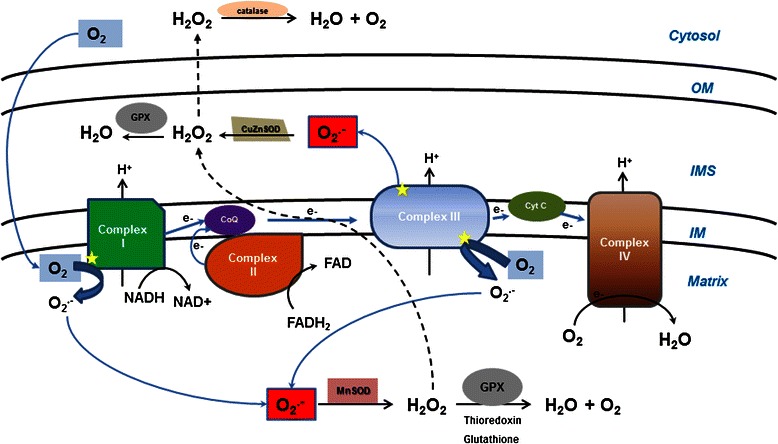
Figure 1
Figure 1
Elevated oxygen triggers intracellular ROS accumulation. The ubisemiquinone intermediates present in complexes I and III of the respiratory chain are the primary source of univalent reduction of oxygen into superoxide (O2 .-) (indicated by stars). At over-oxygenation conditions, electrons leak from complexes I and III generating superoxide increases. Superoxide is converted immediately to hydrogen peroxide (H2O2) by manganese superoxide dismutase (MnSOD) or copper/zinc superoxide dismutase (Cu/ZnSOD). At normoxic conditions, the catalases and peroxidase systems minimize the accumulation of H2O2 but at higher oxygen concentrations; these antioxidant defenses can be overwhelmed and the accumulating H2O2 diffuse freely from the mitochondria (dashed lines) reaching targets that can be damaged such as dehydratases and DNA. Abbreviations: CoQ, coenzyme Q10; Cyt C, cytochrome C; GPX, glutathione peroxidase; IM, inner membrane; IMS, intermembrane space; OM, outer membrane.

References

    1. Oosterhuis NMG, Kossen NWF. Dissolved oxygen concentration profiles in a production-scale bioreactor. Biotechnol Bioeng. 1984;26:546–550. doi: 10.1002/bit.260260522. - DOI - PubMed
    1. Konz JO, King J, Cooney CL. Effects of oxygen on recombinant protein expression. Biotechnol Prog. 1998;14:393–409. doi: 10.1021/bp980021l. - DOI - PubMed
    1. Kazzaz JA, Xu J, Palaia TA, Mantell L, Fein AM, Horowitz S. Cellular oxygen toxicity: oxidant injury without apoptosis. J Biol Chem. 1996;271:15182–15186. doi: 10.1074/jbc.271.25.15182. - DOI - PubMed
    1. Korshunov S, Imlay JA. Detection and quantification of superoxide formed within the periplasm of Escherichia coli. J Bacteriol. 2006;188:6326–6334. doi: 10.1128/JB.00554-06. - DOI - PMC - PubMed
    1. Imlay JA. Cellular defenses against superoxide and hydrogen peroxide. Annu Rev Biochem. 2008;77:755–776. doi: 10.1146/annurev.biochem.77.061606.161055. - DOI - PMC - PubMed

Publication types
