


Clinical characteristics, treatment outcomes, and resource utilization in children and adults with eosinophilic gastroenteritis
- PMID: 25547198
- PMCID: PMC4339627
- DOI: 10.1016/j.dld.2014.11.009
Clinical characteristics, treatment outcomes, and resource utilization in children and adults with eosinophilic gastroenteritis
Abstract
Background: Eosinophilic gastroenteritis is a rare condition where eosinophilic inflammation occurs in the gastrointestinal tract in the absence of secondary causes. Little is known regarding aetiology, pathogenesis, or natural history.
Aims: To characterize the clinical, endoscopic, and histopathologic features of eosinophilic gastroenteritis and to summarize treatment outcomes.
Methods: Pathology reports of all patients who had undergone upper endoscopy with biopsy between January 1, 2000 and June 20, 2013 were reviewed. Eosinophilic gastroenteritis was diagnosed if there were ≥20 eosinophils/hpf on either gastric of duodenal biopsy, symptoms attributable to the gastrointestinal tract, and no known secondary cause of eosinophilia. Descriptive statistics characterized patients diagnosed with eosinophilic gastroenteritis and bivariate analysis compared adults and children.
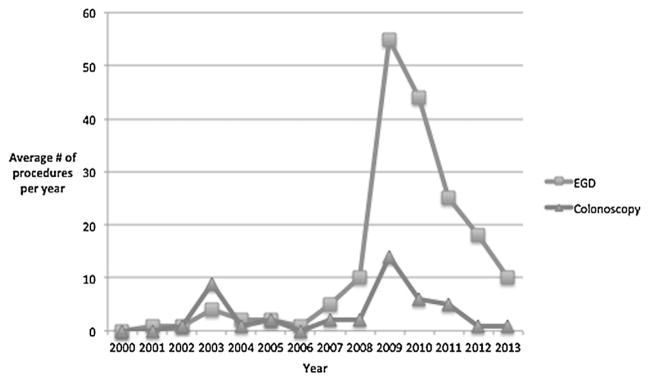
Results: There were 44 patients diagnosed with eosinophilic gastrointestinal disease. The most common symptoms were vomiting (71%) and abdominal pain (62%). Of the eosinophilic gastroenteritis cases, 12 (30%) had esophageal involvement, and 11 (28%) had colonic involvement. For treatment, 36 (80%) received corticosteroids. Overall, 27 (60%) had symptom resolution and 23 (51%) had endoscopic resolution. Cases underwent a mean of five endoscopic procedures per year.
Conclusion: Eosinophilic gastroenteritis presents with non-specific gastrointestinal symptoms and in almost one-third of cases has concomitant esophageal or colonic involvement. It remains difficult to treat, with high rates of endoscopic utilization.
Keywords: Eosinophilia; Eosinophilic gastroenteritis; Eosinophilic gastrointestinal disease.
Copyright © 2014 Editrice Gastroenterologica Italiana S.r.l. Published by Elsevier Ltd. All rights reserved.
Conflict of interest statement
None declared.
Figures
References
-
- Kaijser R. Zur kenntnis der allegischen affecktioner desima verdauungskanal von standpunkt desima chirurgen aus. Arch Klin Chir. 1937;188:36–64.
-
- Rothenberg ME. Eosiniphilic gastrointestinal disorders (EGID) Journal of Allergy and Clinical Immunology. 2004;113:11–28. - PubMed
-
- Khan S, Orenstein SR. Eosinophilic gastroenteritis. Gastroenterology Clinics of North America. 2008;37:333–48. - PubMed
-
- Oh HE, Chetty R. Eosinophilic gastroenteritis: a review. Journal of Gastroenterology. 2008;43:741–50. - PubMed
Publication types
MeSH terms
Substances
Supplementary concepts
Grants and funding
LinkOut - more resources
Full Text Sources
Other Literature Sources
Medical
