


Age-dependent changes in health status in the Childhood Cancer Survivor cohort
- PMID: 25547510
- PMCID: PMC4314595
- DOI: 10.1200/JCO.2014.57.4863
Age-dependent changes in health status in the Childhood Cancer Survivor cohort
Abstract
Purpose: To compare age-dependent changes in health status among childhood cancer survivors and a sibling cohort.
Methods: Adult survivors of childhood cancer and siblings, all participants of the Childhood Cancer Survivor Study, completed three surveys assessing health status. At each of three time points, participants were classified as having poor outcomes in general health, mental health, function, or daily activities if they indicated moderate to extreme impairment. Generalized linear mixed models were used to compare survivors with siblings for each outcome as a function of age and to identify host- and treatment-related factors associated with age-dependent worsening health status.
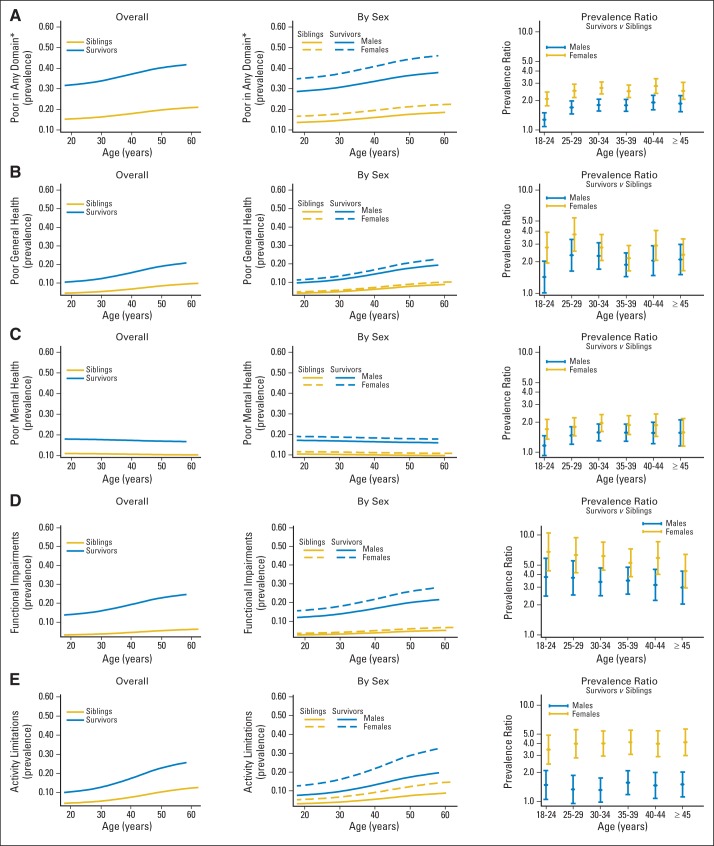
Results: Adverse health status outcomes were more frequent among survivors than siblings, with evidence of a steeper trajectory of age-dependent change among female survivors with impairment in at least one health status domain (P = .01). In adjusted models, survivors were more likely than siblings to report poor general health (prevalence ratio [PR], 2.37; 95% CI, 2.09 to 2.68), adverse mental health (PR, 1.66; 95% CI, 1.52 to 1.80), functional impairment (PR, 4.53; 95% CI, 3.91 to 5.24), activity limitations (PR, 2.38; 95% CI, 2.12 to 2.67), and an adverse health status outcome in any domain (PR, 2.10; 95% CI, 1.97 to 2.23). Cancer treatment and health behaviors influence the magnitude of differences by age groups. Chronic conditions were associated with adverse health status outcomes across organ systems.
Conclusion: The prevalence of poor health status is higher among survivors than siblings, increases rapidly with age, particularly among female participants, and is related to an increasing burden of chronic health conditions.
© 2014 by American Society of Clinical Oncology.
Conflict of interest statement
Authors' disclosures of potential conflicts of interest are found in the article online at
Figures
References
-
- Ross JA, Spector LG, Robison LL, et al. Epidemiology of leukemia in children with Down syndrome. Pediatr Blood Cancer. 2005;44:8–12. - PubMed
-
- Trobaugh-Lotrario AD, Smith AA, Odom LF. Vincristine neurotoxicity in the presence of hereditary neuropathy. Med Pediatr Oncol. 2003;40:39–43. - PubMed
-
- Malkin D, Friend SH, Li FP, et al. Germ-line mutations of the p53 tumor-suppressor gene in children and young adults with second malignant neoplasms. N Engl J Med. 1997;336:734. - PubMed
-
- Relling MV, Rubnitz JE, Rivera GK, et al. High incidence of secondary brain tumours after radiotherapy and antimetabolites. Lancet. 1999;354:34–39. - PubMed
Publication types
MeSH terms
Grants and funding
LinkOut - more resources
Full Text Sources
Other Literature Sources
Medical
Research Materials
