. 2015 Mar;83(3):950-7.
doi: 10.1128/IAI.02601-14. Epub 2014 Dec 29.

Role of the nuclease of nontypeable Haemophilus influenzae in dispersal of organisms from biofilms

Affiliations

Role of the nuclease of nontypeable Haemophilus influenzae in dispersal of organisms from biofilms

Christine Cho et al. Infect Immun. 2015 Mar.

Abstract

Nontypeable Haemophilus influenzae (NTHI) forms biofilms in the middle ear during human infection. The biofilm matrix of NTHI contains extracellular DNA. We show that NTHI possesses a potent nuclease, which is a homolog of the thermonuclease of Staphylococcus aureus. Using a biofilm dispersal assay, studies showed a biofilm dispersal pattern in the parent strain, no evidence of dispersal in the nuclease mutant, and a partial return of dispersion in the complemented mutant. Quantitative PCR of mRNA from biofilms from a 24-h continuous flow system demonstrated a significantly increased expression of the nuclease from planktonic organisms compared to those in the biofilm phase of growth (P < 0.042). Microscopic analysis of biofilms grown in vitro showed that in the nuclease mutant the nucleic acid matrix was increased compared to the wild-type and complemented strains. Organisms were typically found in large aggregates, unlike the wild-type and complement biofilms in which the organisms were evenly dispersed throughout the biofilm. At 48 h, the majority of the organisms in the mutant biofilm were dead. The nuclease mutant formed a biofilm in the chinchilla model of otitis media and demonstrated a propensity to also form similar large aggregates of organisms. These studies indicate that NTHI nuclease is involved in biofilm remodeling and organism dispersal.


Figures

FIG 1
FIG 1
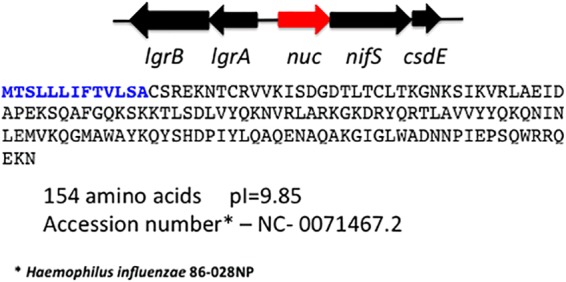
Genomic arrangement and sequence of the NTHI nuc (red) in the H. influenzae 2019 genome. The boldface blue letters indicate the 13-amino-acid signal sequence. The homologous sequence in the H. influenzae RD KW20 genome is HI1296.
FIG 2
FIG 2
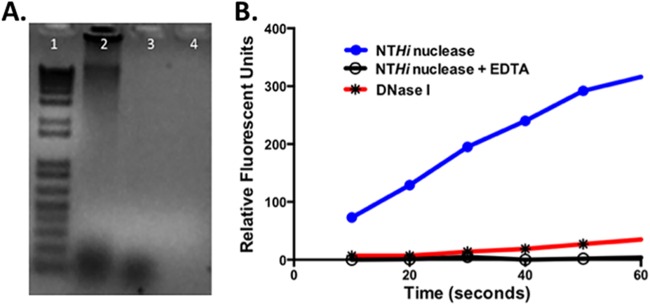
(A) Agarose gel demonstrating the enzymatic activity of Nuc against double-stranded genomic DNA after incubation. Lane 1, molecular weight markers; lane 2, herring sperm DNA alone; lane 3, DNase I (1 U) and herring sperm DNA; lane 4, Nuc (1 μg) and herring sperm DNA. (B) Results of digestion of 25 mM FRET-labeled nucleotide at 25°C with 0.035 nM nuclease (●) or 6.00 nM DNase 1 (✳). The differences in the velocity of the enzymes can be readily seen. The graph also demonstrates the loss of nuclease activity in the presence of 4 mM EDTA (○) due to chelation of the divalent cations Mg2+ and Ca2+.
FIG 3
FIG 3
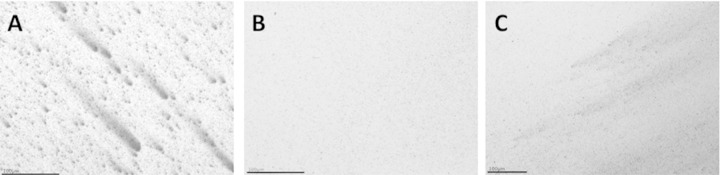
Evidence that the nuclease is the factor responsible for dispersal of NTHI biofilms. (A) “Comet tails” caused by the release of organisms from NTHI 2019 microcolonies/nascent biofilms as organisms transition from the biofilm to planktonic phase over a 24-h period. (B) Study performed on 2019Δnuc, which had no evidence of microcolony formation or dispersal of organisms. (C) Partial complementation in cis of 2019Δnuc because the expression of nuc is unregulated in the complemented strain. Small microcolonies were seen with the comet tail configurations similar to those seen in panel A.
FIG 4
FIG 4
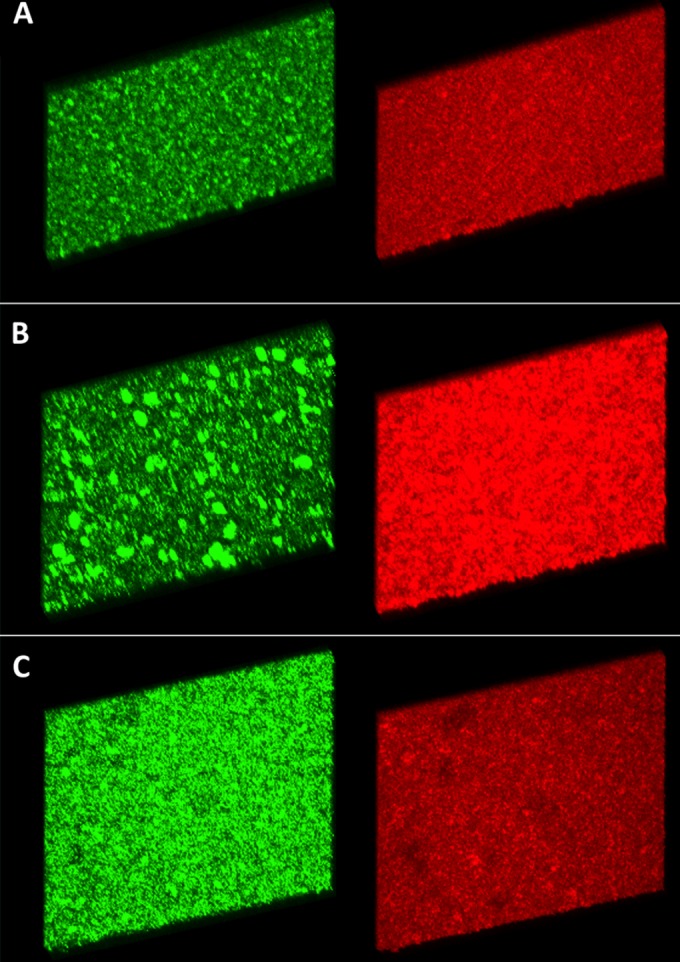
A 50-image stacked z-series at ×20 magnification of 24-h biofilms grown in continuous flow chambers. The samples were stained with propidium iodide (red) and MAb 6E4 (green) prior to visualization. At 24 h, the NTHI 2019Δnuc biofilm contains increased amounts of eDNA and large aggregates of organisms (B). This compares to lesser amounts of eDNA and diffuse arrangement of organisms within the biofilm of NTHI 2019 (A) and NTHI 2019Δnuc::nuc (C).
FIG 5
FIG 5
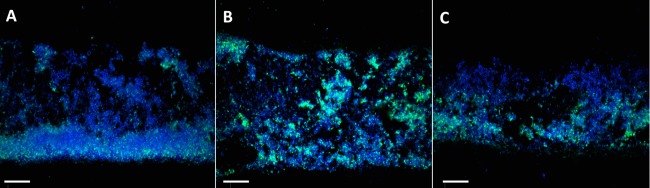
Cryo sections through 24-h biofilms from NTHI 2019 wild type (A), NTHI 2019Δnuc (B), and NTHI 2019Δnuc::nuc (C). The DNA matrix is stained with DAPI, and the NTHI strains are stained with MAb 6E4. Scale bar, 20 μm. The organisms in the parent strain and in the complemented mutant are clearly dispersed throughout the biofilm, whereas they are clustered in the Δnuc mutant.
FIG 6
FIG 6
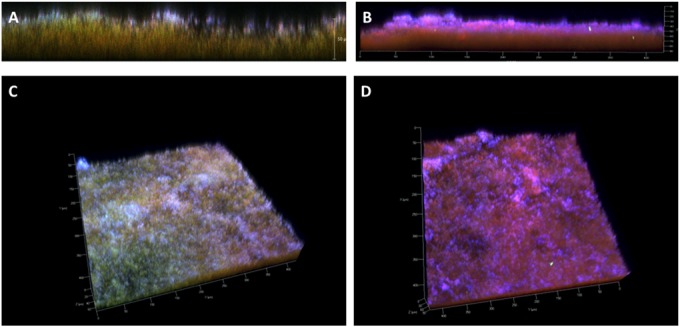
Lateral views and stacked z-series of 48-h biofilms stained with Live/Dead stain (green-red) and DRAQ-5 (blue). (A and C) Biofilm images of NTHI 2019 demonstrating a predominance of live organisms (green), while the images of NTHI 2019Δnuc biofilm (B and D) demonstrate that the majority of organisms were dead (red) by 48 h.
FIG 7
FIG 7
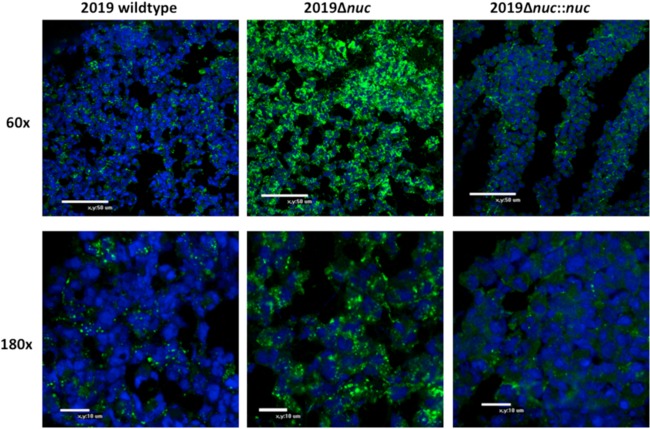
Confocal microscopy analysis of 10-μm-thick sections of biofilm formation at day 5 in the chinchilla middle ear after infection with NTHI 2019, NTHI 2019Δnuc, and NTHI 2019Δnuc::nuc. The NTHI are stained with MAb 6E4 (green), and DNA is stained with DRAQ5 (blue). There is an aggregation of organisms staining with MAb 6E4 in NTHI 2019Δnuc (B) compared to the more diffuse display of organisms in the wild type and the complemented mutant (A and C).

References

    1. Murphy TF, Apicella MA. 1987. Nontypeable Haemophilus influenzae: a review of clinical aspects, surface antigens and the human response to infection. Rev Infect Dis 9:1–15. doi: 10.1093/clinids/9.1.1. - DOI - PubMed
    1. Chin CL, Manzel LJ, Lehman EE, Humlicek AL, Shi L, Starner TD, Denning GM, Murphy TF, Sethi S, Look DC. 2005. Haemophilus influenzae from patients with chronic obstructive pulmonary disease exacerbation induce more inflammation than colonizers. Am J Respir Crit Care Med 172:85–91. doi: 10.1164/rccm.200412-1687OC. - DOI - PMC - PubMed
    1. Post JC. 2001. Direct evidence of bacterial biofilms in otitis media. Laryngoscope 111:2083–2094. doi: 10.1097/00005537-200112000-00001. - DOI - PubMed
    1. Ehrlich GD, Veeh R, Wang X, Costerton JW, Hayes JD, Hu FZ, Daigle BJ, Ehrlich MD, Post JC. 2002. Mucosal biofilm formation on middle-ear mucosa in the chinchilla model of otitis media. JAMA 287:1710–1715. doi: 10.1001/jama.287.13.1710. - DOI - PubMed
    1. Starner TD, Zhang N, Kim G, Apicella MA, McCray PB Jr. 2006. Haemophilus influenzae forms biofilms on airway epithelia: implications in cystic fibrosis. Am J Respir Crit Care Med 174:213–220. doi: 10.1164/rccm.200509-1459OC. - DOI - PMC - PubMed

Publication types

MeSH terms

LinkOut - more resources