


Review
doi: 10.1093/eurheartj/ehu500.
Epub 2014 Dec 29.
Triglycerides on the rise: should we swap seats on the seesaw?
Affiliations
- PMID: 25548060
- PMCID: PMC4471442
- DOI: 10.1093/eurheartj/ehu500
Item in Clipboard
Review
Triglycerides on the rise: should we swap seats on the seesaw?
Eur Heart J.
.
No abstract available
Figures
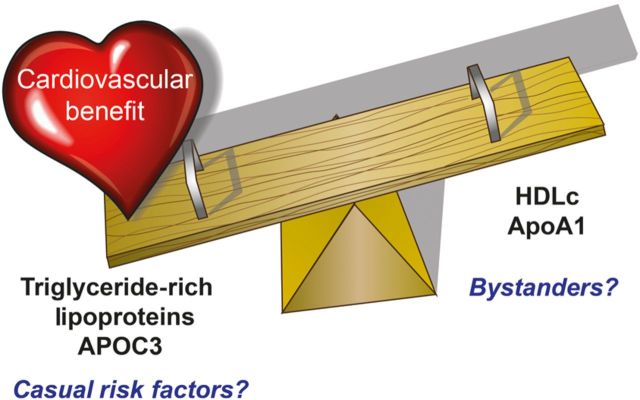
The high-density lipoprotein/triglyceride seesaw. High-density lipoprotein and triglycerides tend to vary inversely. Traditional thought has focused on the benefits of raising high-density lipoprotein and high-density lipoprotein as a protective factor for atherosclerosis. Triglycerides have received less attention as a causal risk factor as adjustment for high-density lipoprotein attenuates its association with risk. The new clinical and genetic data described in this commentary indicate that triglycerides and specifically the apolipoprotein constituent of many triglyceride-rich lipoproteins, apolipoprotein C3, may actually lie in the causal pathway for atherosclerosis. Thus, contrary to common belief, the current data suggest that we should focus more on triglyceride-rich lipoproteins as a target for cardiovascular risk reduction.
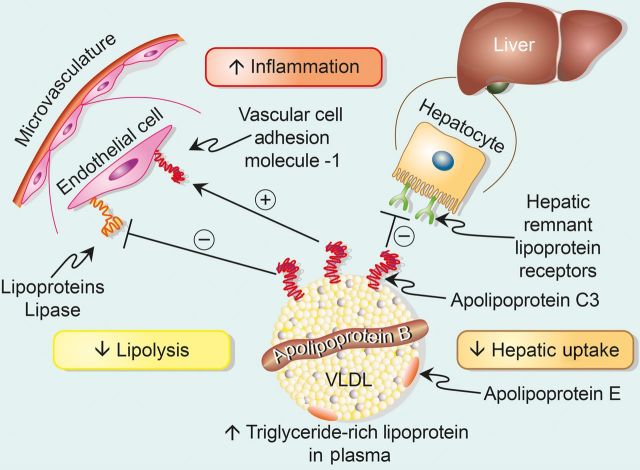
Apolipoprotein C3 regulates triglyceride-rich lipoprotein concentrations and can promote inflammation. The figure depicts very low-density lipoprotein as a prototypical triglyceride-rich lipoprotein. The single equatorial apolipoprotein B moiety encircles the particle. Apolipoprotein constituents associated with a sub-population of triglyceride-rich lipoproteins include apolipoprotein E (a key ligand for the low-density lipoprotein receptor) and apolipoprotein C3, implicated in atherogenesis by a variety of observational, in vitro, and genetic studies as discussed. In particular, apolipoprotein C3 can inhibit lipoprotein lipase preventing the catabolism of triglyceride-rich lipoproteins and raise their steady-state concentration due to a decrease in lipolysis. Apolipoprotein C3 can also inhibit the uptake of triglyceride-rich lipoprotein particles by remnant lipoprotein receptors, for example expressed on the surface of the hepatocyte as depicted. This inhibition of peripheral uptake of triglyceride-rich lipoproteins will conspire with the reduced lipolysis to increase further the concentration of triglyceride-rich lipoproteins in the plasma. In addition to these alterations in the metabolism of triglyceride-rich lipoproteins, apolipoprotein C3 may have direct proinflammatory effects, for example the induction of vascular cell adhesion molecule-1, an endothelial-leucocyte adhesion molecule implicated in recruitment of monocytes, the precursor of foam cells in the atherosclerotic plaque and contributors to ongoing inflammation implicated in plaque evolution and complication.
References
-
- Voight BF, Peloso GM, Orho-Melander M, Frikke-Schmidt R, Barbalic M, Jensen MK, Hindy G, Holm H, Ding EL, Johnson T, Schunkert H, Samani NJ, Clarke R, Hopewell JC, Thompson JF, Li M, Thorleifsson G, Newton-Cheh C, Musunuru K, Pirruccello JP, Saleheen D, Chen L, Stewart A, Schillert A, Thorsteinsdottir U, Thorgeirsson G, Anand S, Engert JC, Morgan T, Spertus J, Stoll M, Berger K, Martinelli N, Girelli D, McKeown PP, Patterson CC, Epstein SE, Devaney J, Burnett MS, Mooser V, Ripatti S, Surakka I, Nieminen MS, Sinisalo J, Lokki ML, Perola M, Havulinna A, de Faire U, Gigante B, Ingelsson E, Zeller T, Wild P, de Bakker PI, Klungel OH, Maitland-van der Zee AH, Peters BJ, de Boer A, Grobbee DE, Kamphuisen PW, Deneer VH, Elbers CC, Onland-Moret NC, Hofker MH, Wijmenga C, Verschuren WM, Boer JM, van der Schouw YT, Rasheed A, Frossard P, Demissie S, Willer C, Do R, Ordovas JM, Abecasis GR, Boehnke M, Mohlke KL, Daly MJ, Guiducci C, Burtt NP, Surti A, Gonzalez E, Purcell S, Gabriel S, Marrugat J, Peden J, Erdmann J, Diemert P, Willenborg C, Konig IR, Fischer M, Hengstenberg C, Ziegler A, Buysschaert I, Lambrechts D, Van de Werf F, Fox KA, El Mokhtari NE, Rubin D, Schrezenmeir J, Schreiber S, Schafer A, Danesh J, Blankenberg S, Roberts R, McPherson R, Watkins H, Hall AS, Overvad K, Rimm E, Boerwinkle E, Tybjaerg-Hansen A, Cupples LA, Reilly MP, Melander O, Mannucci PM, Ardissino D, Siscovick D, Elosua R, Stefansson K, O'Donnell CJ, Salomaa V, Rader DJ, Peltonen L, Schwartz SM, Altshuler D, Kathiresan S. Plasma HDL cholesterol and risk of myocardial infarction: a Mendelian randomisation study. Lancet 2012;380:572–580. - PMC - PubMed
-
- Sarwar N, Danesh J, Eiriksdottir G, Sigurdsson G, Wareham N, Bingham S, Boekholdt SM, Khaw KT, Gudnason V. Triglycerides and the risk of coronary heart disease: 10,158 incident cases among 262,525 participants in 29 Western prospective studies. Circulation 2007;115:450–458. - PubMed
-
- Sarwar N, Sandhu MS, Ricketts SL, Butterworth AS, Di Angelantonio E, Boekholdt SM, Ouwehand W, Watkins H, Samani NJ, Saleheen D, Lawlor D, Reilly MP, Hingorani AD, Talmud PJ, Danesh J. Triglyceride-mediated pathways and coronary disease: collaborative analysis of 101 studies. Lancet 2010;375:1634–1639. - PMC - PubMed
-
- Zilversmit DB. Atherogenic nature of triglycerides, postprandial lipidemia, and triglyceride-rich remnant lipoproteins. Clin Chem 1995;41:153–158. - PubMed
-
- Bansal S, Buring JE, Rifai N, Mora S, Sacks FM, Ridker PM. Fasting compared with nonfasting triglycerides and risk of cardiovascular events in women. JAMA 2007;298:309–316. - PubMed
Publication types
MeSH terms
Substances
Grants and funding
LinkOut - more resources
Full Text Sources
Other Literature Sources
