


Ancestral duplications and highly dynamic opsin gene evolution in percomorph fishes
- PMID: 25548152
- PMCID: PMC4321309
- DOI: 10.1073/pnas.1417803112
Ancestral duplications and highly dynamic opsin gene evolution in percomorph fishes
Abstract
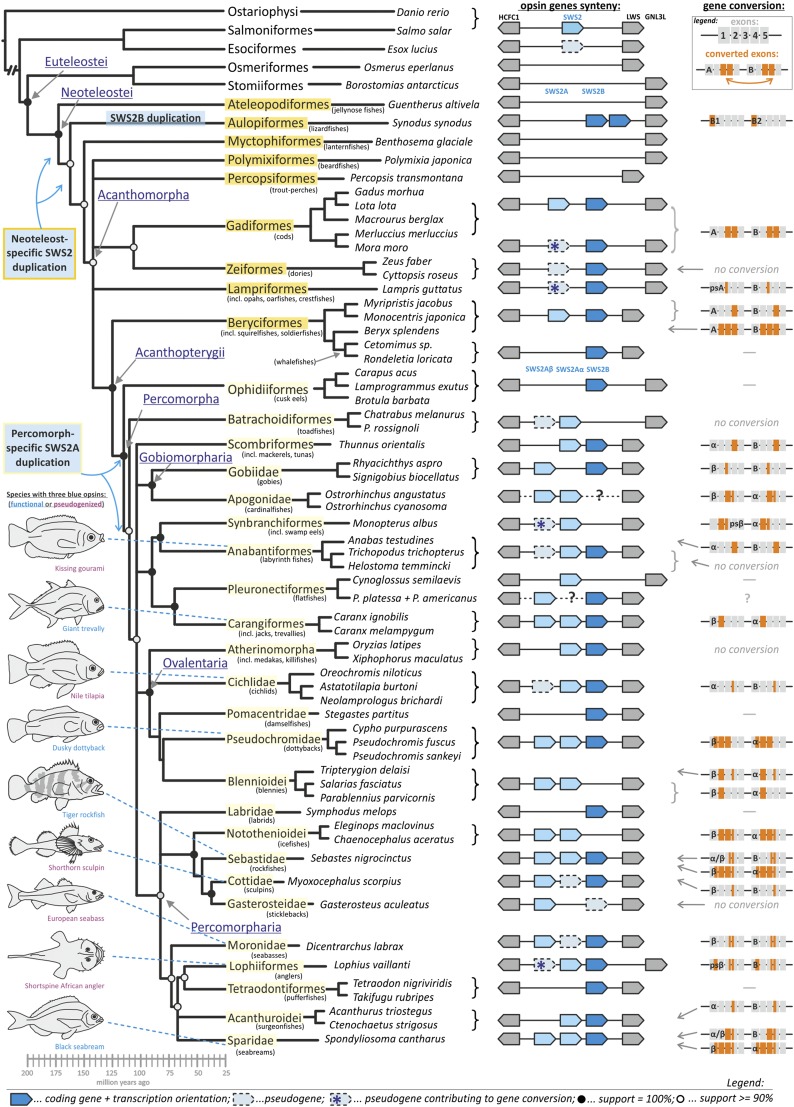
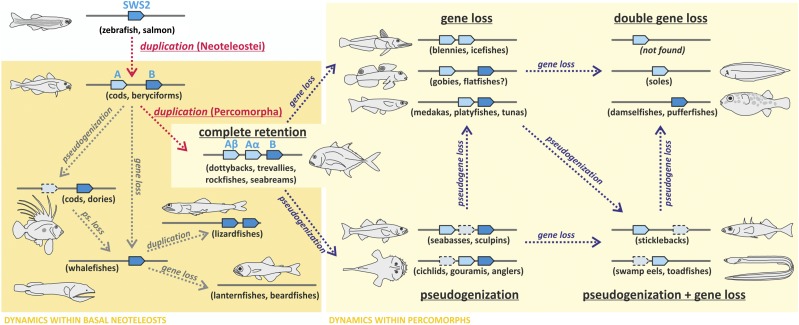
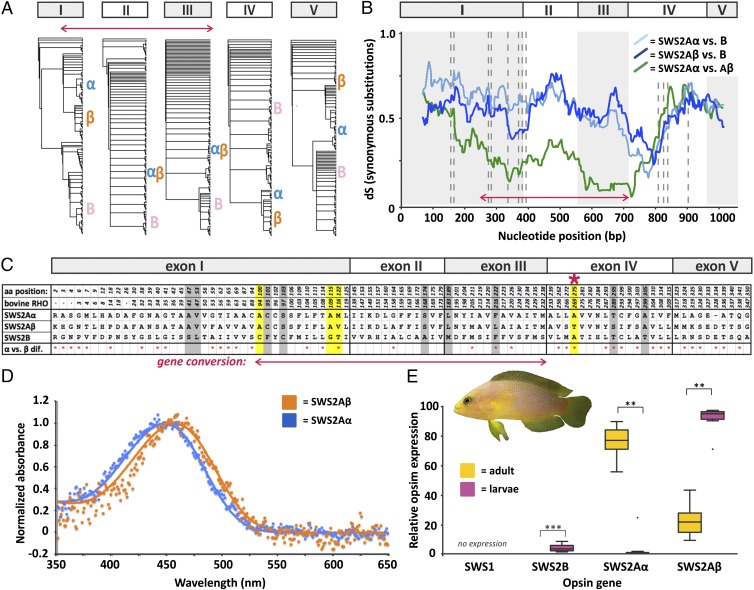
Single-gene and whole-genome duplications are important evolutionary mechanisms that contribute to biological diversification by launching new genetic raw material. For example, the evolution of animal vision is tightly linked to the expansion of the opsin gene family encoding light-absorbing visual pigments. In teleost fishes, the most species-rich vertebrate group, opsins are particularly diverse and key to the successful colonization of habitats ranging from the bioluminescence-biased but basically dark deep sea to clear mountain streams. In this study, we report a previously unnoticed duplication of the violet-blue short wavelength-sensitive 2 (SWS2) opsin, which coincides with the radiation of highly diverse percomorph fishes, permitting us to reinterpret the evolution of this gene family. The inspection of close to 100 fish genomes revealed that, triggered by frequent gene conversion between duplicates, the evolutionary history of SWS2 is rather complex and difficult to predict. Coincidentally, we also report potential cases of gene resurrection in vertebrate opsins, whereby pseudogenized genes were found to convert with their functional paralogs. We then identify multiple novel amino acid substitutions that are likely to have contributed to the adaptive differentiation between SWS2 copies. Finally, using the dusky dottyback Pseudochromis fuscus, we show that the newly discovered SWS2A duplicates can contribute to visual adaptation in two ways: by gaining sensitivities to different wavelengths of light and by being differentially expressed between ontogenetic stages. Thus, our study highlights the importance of comparative approaches in gaining a comprehensive view of the dynamics underlying gene family evolution and ultimately, animal diversification.
Keywords: Percomorpha; SWS2; gene conversion; gene duplication; gene resurrection.
Conflict of interest statement
The authors declare no conflict of interest.
Figures
Comment in
-
Seeing is believing: Dynamic evolution of gene families.Proc Natl Acad Sci U S A. 2015 Feb 3;112(5):1252-3. doi: 10.1073/pnas.1423685112. Epub 2015 Jan 26. Proc Natl Acad Sci U S A. 2015. PMID: 25624486 Free PMC article. No abstract available.
References
-
- Taylor JS, Raes J. Duplication and divergence: The evolution of new genes and old ideas. Annu Rev Genet. 2004;38:615–643. - PubMed
-
- Ohno S. Evolution by Gene Duplication. Springer; Heidelberg: 1970.
-
- Wagner GP, Pavlicev M, Cheverud JM. The road to modularity. Nat Rev Genet. 2007;8(12):921–931. - PubMed
-
- Wolfe KH, Shields DC. Molecular evidence for an ancient duplication of the entire yeast genome. Nature. 1997;387(6634):708–713. - PubMed
Publication types
MeSH terms
Substances
Associated data
- Actions
- Actions
- Actions
- Actions
- Actions
- Actions
- Actions
- Actions
- Actions
- Actions
- Actions
- Actions
- Actions
- Actions
- Actions
- Actions
- Actions
- Actions
- Actions
- Actions
- Actions
- Actions
- Actions
- Actions
- Actions
- Actions
- Actions
- Actions
- Actions
- Actions
- Actions
- Actions
- Actions
- Actions
- Actions
- Actions
- Actions
- Actions
- Actions
- Actions
- Actions
- Actions
- Actions
- Actions
- Actions
- Actions
- Actions
- Actions
- Actions
- Actions
- Actions
- Actions
- Actions
- Actions
- Actions
- Actions
- Actions
- Actions
- Actions
- Actions
- Actions
- Actions
- Actions
- Actions
- Actions
- Actions
- Actions
- Actions
- Actions
- Actions
- Actions
- Actions
- Actions
- Actions
- Actions
- Actions
- Actions
- Actions
- Actions
- Actions
- Actions
- Actions
- Actions
- Actions
- Actions
- Actions
- Actions
- Actions
- Actions
- Actions
- Actions
- Actions
- Actions
- Actions
- Actions
- Actions
- Actions
- Actions
- Actions
- Actions
- Actions
- Actions
- Actions
- Actions
Grants and funding
LinkOut - more resources
Full Text Sources
Other Literature Sources
