


doi: 10.1155/2014/239641.
Epub 2014 Dec 4.
Identification of new metabolites of bacterial transformation of indole by gas chromatography-mass spectrometry and high performance liquid chromatography
Affiliations
- PMID: 25548566
- PMCID: PMC4274814
- DOI: 10.1155/2014/239641
Item in Clipboard
Identification of new metabolites of bacterial transformation of indole by gas chromatography-mass spectrometry and high performance liquid chromatography
Int J Anal Chem.
2014.
Abstract
Arthrobacter sp. SPG transformed indole completely in the presence of an additional carbon source. High performance liquid chromatography and gas chromatography-mass spectrometry detected indole-3-acetic acid, indole-3-glyoxylic acid, and indole-3-aldehyde as biotransformation products. This is the first report of the formation of indole-3-acetic acid, indole-3-glyoxylic acid, and indole-3-aldehyde from indole by any bacterium.
Figures
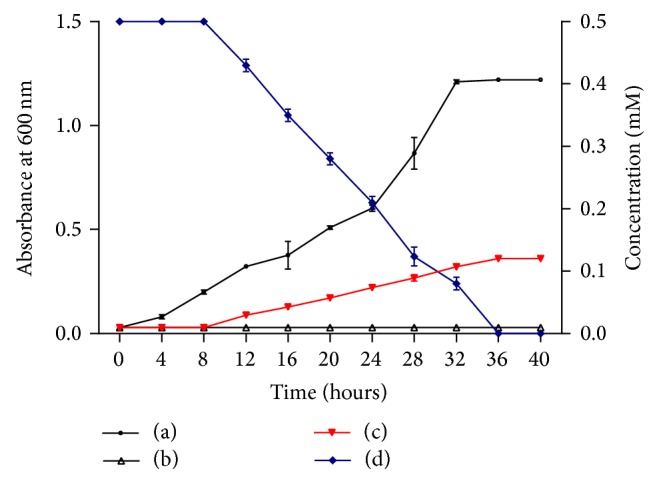
Growth of Arthrobacter sp. SPG in (a) minimal medium containing 10 mM sodium succinate, (b) minimal medium containing 0.5 mM indole, and (c) minimal medium containing both 10 mM sodium succinate and 0.5 mM indole. (d) Indole depletion by Arthrobacter sp. SPG.
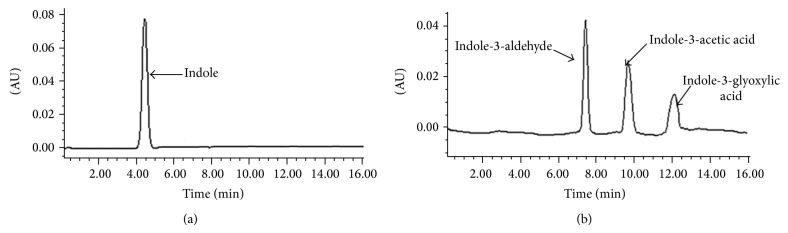
HPLC analysis of samples of indole biotransformation by Arthrobacter sp. SPG. (a) 8 h sample showing only peak for indole and (b) 36 h sample showing complete bacterial transformation of indole into indole-3-acetic acid, indole-3-glyoxylic acid, and indole-3-aldehyde.
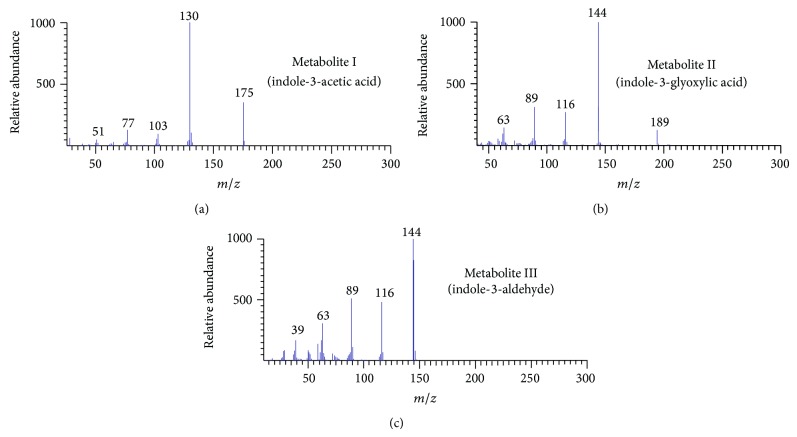
GC-MS analysis showing mass spectrum of metabolite I (indole-3-acetic acid, (a)), metabolite II (indole-3-glyoxylic acid, (b)), and metabolite III (indole-3-aldehyde, (c)).
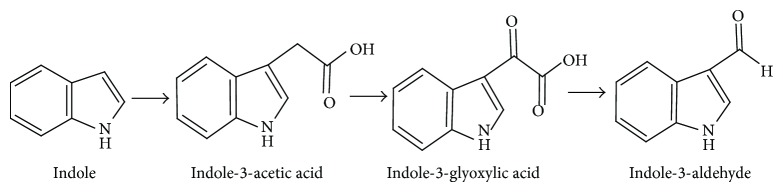
Proposed pathway of indole transformation for Arthrobacter sp. SPG.
References
-
- Qu Y., Xu B., Zhang X., Ma Q., Zhou H., Kong C., Zhang Z., Zhou J. Biotransformation of indole by whole cells of recombinant biphenyl dioxygenase and biphenyl-2,3-dihydrodiol-2,3-dehydrogenase. Biochemical Engineering Journal. 2013;72:54–60. doi: 10.1016/j.bej.2012.12.021. - DOI
-
- El-Shagi H., Schulte U., Zenk M. H. Specific inhibition of anthraquinone formation by amino compounds in Morinda cell cultures. Naturwissenschaften. 1984;71(5):267. doi: 10.1007/BF00441342. - DOI
-
- Sakamoto Y., Uchida M., Ichibara K. The bacterial decomposition of indole. I. Studies on its metabolic pathway by successive adaptation. Medical Journal of Osaka University. 1953;3:477–486.
LinkOut - more resources
Full Text Sources
Other Literature Sources
