


Etiology of bicuspid aortic valve disease: Focus on hemodynamics
- PMID: 25548612
- PMCID: PMC4278157
- DOI: 10.4330/wjc.v6.i12.1227
Etiology of bicuspid aortic valve disease: Focus on hemodynamics
Abstract
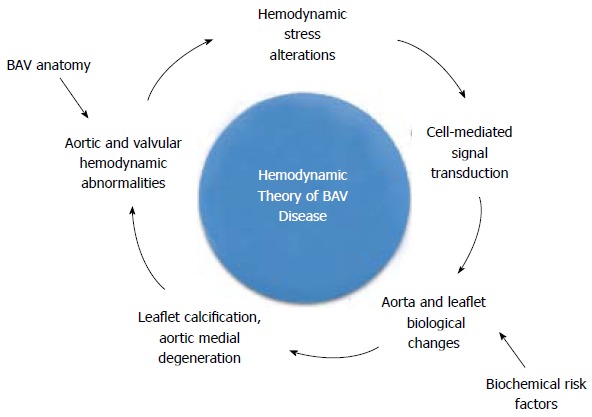
The bicuspid aortic valve (BAV) is the most common form of inheritable cardiac defect. Although this abnormality may still achieve normal valvular function, it is often associated with secondary valvular and aortic complications such as calcific aortic valve disease and aortic dilation. The clinical significance and economic burden of BAV disease justify the need for improved clinical guidelines and more robust therapeutic modalities, which address the root-cause of those pathologies. Unfortunately, the etiology of BAV valvulopathy and aortopathy is still a debated issue. While the BAV anatomy and its secondary complications have been linked historically to a common genetic root, recent advances in medical imaging have demonstrated the existence of altered hemodynamics near BAV leaflets prone to calcification and BAV aortic regions vulnerable to dilation. The abnormal mechanical stresses imposed by the BAV on its leaflets and on the aortic wall could be transduced into cell-mediated processes, leading ultimately to valvular calcification and aortic medial degeneration. Despite increasing evidence for this hemodynamic etiology, the demonstration of the involvement of mechanical abnormalities in the pathogenesis of BAV disease requires the investigation of causality between the blood flow environment imposed on the leaflets and the aortic wall and the local biology, which has been lacking to date. This editorial discusses the different hypothetical etiologies of BAV disease with a particular focus on the most recent advances in cardiovascular imaging, flow characterization techniques and tissue culture methodologies that have provided new evidence in support of the hemodynamic theory.
Keywords: Aortopathy; Bicuspid aortic valve; Hemodynamics; Shear stress; Valvulopathy.
Figures
References
-
- Roberts WC. The congenitally bicuspid aortic valve. A study of 85 autopsy cases. Am J Cardiol. 1970;26:72–83. - PubMed
-
- Hoffman JI, Kaplan S. The incidence of congenital heart disease. J Am Coll Cardiol. 2002;39:1890–1900. - PubMed
-
- Roberts WC, Ko JM. Frequency by decades of unicuspid, bicuspid, and tricuspid aortic valves in adults having isolated aortic valve replacement for aortic stenosis, with or without associated aortic regurgitation. Circulation. 2005;111:920–925. - PubMed
-
- Sabet HY, Edwards WD, Tazelaar HD, Daly RC. Congenitally bicuspid aortic valves: a surgical pathology study of 542 cases (1991 through 1996) and a literature review of 2,715 additional cases. Mayo Clin Proc. 1999;74:14–26. - PubMed
LinkOut - more resources
Full Text Sources
Other Literature Sources
