


Potassium channel antagonists 4-aminopyridine and the T-butyl carbamate derivative of 4-aminopyridine improve hind limb function in chronically non-ambulatory dogs; a blinded, placebo-controlled trial
- PMID: 25551385
- PMCID: PMC4281252
- DOI: 10.1371/journal.pone.0116139
Potassium channel antagonists 4-aminopyridine and the T-butyl carbamate derivative of 4-aminopyridine improve hind limb function in chronically non-ambulatory dogs; a blinded, placebo-controlled trial
Abstract
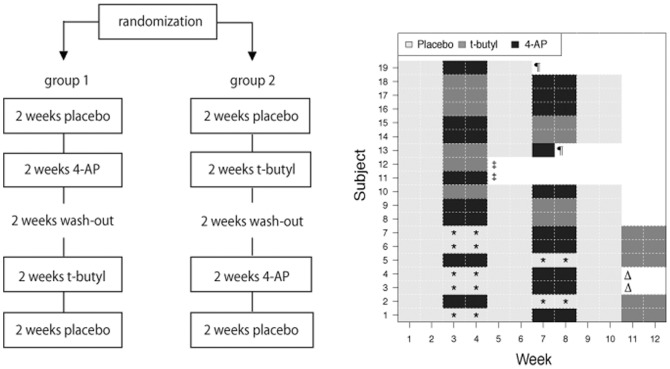
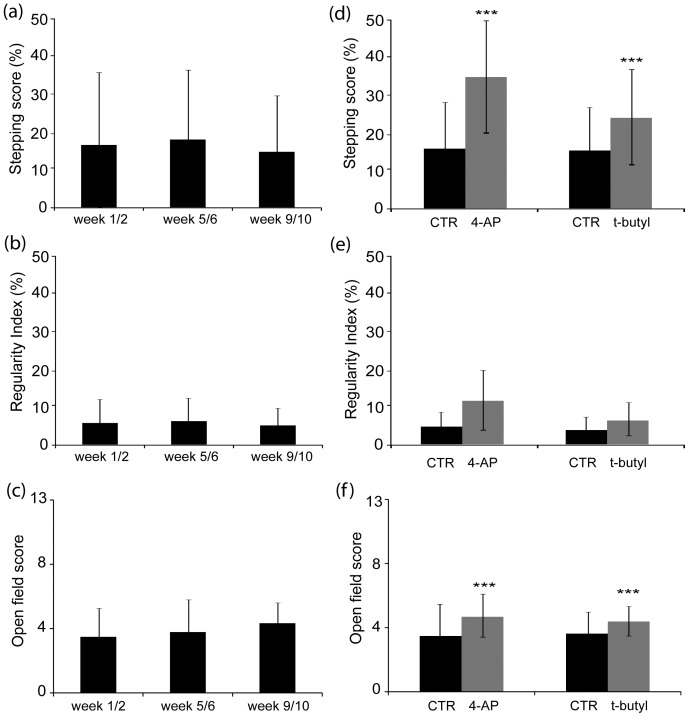
4-Aminopyridine (4-AP) blocks voltage gated potassium channels, restoring conduction to demyelinated axons and improving function in demyelinating conditions, but its use is associated with adverse effects and benefit in spinal cord injury is limited. Derivatives of 4-AP have been developed to improve clinical efficacy while reducing toxicity. We compared the therapeutic effects of orally administered 4-AP and its t-butyl carbamate derivative (t-butyl) with placebo in dogs that had suffered an acute spinal cord injury that left them chronically paralyzed. Nineteen dogs were entered into the trial, conducted in two-week treatment blocks starting with placebo, followed by random assignment to 4-AP or t-butyl, a washout and then the opposite medication followed by placebo. Investigators and owners were blinded to treatment group. Primary outcome measures included open field gait score (OFS), and treadmill based stepping score and regularity index, with additional secondary measures also considered. Thirteen of 19 dogs completed the protocol. Two were euthanized due to unrelated heath problems, two developed side effects and two were unable to complete for unrelated reasons. Dogs showed significant improvement in supported stepping score (from 17.39 to 37.24% with 4-AP; 16.85 to 29.18% with t-butyl p<0.0001) and OFS (from 3.63 to 4.73 with 4-AP; 3.78 to 4.45 with t-butyl, p = 0.005). Response was individually variable and most dramatic in three dogs that were able to walk without support with treatment. No significant difference was found between 4-AP and t-butyl. No adverse effects were reported with t-butyl but gastrointestinal upset and seizures were observed in two dogs with 4-AP. In conclusion, both 4-AP and t-butyl significantly improved supported stepping ability in dogs with chronic spinal cord injury with no adverse effects noted with t-butyl. Drug response varied widely between individuals, highlighting the need to understand the factors that influence canine and human patients' response to therapy.
Conflict of interest statement
Figures
References
-
- Kakulas BA (1999) A review of the neuropathology of human spinal cord injury with emphasis on special features. J Spinal Cord Med 22:119–124. - PubMed
-
- Blight AR (1985) Delayed demyelination and macrophage invasion: a candidate for secondary cell damage in spinal cord injury. Cent Nerv Syst Trauma 2(4):299–315. - PubMed
-
- Totoiu MO, Keirstead HS (2005) Spinal cord injury is accompanied by chronic progressive demyelination. J Comp Neurol 13 486(4):373–83. - PubMed
-
- Norenberg MD, Smith J, Marcillo A (2004) The pathology of human spinal cord injury: defining the problems. J Neurotrauma 21:429–440. - PubMed
-
- Guest JD, Hiester ED, Bunge RP (2005) Demyelination and Schwann cell responses adjacent to injury epicenter cavities following chronic human spinal cord injury. Exp Neurol 192:384–393. - PubMed
Publication types
MeSH terms
Substances
LinkOut - more resources
Full Text Sources
Other Literature Sources
Medical
