The amyloidogenic V122I transthyretin variant in elderly black Americans
- PMID: 25551524
- PMCID: PMC4382209
- DOI: 10.1056/NEJMoa1404852
The amyloidogenic V122I transthyretin variant in elderly black Americans
Abstract
Background: Approximately 4% of black Americans carry a valine-to-isoleucine substitution (V122I) in the transthyretin protein, which has been associated with late-onset restrictive amyloid cardiomyopathy and increased risks of death and heart failure.
Methods: We determined genotype status for the transthyretin gene (TTR) in 3856 black participants in the Atherosclerosis Risk in Communities study and assessed clinical profiles, mortality, and the risk of incident heart failure in V122I TTR variant carriers (124 participants [3%]) versus noncarriers (3732 participants). Cardiac structure and function and features suggestive of cardiac amyloidosis were assessed in participants who underwent echocardiography during visit 5 (2011 to 2013), when they were older than 65 years of age.
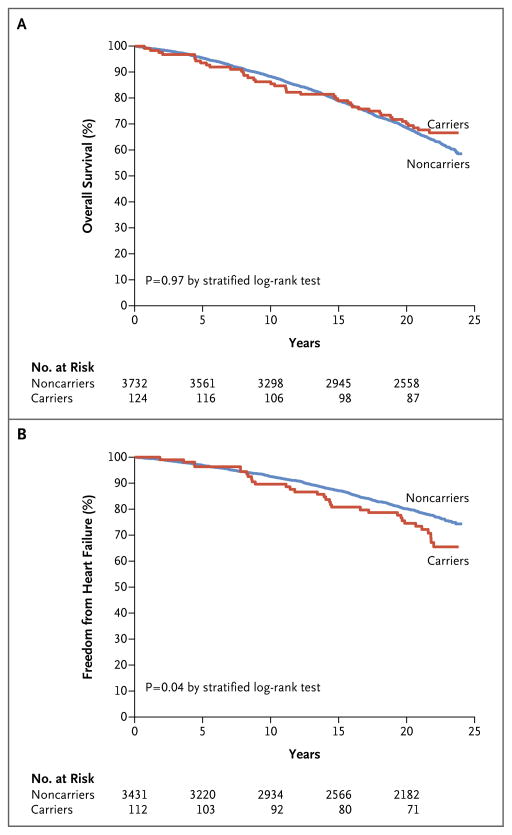
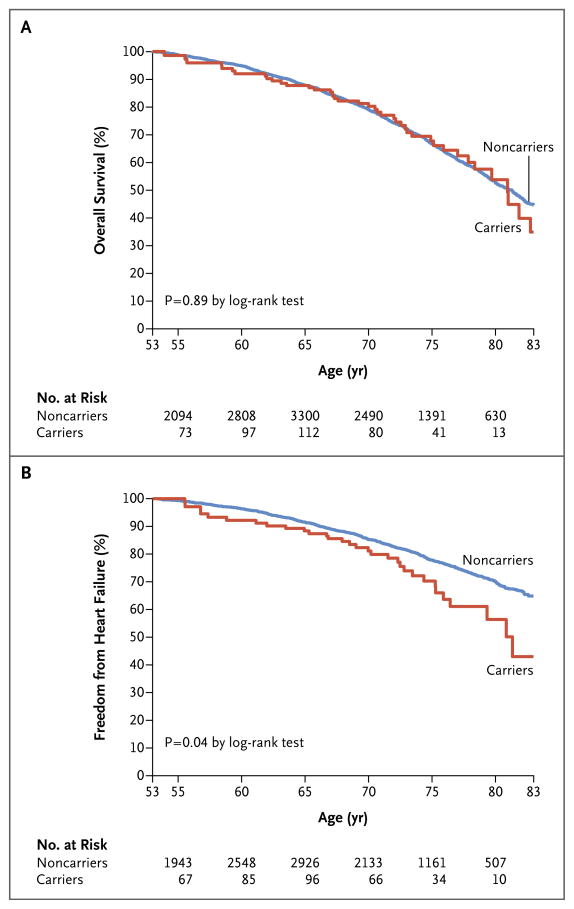
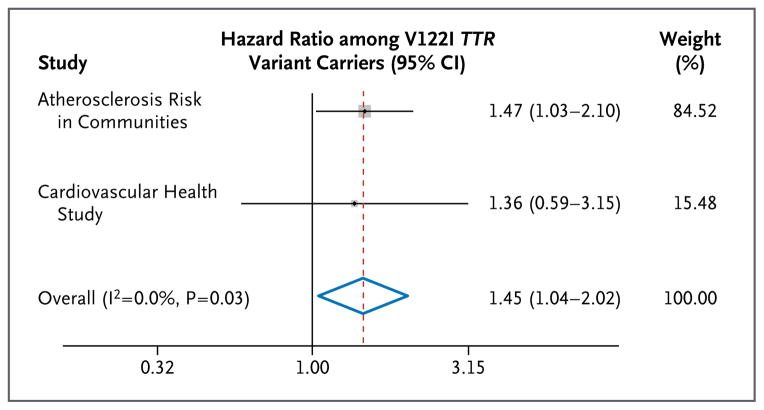
Results: After 21.5 years of follow-up, we did not detect a significant difference in mortality between carriers (41 deaths, 33%) and noncarriers (1382 deaths, 37%; age- and sex-stratified hazard ratio among carriers, 0.99; 95% confidence interval [CI], 0.73 to 1.36; P=0.97). The TTR variant was associated with an increased risk of incident heart failure (age- and sex-stratified hazard ratio, 1.47; 95% CI, 1.03 to 2.10; P=0.04). On echocardiography at visit 5, carriers (46 participants) had worse systolic and diastolic function, as well as a higher level of N-terminal pro-brain natriuretic peptide, than noncarriers (1194 participants), although carriers had a low prevalence (7%) of overt manifestations of amyloid cardiomyopathy.
Conclusions: We did not detect a significant difference in mortality between V122I TTR allele carriers and noncarriers, a finding that contrasts with prior observations; however, the risk of heart failure was increased among carriers. The prevalence of overt cardiac abnormalities among V122I TTR carriers was low. (Funded by the National Heart, Lung, and Blood Institute and others.).
Figures
Comment in
-
Genetics: TTR and HF in black Americans.Nat Rev Cardiol. 2015 Mar;12(3):130. doi: 10.1038/nrcardio.2015.1. Epub 2015 Jan 20. Nat Rev Cardiol. 2015. PMID: 25601349 No abstract available.
-
V122I transthyretin variant in elderly black Americans.N Engl J Med. 2015 Apr 30;372(18):1769. doi: 10.1056/NEJMc1503222. N Engl J Med. 2015. PMID: 25923562 No abstract available.
-
V122I transthyretin variant in elderly black Americans.N Engl J Med. 2015 Apr 30;372(18):1768. doi: 10.1056/NEJMc1503222. N Engl J Med. 2015. PMID: 25923563 No abstract available.
-
V122I transthyretin variant in elderly black Americans.N Engl J Med. 2015 Apr 30;372(18):1769. doi: 10.1056/NEJMc1503222. N Engl J Med. 2015. PMID: 25923564 No abstract available.
References
-
- Falk RH, Dubrey SW. Amyloid heart disease. Prog Cardiovasc Dis. 2010;52:347–61. Erratum, Prog Cardiovasc Dis 2010;52:445–7. - PubMed
-
- Ando Y, Nakamura M, Araki S. Transthyretin-related familial amyloidotic polyneuropathy. Arch Neurol. 2005;62:1057–62. - PubMed
-
- Jacobson DR, Pastore RD, Yaghoubian R, et al. Variant-sequence transthyretin (isoleucine 122) in late-onset cardiac amyloidosis in black Americans. N Engl J Med. 1997;336:466–73. - PubMed
-
- Rapezzi C, Quarta CC, Obici L, et al. Disease profile and differential diagnosis of hereditary transthyretin-related amyloidosis with exclusively cardiac phenotype: an Italian perspective. Eur Heart J. 2013;34:520–8. - PubMed
-
- Rowczenio D, Wechalekar A. Mutations in hereditary amyloidosis. ( http://www.amyloidosismutations.com/mutattr.php) - PubMed
Publication types
MeSH terms
Substances
Grants and funding
- HHSN268201100009I/HL/NHLBI NIH HHS/United States
- HHSN268201100010C/HL/NHLBI NIH HHS/United States
- HHSN268201100008C/HL/NHLBI NIH HHS/United States
- HC-11-08/HC/NHLBI NIH HHS/United States
- HHSN268201100007C/HL/NHLBI NIH HHS/United States
- HHSN268201100011I/HL/NHLBI NIH HHS/United States
- R01 AG19259/AG/NIA NIH HHS/United States
- HHSN268201100006C/HL/NHLBI NIH HHS/United States
- HHSN268201100005I/HL/NHLBI NIH HHS/United States
- P30 AG021332/AG/NIA NIH HHS/United States
- HHSN268201100012C/HL/NHLBI NIH HHS/United States
- K08 HL116792/HL/NHLBI NIH HHS/United States
- HHSN268201100005G/HL/NHLBI NIH HHS/United States
- HHSN268201100008I/HL/NHLBI NIH HHS/United States
- R01 AG018915/AG/NIA NIH HHS/United States
- HHSN268201100011C/HL/NHLBI NIH HHS/United States
- HHSN268201100009C/HL/NHLBI NIH HHS/United States
- HHSN268201100005C/HL/NHLBI NIH HHS/United States
- HHSN268201100007I/HL/NHLBI NIH HHS/United States
- R01 AG019259/AG/NIA NIH HHS/United States
LinkOut - more resources
Full Text Sources
Other Literature Sources
Medical
Research Materials
Miscellaneous