


How long does biomedical research take? Studying the time taken between biomedical and health research and its translation into products, policy, and practice
- PMID: 25552353
- PMCID: PMC4297458
- DOI: 10.1186/1478-4505-13-1
How long does biomedical research take? Studying the time taken between biomedical and health research and its translation into products, policy, and practice
Abstract
Background: The time taken, or 'time lags', between biomedical/health research and its translation into health improvements is receiving growing attention. Reducing time lags should increase rates of return to such research. However, ways to measure time lags are under-developed, with little attention on where time lags arise within overall timelines. The process marker model has been proposed as a better way forward than the current focus on an increasingly complex series of translation 'gaps'. Starting from that model, we aimed to develop better methods to measure and understand time lags and develop ways to identify policy options and produce recommendations for future studies.
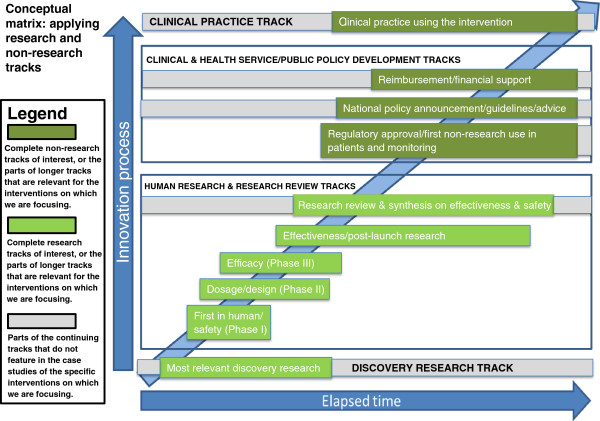
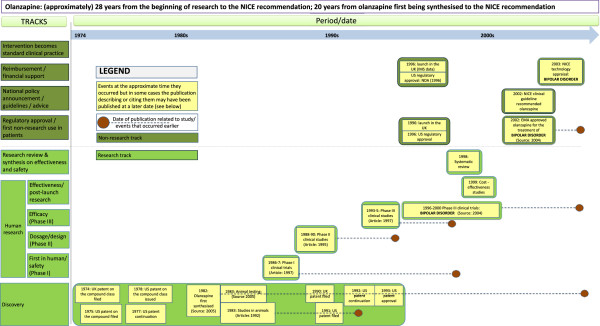
Methods: Following reviews of the literature on time lags and of relevant policy documents, we developed a new approach to conduct case studies of time lags. We built on the process marker model, including developing a matrix with a series of overlapping tracks to allow us to present and measure elements within any overall time lag. We identified a reduced number of key markers or calibration points and tested our new approach in seven case studies of research leading to interventions in cardiovascular disease and mental health. Finally, we analysed the data to address our study's key aims.
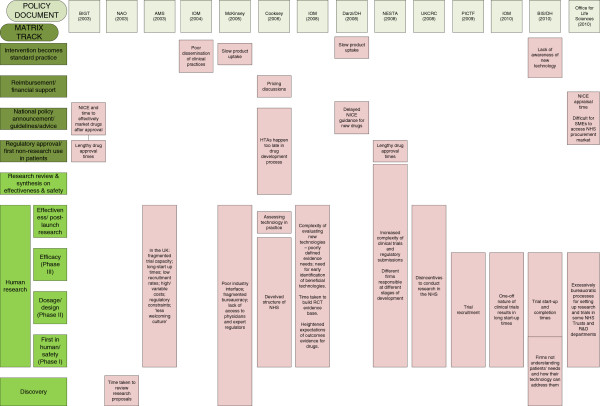
Results: The literature review illustrated the lack of agreement on starting points for measuring time lags. We mapped points from policy documents onto our matrix and thus highlighted key areas of concern, for example around delays before new therapies become widely available. Our seven completed case studies demonstrate we have made considerable progress in developing methods to measure and understand time lags. The matrix of overlapping tracks of activity in the research and implementation processes facilitated analysis of time lags along each track, and at the cross-over points where the next track started. We identified some factors that speed up translation through the actions of companies, researchers, funders, policymakers, and regulators. Recommendations for further work are built on progress made, limitations identified and revised terminology.
Conclusions: Our advances identify complexities, provide a firm basis for further methodological work along and between tracks, and begin to indicate potential ways of reducing lags.
Figures
References
-
- Buxton M, Hanney S, Morris S, Sundmacher L, Mestre-Ferrandiz J, Garau M, Sussex J, Grant J, Ismail S, Nason E, Wooding S. Medical Research: What’s it Worth? London: Medical Research Council, Wellcome Trust and Academy of Medical Sciences; 2008.
-
- Rogers E. Diffusion of Innovations. 4. New York, NY: The Free Press; 1995.
Publication types
MeSH terms
Grants and funding
LinkOut - more resources
Full Text Sources
Other Literature Sources
