Review
. 2015 Feb:32:21-7.
doi: 10.1016/j.coi.2014.12.002. Epub 2014 Dec 29.

C-type lectins in immunity: recent developments

Affiliations
Review

C-type lectins in immunity: recent developments

Ivy M Dambuza et al. Curr Opin Immunol. 2015 Feb.

Abstract

C-type lectin receptors (CLRs) comprise a large superfamily of proteins, which recognise a diverse range of ligands, and are defined by the presence of at least one C-type lectin-like domain (CTLD). Of particular interest are the single extracellular CTLD-containing receptors of the 'Dectin-1' and 'Dectin-2' clusters, which associate with signalling adaptors or possess integral intracellular signalling domains. These CLRs have traditionally been associated with the recognition of fungi, but recent discoveries have revealed diverse and unexpected functions. In this review, we describe their newly identified roles in anti-microbial host defence, homeostasis, autoimmunity, allergy and their functions in the recognition and response to dead and cancerous cells.


Figures

Figure 1
Figure 1
Organisation and orientation of transcription of the genes in the human and mouse ‘Dectin-1’ and ‘Dectin-2’ clusters. ‘Dectin-1’ cluster is in the centromeric part of the human NK gene complex in chromosome 12 (Chr12) and the corresponding region in the mouse is in chromosome 6 (Chr6), while the ‘Dectin-2’ cluster is encoded at the telometric end of the NK gene complex. Linkage, relative size and orientation of the genes are depicted.
Figure 2
Figure 2
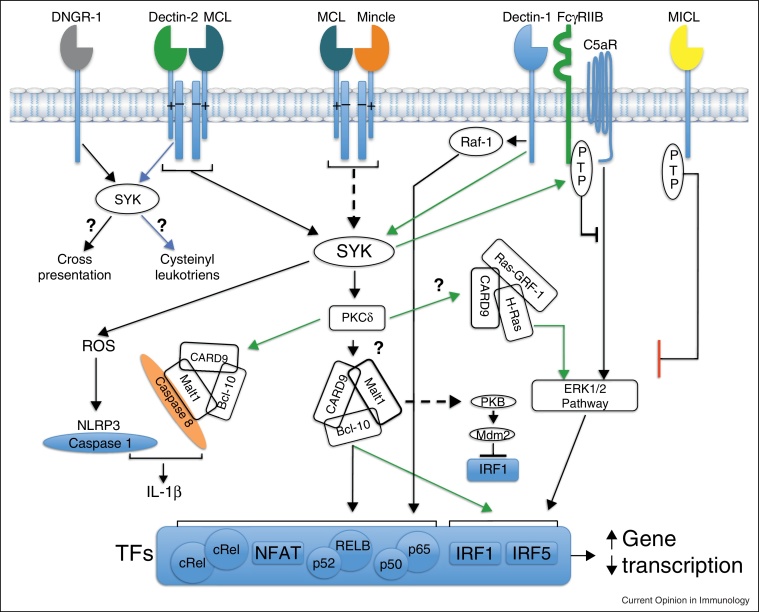
Schematic representation of selected signal networks induced by various CLRs of the ‘Dectin-1’ and ‘Dectin-2’ clusters. Sensing of microbes by activatory CLRs such as Dectin-1, Dectin-2, Mincle and MCL mediate inflammation and immunity or antigen cross-presentation through activation of Syk-dependent and Syk-independent pathways (like the one mediated by Raf-1). Downstream signals from Syk leads to production of ROS and transcription factor activation by CARD9–Bcl-10–Malt-1 and more recently, CARD9–H-Ras–Ras-GRF1 complex. In some instances, activation of Syk by activatory CLRs like Dectin-1 can attenuate inflammatory signals by activating protein tyrosine phosphatases (PTP: SHIP, SHP-1 and SHP-2), which are recruited to inhibitory receptors such as MICL and FcγRIIB. Signals emanating from specific CLRs are depicted: Dectin-1 (green arrows), Dectin-2 (blue arrows) and Mincle (dashed black arrows). Question marks depict unknown or unclear pathways.

References

    1. Drickamer K., Fadden A.J. Genomic analysis of C-type lectins. Biochem Soc Symp. 2002:59–72. - PubMed
    1. Zelensky A.N., Gready J.E. The C-type lectin-like domain superfamily. FEBS J. 2005;272:6179–6217. - PubMed
    1. Kerrigan A.M., Brown G.D. Syk-coupled C-type lectins in immunity. Trends Immunol. 2011;32:151–156. - PMC - PubMed
    1. Sancho D., Reis e Sousa C. Signaling by myeloid C-type lectin receptors in immunity and homeostasis. Annu Rev Immunol. 2012;30:491–529. - PMC - PubMed
    2. Comprehensive review of myeloid CLRs and the roles they play in immunity, pathology and homeostasis.

    1. Redelinghuys P., Brown G.D. Inhibitory C-type lectin receptors in myeloid cells. Immunol Lett. 2011;136:1–12. - PMC - PubMed

Publication types

MeSH terms