


Declines in inflammation predict greater white matter microstructure in older adults
- PMID: 25554492
- PMCID: PMC4339188
- DOI: 10.1016/j.neurobiolaging.2014.11.004
Declines in inflammation predict greater white matter microstructure in older adults
Abstract
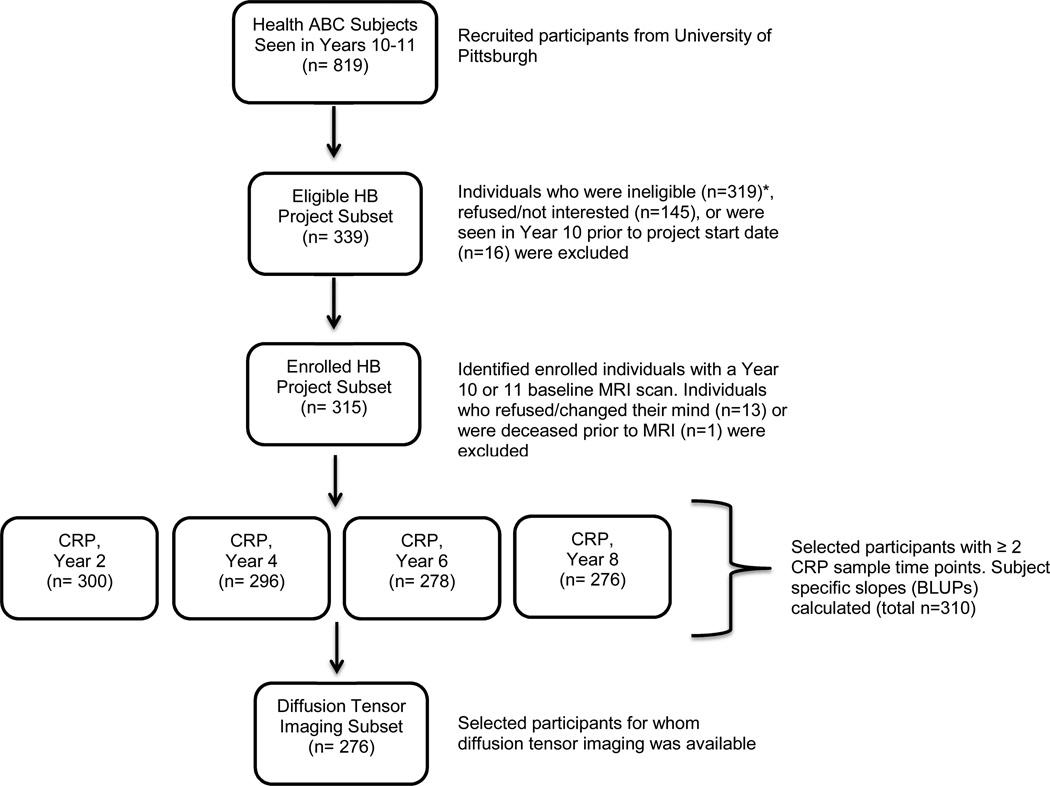
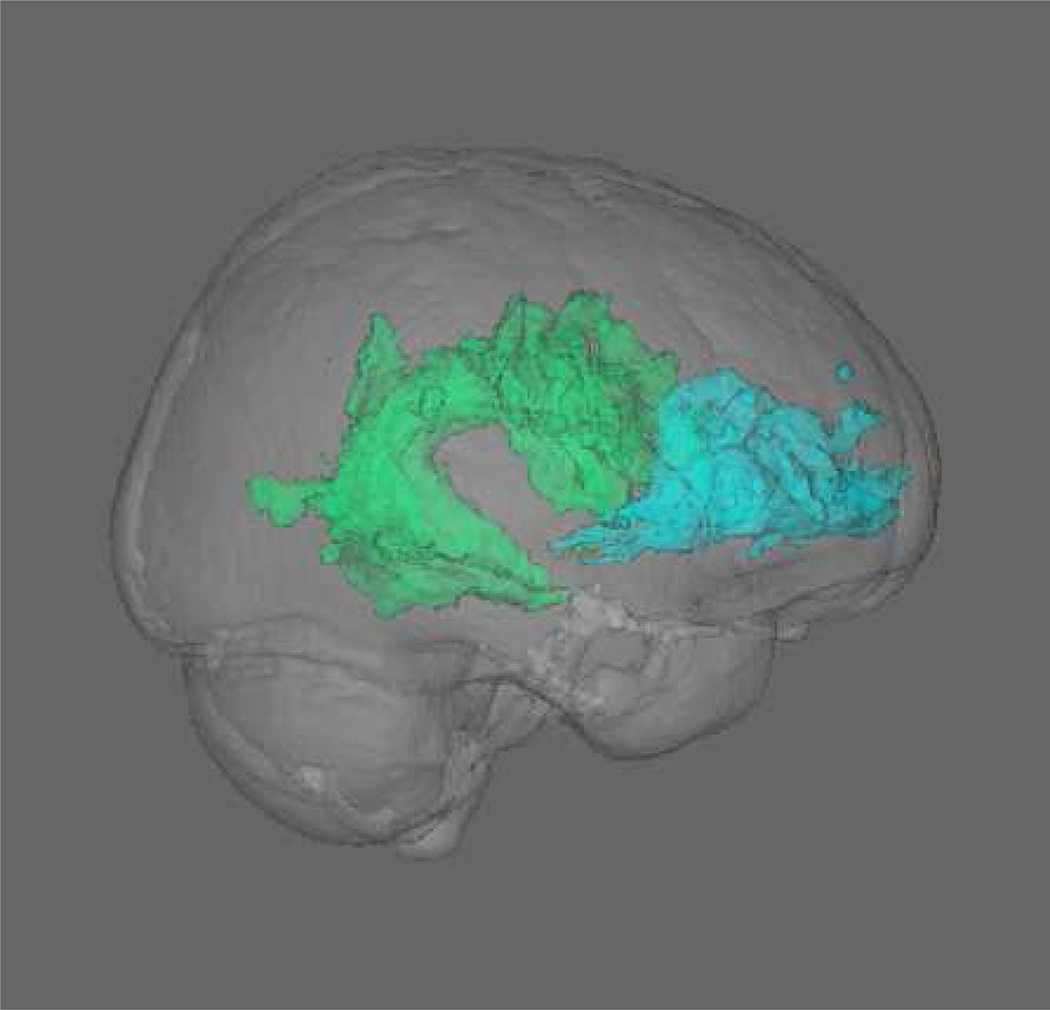
Protracted systemic inflammation has been associated with adverse effects on cognition and brain structure and may accelerate neurodegenerative disease processes; however, it is less clear whether changes in inflammation are associated with brain structure. We studied 276 black and white older adults (mean age = 83 years at time of imaging) enrolled in a prospective study of aging. Inflammation (measured with c-reactive protein, CRP) was assessed repeatedly over 6 years (i.e., year 2, 4, 6, and 8). Brain magnetic resonance imaging (MRIs) were obtained at years 10-11 with diffusion tensor imaging; regions of interest included late-myelinating areas vulnerable to aging, including frontal-parietal (superior longitudinal fasciculus [SLF]-dorsal) and temporal (SLF-temporal; uncinate) white matter tracts. Mean CRP values significantly declined (t = -5.54, p < 0.0001) over 6 years, and subject-specific slopes (best linear unbiased predictors of slopes) all showed a decline (mean = -0.57, standard deviation = 0.53) for our participant sample. More than 50% of study participants were still in the moderate to high cardiovascular risk range based on CRP values at year 8. After controlling for demographics, vascular risk factors and MRI white matter hyperintensities, larger decreases in CRP values over time were significantly associated with higher fractional anisotropy in the SLF-dorsal (beta = -0.0052, standard error [SE] = 0.003; 95% confidence interval [CI] = -0.0103 to -0.0025, p = 0.04), SLF-temporal (beta = -0.0109, SE = 0.004; 95% CI = -0.0189 to -0.0029, p = 0.008), and uncinate (beta = -0.0067, SE = 0.003; 95% CI = -0.0132 to -0.0001, p = 0.05) fasciculi. Results suggest that in a prospective cohort of older individuals, faster declines in inflammation over time are related to indicators of white matter health, even after accounting for vascular risk factors.
Keywords: CRP; Diffusion tensor imaging; Longitudinal; Pro-inflammatory.
Copyright © 2015 Elsevier Inc. All rights reserved.
Conflict of interest statement
The authors have no conflicts of interest or relevant disclosures.
Figures
References
-
- Andersson JLR, Jenkinson M, Smith S. Non-linear optimisation. 2007
-
- Ballou SP, Lozanski FB, Hodder S, Rzewnicki DL, Mion LC, Sipe JD, Ford AB, Kushner I. Quantitative and qualitative alterations of acute-phase proteins in healthy elderly persons. Age Ageing. 1996;25:224–230. - PubMed
-
- Basser PJ, Mattiello J, LeBihan D. Estimation of the effective self-diffusion tensor from the NMR spin echo. J. Magn. Reson. B. 1994;103:247–254. - PubMed
-
- Bermejo P, Martin-Aragon S, Benedi J, Susin C, Felici E, Gil P, Ribera JM, Villar AM. Differences of peripheral inflammatory markers between mild cognitive impairment and Alzheimer's disease. 2008;117:198–202. - PubMed
Publication types
MeSH terms
Substances
Grants and funding
- P30 AG024827/AG/NIA NIH HHS/United States
- R01-AG028050/AG/NIA NIH HHS/United States
- N01-AG-6-2101/AG/NIA NIH HHS/United States
- N01 AG062101/AG/NIA NIH HHS/United States
- R01 AG028288/AG/NIA NIH HHS/United States
- N01-AG-6-2103/AG/NIA NIH HHS/United States
- R01-NR012459/NR/NINR NIH HHS/United States
- N01 AG062106/AG/NIA NIH HHS/United States
- R01 NR012459/NR/NINR NIH HHS/United States
- K23 AG042492-01/AG/NIA NIH HHS/United States
- N01 AG062103/AG/NIA NIH HHS/United States
- K23 AG042492/AG/NIA NIH HHS/United States
- R01 AG028050/AG/NIA NIH HHS/United States
- N01-AG-6-2106/AG/NIA NIH HHS/United States
- R01-AG028288/AG/NIA NIH HHS/United States
LinkOut - more resources
Full Text Sources
Other Literature Sources
Medical
Research Materials
Miscellaneous
