


Incorporating primary and secondary prevention approaches to address childhood obesity prevention and treatment in a low-income, ethnically diverse population: study design and demographic data from the Texas Childhood Obesity Research Demonstration (TX CORD) study
- PMID: 25555188
- PMCID: PMC4696423
- DOI: 10.1089/chi.2014.0084
Incorporating primary and secondary prevention approaches to address childhood obesity prevention and treatment in a low-income, ethnically diverse population: study design and demographic data from the Texas Childhood Obesity Research Demonstration (TX CORD) study
Abstract
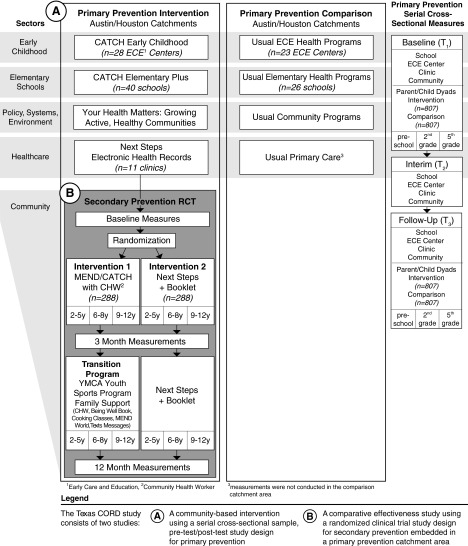
Background: There is consensus that development and evaluation of a systems-oriented approach for child obesity prevention and treatment that includes both primary and secondary prevention efforts is needed. This article describes the study design and baseline data from the Texas Childhood Obesity Research Demonstration (TX CORD) project, which addresses child obesity among low-income, ethnically diverse overweight and obese children, ages 2-12 years; a two-tiered systems-oriented approach is hypothesized to reduce BMI z-scores, compared to primary prevention alone.
Methods: Our study aims are to: (1) implement and evaluate a primary obesity prevention program; (2) implement and evaluate efficacy of a 12-month family-centered secondary obesity prevention program embedded within primary prevention; and (3) quantify the incremental cost-effectiveness of the secondary prevention program. Baseline demographic and behavioral data for the primary prevention community areas are presented.
Results: Baseline data from preschool centers, elementary schools, and clinics indicate that most demographic variables are similar between intervention and comparison communities. Most families are low income (≤$25,000) and Hispanic/Latino (73.3-83.8%). The majority of parents were born outside of the United States. Child obesity rates exceed national values, ranging from 19.0% in preschool to 35.2% in fifth-grade children. Most parents report that their children consume sugary beverages, have a television in the bedroom, and do not consume adequate amounts of fruits and vegetables.
Conclusions: Interventions to address childhood obesity are warranted in low-income, ethnically diverse communities. Integrating primary and secondary approaches is anticipated to provide sufficient exposure that will lead to significant decreases in childhood obesity.
Figures
References
-
- Must A, Strauss RS. Risks and consequences of childhood and adolescent obesity. Int J Obes Relat Metab Disord 1999;23(Suppl 2):S2–S11 - PubMed
-
- Freedman DS, Dietz WH, Srinivasan SR, et al. The relation of overweight to cardiovascular risk factors among children and adolescents: The Bogalusa Heart Study. Pediatrics 1999;103:1175–1182 - PubMed
-
- Finkelstein EA, Trogdon JG, Cohen JW, et al. Annual medical spending attributable to obesity: Payer- and service-specific estimates. Health Aff (Millwood) 2009;28:w822–w831 - PubMed
-
- Hoelscher DM, Kirk S, Ritchie L, et al. Position of the Academy of Nutrition and Dietetics: Interventions for the prevention and treatment of pediatric overweight and obesity. J Acad Nutr Diet 2013;113:1375–1394 - PubMed
Publication types
MeSH terms
Grants and funding
LinkOut - more resources
Full Text Sources
Other Literature Sources
Medical
