


Severe obesity and comorbid condition impact on the weight-related quality of life of the adolescent patient
- PMID: 25556022
- PMCID: PMC4344894
- DOI: 10.1016/j.jpeds.2014.11.022
Severe obesity and comorbid condition impact on the weight-related quality of life of the adolescent patient
Abstract
Objectives: To assess links between comorbid health status, severe excess weight, and weight-related quality of life (WRQOL) in adolescents with severe obesity and undergoing weight-loss surgery (WLS) to inform clinical care.
Study design: Baseline (preoperative) data from Teen Longitudinal Assessment of Bariatric Surgery, a prospective multicenter observational study of 242 adolescents with severe obesity (MedianBMI = 50.5 kg/m(2); Meanage = 17.1; 75.6% female; 71.9% white) undergoing WLS, were used to examine the impact of demographics, body mass index (BMI), presence/absence of 16 comorbid conditions, and a cumulative comorbidity load (CLoad) index on WRQOL scores (Impact of Weight on Quality of Life-Kids).
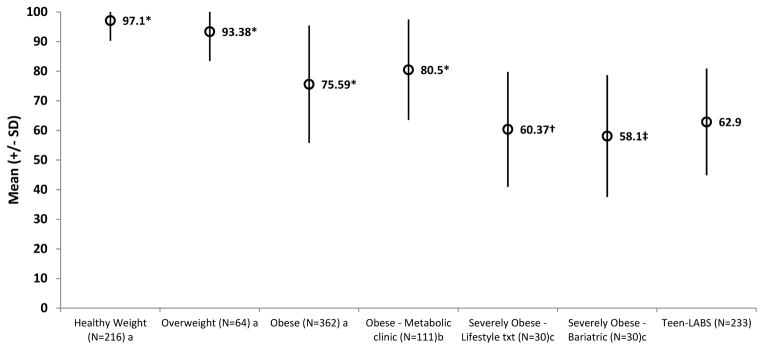
Results: WRQOL was significantly lower than reference samples of healthy weight, overweight, and obese samples. Of 16 comorbid conditions, the most prevalent were dyslipidemia (74.4%), chronic pain (58.3%), and obstructive sleep apnea (56.6%). Male subjects had a greater CLoad (P = .01) and BMI (P = .01), yet less impairment in total WRQOL (P < .01) than females. CLoad was a significant predictor of male WRQOL. For females, psychosocial (vs physical) comorbidities, BMI, and white race were significant predictors of WRQOL impairment. Less prevalent conditions (eg, stress urinary incontinence) also emerged as contributors to lower WRQOL.
Conclusions: WRQOL impairment is substantial for adolescents with severe obesity undergoing WLS, with predictors varying by sex. These patient-data highlight targets for education, support, and adjunctive care referrals before WLS. Furthermore, they provide a comprehensive empirical base for understanding heterogeneity in adolescent WRQOL outcomes after WLS, as weight and comorbidity profiles change over time.
Copyright © 2015 Elsevier Inc. All rights reserved.
Figures
References
-
- Schipper H, Clinch JJ, Olweny CL. Quality of life studies: Definitions and conceptual issues. In: Spilker B, editor. Quality of life and pharmacoeconomics in clinical trials. 2. Philadelphia: Lippincott-Raven; 1996. pp. 11–23.
-
- Guyatt GH, Jaeschke R, Feeny DH, Patrick DL. Measurments in clinical trials: Choosing the right approach. In: Spilker B, editor. Quality of Life and Pharmacoeconomics in Clinical Trials. 2. Minnetonka: Lippincott Williams & Wilkins; 1996. pp. 41–7.
Publication types
MeSH terms
Grants and funding
- UL1 TR001070/TR/NCATS NIH HHS/United States
- U01DK072493/DK/NIDDK NIH HHS/United States
- UL1RR025755/RR/NCRR NIH HHS/United States
- M01-RR00188/RR/NCRR NIH HHS/United States
- UM1 DK072493/DK/NIDDK NIH HHS/United States
- UM1 DK095710/DK/NIDDK NIH HHS/United States
- P30 DK079626/DK/NIDDK NIH HHS/United States
- UL1TR000005/TR/NCATS NIH HHS/United States
- UL1 TR001425/TR/NCATS NIH HHS/United States
- UL1 RR024153/RR/NCRR NIH HHS/United States
- UM1DK072493/DK/NIDDK NIH HHS/United States
- UM1DK095710/DK/NIDDK NIH HHS/United States
- UL1TR000165/TR/NCATS NIH HHS/United States
- P30 DK078392/DK/NIDDK NIH HHS/United States
- UL1 TR000077-04/TR/NCATS NIH HHS/United States
- U01 DK072493/DK/NIDDK NIH HHS/United States
- UL1 TR000077/TR/NCATS NIH HHS/United States
LinkOut - more resources
Full Text Sources
Other Literature Sources
Medical
