Review
. 2015 Jan;34(1):28-40.
doi: 10.5732/cjc.014.10284.

Key nodes of a microRNA network associated with the integrated mesenchymal subtype of high-grade serous ovarian cancer

Affiliations
Review

Key nodes of a microRNA network associated with the integrated mesenchymal subtype of high-grade serous ovarian cancer

Yan Sun et al. Chin J Cancer. 2015 Jan.

Abstract

Metastasis is the main cause of cancer mortality. One of the initiating events of cancer metastasis of epithelial tumors is epithelial-to-mesenchymal transition (EMT), during which cells dedifferentiate from a relatively rigid cell structure/morphology to a flexible and changeable structure/morphology often associated with mesenchymal cells. The presence of EMT in human epithelial tumors is reflected by the increased expression of genes and levels of proteins that are preferentially present in mesenchymal cells. The combined presence of these genes forms the basis of mesenchymal gene signatures, which are the foundation for classifying a mesenchymal subtype of tumors. Indeed, tumor classification schemes that use clustering analysis of large genomic characterizations, like The Cancer Genome Atlas (TCGA), have defined mesenchymal subtype in a number of cancer types, such as high-grade serous ovarian cancer and glioblastoma. However, recent analyses have shown that gene expression-based classifications of mesenchymal subtypes often do not associate with poor survival. This "paradox" can be ameliorated using integrated analysis that combines multiple data types. We recently found that integrating mRNA and microRNA (miRNA) data revealed an integrated mesenchymal subtype that is consistently associated with poor survival in multiple cohorts of patients with serous ovarian cancer. This network consists of 8 major miRNAs and 214 mRNAs. Among the 8 miRNAs, 4 are known to be regulators of EMT. This review provides a summary of these 8 miRNAs, which were associated with the integrated mesenchymal subtype of serous ovarian cancer.


Figures
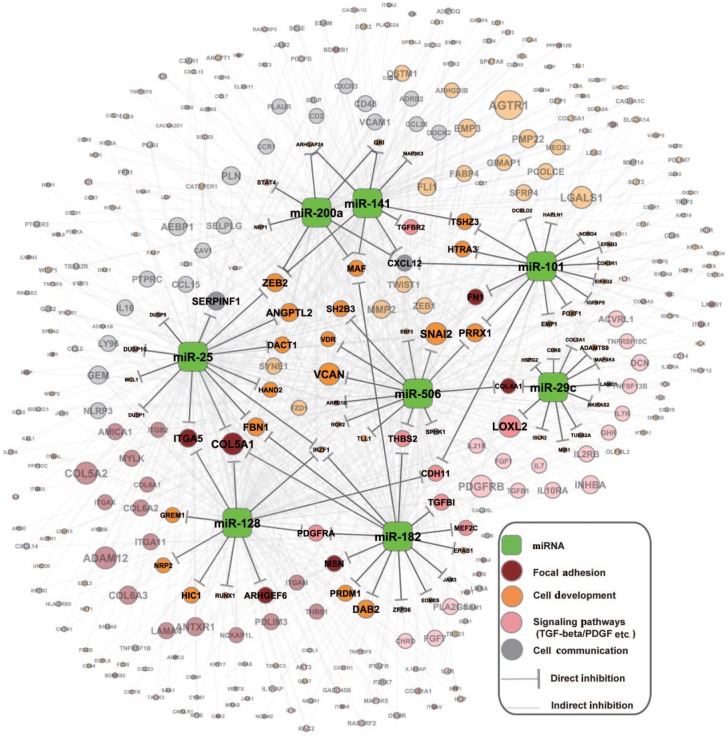
Figure 1.
Figure 1.. The key microRNAs (miRNAs) in the integrated mesenchymal subtype of The Cancer Genome Atlas (TCGA) high-grade serous ovarian cancer cases.
This figure is part of Figure 3 in Yang et al. (used with approval from the publisher). The miRNA-gene network shows the relationships between 8 key miRNAs and epithelial-to-mesenchymal transition (EMT) signature genes they are predicted to regulate. The size of each gene node indicates the number of predicted key miRNAs regulators; the colors indicate the annotated function of the gene. Only genes with gene ontology (GO) and Kyoto encyclopedia of genes and genomes (KEGG) annotations are shown in this network. TGF-β, transforming growth factor β; PDGF, platelet-derived growth factor.
Figure 2.
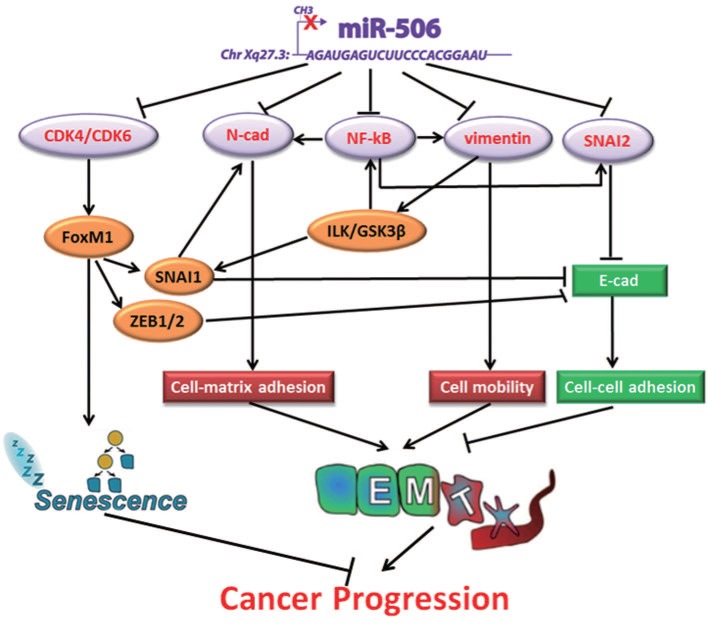
Figure 2.. The miR-506 network regulates EMT and cellular senescence.
miR-506 directly targets SNAI2, vimentin, N-cad, NFκB and CDK4/CDK6. miR-506 down-regulates SNAI2 which increases E-cad expression and subsequently promotes cell-cell adherence. miR-506 directly down-regulates vimentin and N-cadherin, which reduces cell mobility and cell-matrix adherence. miR-506 also targets NFκB p65 which transactivates N-cad and vimentin and is implicated in the regulation of EMT,. miR-506 inhibits the expression of FoxM1 by directly down-regulating CDK4/CDK6, which not only promotes cellular senescence but also inhibits EMT via suppressing the expression of SNAI1 and ZEB1/2. Therefore, miR-506 inhibits cancer progression through suppressing EMT and promoting cellular senescence. Decreased expression of miR-506 partially results from promoter methylation. EMT, epithelial-to-mesenchymal transition; E-cad, E-cadherin; SNAI2, snail family zinc finger 2; N-cad, N-cadherin; NFκB, nuclear factor kappa B; CDK4, cyclin-dependent kinase 4; CDK6, cyclin-dependent kinase 6; FoxM1, Forkhead box protein M1; SNAI1, snail family zinc finger 1; ZEB1, zinc finger E-box binding homeobox 1; ZEB2, zinc finger E-box binding homeobox 2; ILK, integrin-linked kinase; GSK-3β, Glycogen synthase kinase 3β.
Figure 3.
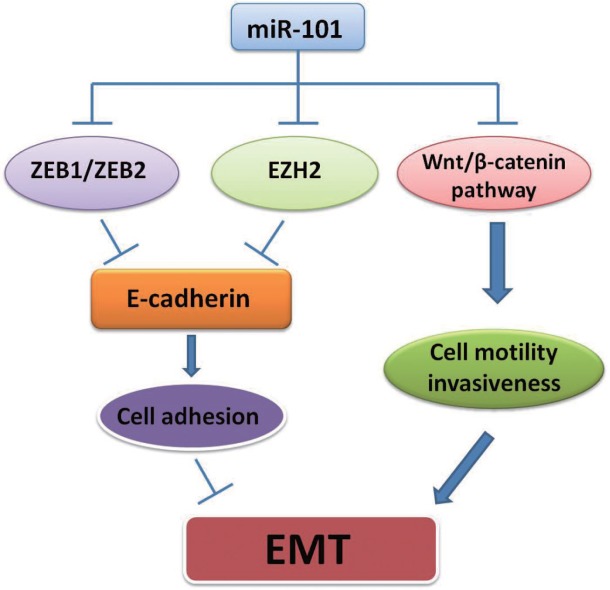
Figure 3.. The miR-101 network regulates EMT.
miR-101 directly targets ZEB1/ZEB2, EZH2,, and Wnt/β-catenin. miR-101 down-regulates ZEB1/ZEB2 and EZH2, which increases E-cadherin expression and subsequently promotes EMT. miR-101 down-regulates the Wnt/β-catenin pathway, which promotes cell motility and invasiveness. Thus, miR-101 suppresses EMT through targeting these signal pathways. EMT, epithelial-to-mesenchymal transition; ZEB1, zinc finger E-box binding homeobox 1; ZEB2, zinc finger E-box binding homeobox 2; EZH2, enhancer of zeste homolog 2.

References

    1. Huang T, Alvarez A, Hu B, et al. Noncoding RNAs in cancer and cancer stem cells. Chin J Cancer. 2013;32:582–593. - PMC - PubMed
    1. Taranger CK, Noer A, Sorensen AL, et al. Induction of dedifferen-tiation, genomewide transcriptional programming, and epigenetic reprogramming by extracts of carcinoma and embryonic stem cells. Mol Biol Cell. 2005;16:5719–5735. - PMC - PubMed
    1. Lu M, Jolly MK, Levine H, et al. MicroRNA-based regulation of epithelial-hybrid-mesenchymal fate determination. Proc Natl Acad Sci U S A. 2013;110:18144–18149. - PMC - PubMed
    1. Ubil E, Duan J, Pillai IC, et al. Mesenchymal-endothelial transition contributes to cardiac neovascularization. Nature. 2014;514:585–590. - PMC - PubMed
    1. Lopez-Novoa JM, Nieto MA. Inflammation and EMT: an alliance towards organ fibrosis and cancer progression. EMBO Mol Med. 2009;1:303–314. - PMC - PubMed

Publication types

MeSH terms