


A randomized controlled pilot study of the therapeutic effects of yoga in people with Parkinson's disease
- PMID: 25558138
- PMCID: PMC4278140
- DOI: 10.4103/0973-6131.146070
A randomized controlled pilot study of the therapeutic effects of yoga in people with Parkinson's disease
Abstract
Background: Exercise can be beneficial for cardiopulmonary, musculoskeletal or neurological systems, and other factors including mood, and may be beneficial in reducing fall risks, dementia and variables associated with quality of life (QOL). Parkinson's disease (PD) produces progressive motor and cognitive deterioration that may leave those inflicted unable to participate in standard exercise programs. Alternative forms of exercise such as yoga may be successful in improving physical function, QOL and physiological variables for overall well-being.
Aim: This randomized controlled pilot study investigated the effectiveness of yoga intervention on physiological and health-related QOL measures in people with PD.
Methods and materials: Thirteen people with stage 1-2 PD were randomized to either a yoga (n = 8) or a control group (n = 5). The yoga group participated in twice-weekly yoga sessions for 12 weeks. Participants were tested at baseline, and at 6 and 12 weeks using the Unified Parkinson's Disease Rating Scale (UPDRS), clinical measures of health-related QOL and physiological measures.
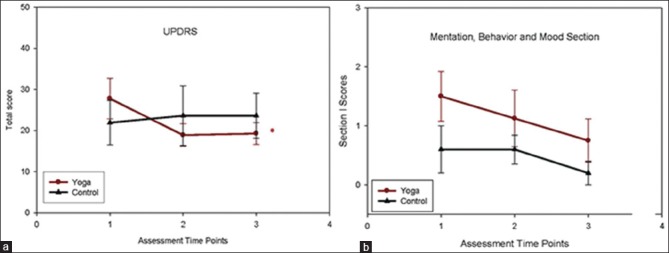
Results: Significant improvement in UPDRS scores (P = .006), diastolic blood pressure (P = 0.036) and average forced vital capacity (P = 0.03) was noted in the yoga group over time. Changes between groups were also noted in two SF-36 subscales. Positive trends of improvement were noted in depression scores (P = 0.056), body weight (P = 0.056) and forced expiratory volume (P = 0.059). Yoga participants reported more positive symptom changes including immediate tremor reduction.
Conclusions: The results suggest that yoga may improve aspects of QOL and physiological functions in stages 1-2 PD. Future larger studies are needed to confirm and extend our findings of the effects of yoga in PD.
Keywords: Blood pressure; Parkinson's disease; depression; pulmonary function; quality of life; yoga.
Conflict of interest statement
Figures
References
-
- Péchevis M, Clarke CE, Vieregge P, Khoshnood B, Deschaseaux-Voinet C, Berdeaux G, et al. Trial Study Group. Effects of dyskinesias in Parkinson's disease on quality of life and health-related costs: A prospective European study. Eur J Neurol. 2005;12:956–63. - PubMed
-
- Chapuis S, Ouchchane L, Metz O, Gerbaud L, Durif F. Impact of the motor complications of Parkinson's disease on the quality of life. Mov Disord. 2005;20:224–30. - PubMed
-
- Schrag A. Quality of life and depression in Parkinson's disease. J Neurol Sci. 2006;248:151–7. - PubMed
-
- Garber CE, Friedman JH. Effects of fatigue on physical activity and function in patients with Parkinson's disease. Neurology. 2003;60:1119–24. - PubMed
-
- Köseoðlu F, Inan L, Ozel S, Deviren SD, Karabiyikoðlu G, Yorgancioðlu R, et al. The effects of a pulmonary rehabilitation program on pulmonary function tests and exercise tolerance in patients with Parkinson's disease. Funct Neurol. 1997;12:319–25. - PubMed
Grants and funding
LinkOut - more resources
Full Text Sources
Other Literature Sources