The correlation between the Trendelenburg position and the stroke volume variation
- PMID: 25558337
- PMCID: PMC4280474
- DOI: 10.4097/kjae.2014.67.6.378
The correlation between the Trendelenburg position and the stroke volume variation
Abstract
Background: The stroke volume variation (SVV), based on lung-heart interaction during mechanical ventilation, is a useful dynamic parameter for fluid responsiveness. However, it is affected by many factors. The aim of this study was to evaluate the effects of SVV on Trendelenburg (T) and reverse Trendelenburg (RT) position and to further elaborate on the patterns of the SVV with position.
Methods: Forty-two patients undergoing elective surgery were enrolled in this study. Fifteen minutes after standardized induction of anesthesia with propofol, fentanyl, and rocuronium with volume controlled ventilation (tidal volume of 8 ml/kg of ideal body weight, inspiration : expiration ratio of 1 : 2, and respiratory rate of 10-13 breaths/min), the patients underwent posture changes as follows: supine, T position at slopes of operating table of -5°, -10°, and -15°, and RT position at slopes of operating table of 5°, 10°, and 15°. At each point, SVV, cardiac output (CO), peak airway pressure (PAP), mean blood pressure, and heart rate (HR) were recorded.
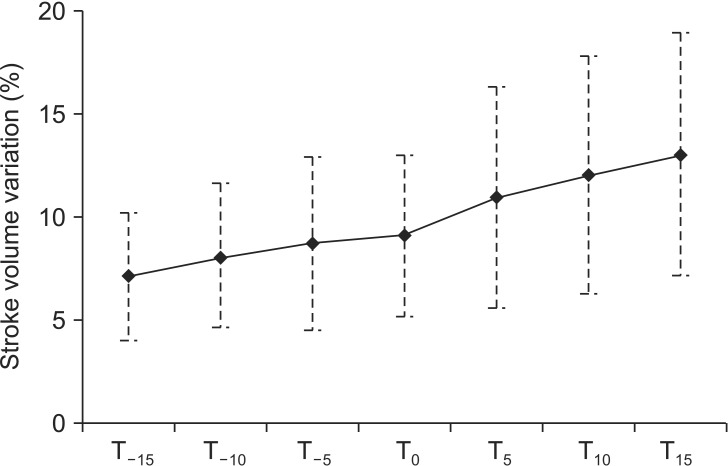
Results: The SVV was significant decreased with decreased slopes of operating table in T position, and increased with increased slopes of operating table in RT position (P = 0.000). Schematically, it was increased by 1% when the slope of operating table was increased by 5°. But, the CO and PAP were significant increased with decreased slopes of operating table in T position, and decreased with increased slopes of operating table in RT position (P = 0.045, 0.027).
Conclusions: SVV is subjected to the posture, and we should take these findings into account on reading SVV for fluid therapy.
Keywords: Fluid therapy; Reverse Trendelenburg position; Stroke volume variation; Trendelenburg position.
Figures
References
-
- Donati A, Loggi S, Preiser JC, Orsetti G, Münch C, Gabbanelli V, et al. Goal-directed intraoperative therapy reduces morbidity and length of hospital stay in high-risk surgical patients. Chest. 2007;132:1817–1824. - PubMed
-
- Michard F, Teboul JL. Predicting fluid responsiveness in ICU patients: a critical analysis of the evidence. Chest. 2002;121:2000–2008. - PubMed
-
- Zhang Z, Lu B, Sheng X, Jin N. Accuracy of stroke volume variation in predicting fluid responsiveness: a systematic review and meta-analysis. J Anesth. 2011;25:904–916. - PubMed
LinkOut - more resources
Full Text Sources
Other Literature Sources
Medical
Research Materials