


Evaluation of effectiveness and cost-effectiveness of a clinical decision support system in managing hypertension in resource constrained primary health care settings: results from a cluster randomized trial
- PMID: 25559011
- PMCID: PMC4330052
- DOI: 10.1161/JAHA.114.001213
Evaluation of effectiveness and cost-effectiveness of a clinical decision support system in managing hypertension in resource constrained primary health care settings: results from a cluster randomized trial
Abstract
Background: Randomized control trials from the developed world report that clinical decision support systems (DSS) could provide an effective means to improve the management of hypertension (HTN). However, evidence from developing countries in this regard is rather limited, and there is a need to assess the impact of a clinical DSS on managing HTN in primary health care center (PHC) settings.
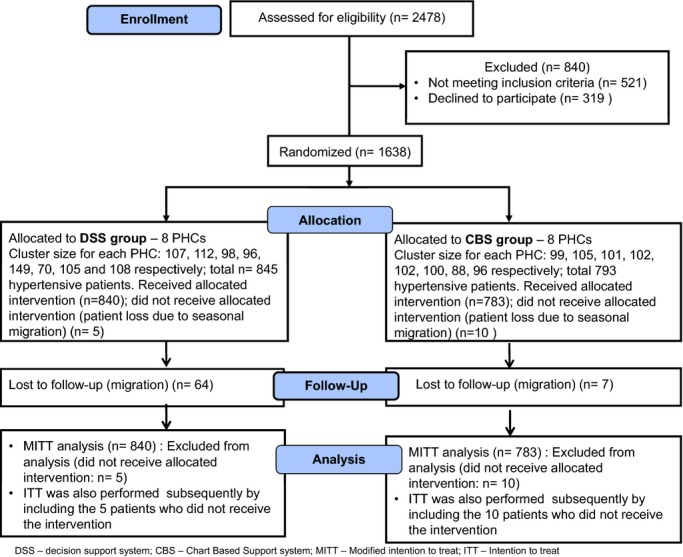
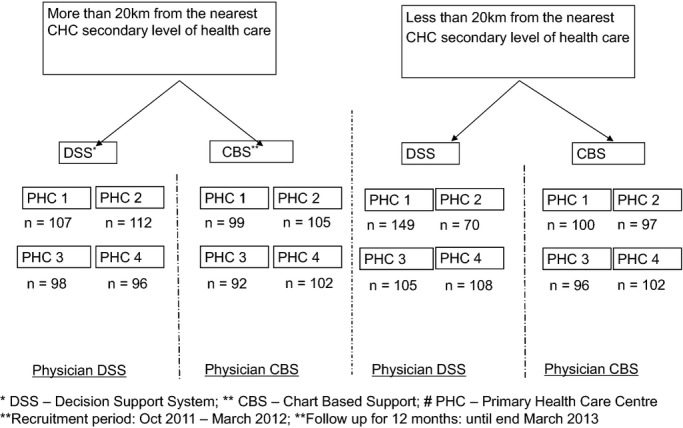
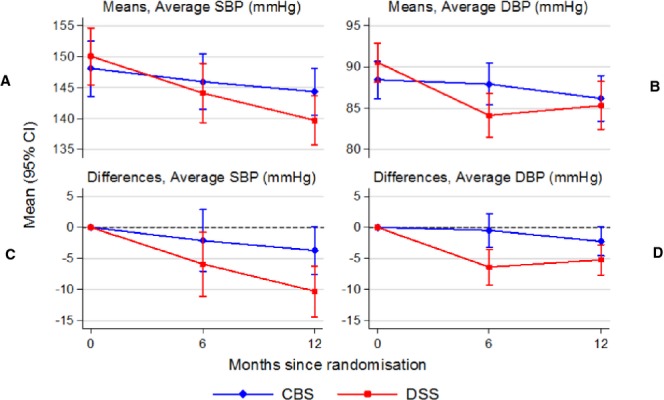
Methods and results: We performed a cluster randomized trial to test the effectiveness and cost-effectiveness of a clinical DSS among Indian adult hypertensive patients (between 35 and 64 years of age), wherein 16 PHC clusters from a district of Telangana state, India, were randomized to receive either a DSS or a chart-based support (CBS) system. Each intervention arm had 8 PHC clusters, with a mean of 102 hypertensive patients per cluster (n=845 in DSS and 783 in CBS groups). Mean change in systolic blood pressure (SBP) from baseline to 12 months was the primary endpoint. The mean difference in SBP change from baseline between the DSS and CBS at the 12th month of follow-up, adjusted for age, sex, height, waist, body mass index, alcohol consumption, vegetable intake, pickle intake, and baseline differences in blood pressure, was -6.59 mm Hg (95% confidence interval: -12.18 to -1.42; P=0.021). The cost-effective ratio for CBS and DSS groups was $96.01 and $36.57 per mm of SBP reduction, respectively.
Conclusion: Clinical DSS are effective and cost-effective in the management of HTN in resource-constrained PHC settings.
Clinical trial registration url: http://www.ctri.nic.in. Unique identifier: CTRI/2012/03/002476.
Keywords: cluster randomized trials; computers; cost‐effectiveness; effectiveness; hypertension.
© 2015 The Authors. Published on behalf of the American Heart Association, Inc., by Wiley Blackwell.
Figures

References
-
- Anderson JA, Willson P, Peterson NJ, Murphy C, Kent TA. Prototype to practice: developing and testing a clinical decision support system for secondary stroke prevention in a veterans healthcare facility. Comput Inform Nurs. 2010; 28:353-363. - PubMed
-
- Garg AX, Adhikari NK, McDonald H, Rosas‐Arellano MP, Devereaux PJ, Beyene J, Sam J, Haynes RB. Effects of computerized clinical decision support systems on practitioner performance and patient outcomes: a systematic review. JAMA. 2005; 293:1223-1238. - PubMed
-
- Bosworth HB, Olsen MK, McCant F, Harrelson M, Gentry P, Rose C, Goldstein MK, Hoffman BB, Powers B, Oddone EZ. Hypertension Intervention Nurse Telemedicine Study (HINTS): testing a multifactorial tailored behavioral/educational and a medication management intervention for blood pressure control. Am Heart J. 2007; 153:918-924. - PubMed
Publication types
MeSH terms
Grants and funding
LinkOut - more resources
Full Text Sources
Medical
