Review
. 2015 Mar;93(3):233-44.
doi: 10.1038/icb.2014.101. Epub 2015 Jan 6.

Beyond receptors and signaling: epigenetic factors in the regulation of innate immunity

Affiliations
Review

Beyond receptors and signaling: epigenetic factors in the regulation of innate immunity

Stuti Mehta et al. Immunol Cell Biol. 2015 Mar.

Abstract

The interaction of innate immune cells with pathogens leads to changes in gene expression that elicit our body's first line of defense against infection. Although signaling pathways and transcription factors have a central role, it is becoming increasingly clear that epigenetic factors, in the form of DNA or histone modifications, as well as noncoding RNAs, are critical for generating the necessary cell lineage as well as context-specific gene expression in diverse innate immune cell types. Much of the epigenetic landscape is set during cellular differentiation; however, pathogens and other environmental triggers also induce changes in histone modifications that can either promote tolerance or 'train' innate immune cells for a more robust antigen-independent secondary response. Here we review the important contribution of epigenetic factors to the initiation, maintenance and training of innate immune responses. In addition, we explore how pathogens have hijacked these mechanisms for their benefit and the potential of small molecules targeting chromatin machinery as a way to boost or subdue the innate immune response in disease.


Conflict of interest statement

The authors declare no conflict of interest.

Figures
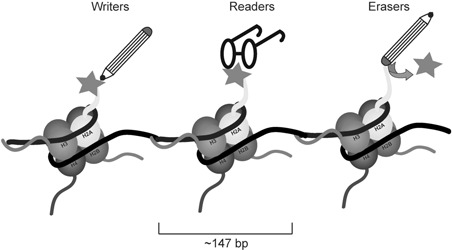
Figure 1
Figure 1
Writers, readers and erasers of histone covalent modifications. Schematic representation of DNA (black ribbon) wound around histone octamers. Each octamer is made up of two copies each of four histone proteins around which ~147 bp of DNA is wound. N‐terminal ‘tails’ of the histone proteins protrude from the core of the octamer and are the sites of reversible covalent modifications such as acetylation, methylation, phosphorylation and ubiquitination (all represented by a generic pink star). The gain of covalent modifications is catalyzed by histone‐modifying enzymes—that is, ‘writers’. ‘Readers’ recognize specific modifications and in doing so assist assembly of chromatin‐remodeling complexes at the sites of recognition, and ‘erasers’ catalyze removal of covalent modifications. A full color version of this figure is available at the Immunology and Cell Biology journal online.
Figure 2
Figure 2
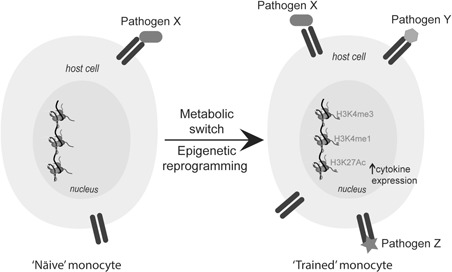
Epigenetic reprogramming in training of innate immune cells. Upon pathogen X recognition by a receptor, naive monocytes undergo epigenetic reprogramming and a metabolic shift, and become primed to respond more robustly to nonspecific (Pathogens X, Y and Z) secondary stimulation. A full color version of this figure is available at the I mmunology and Cell Biology journal online.
Figure 3
Figure 3
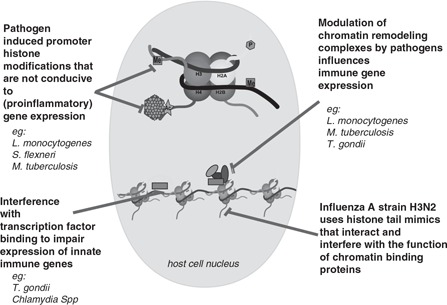
Schematic representation of various strategies employed by pathogens to modulate the host innate immune gene expression response to their advantage. Top: a histone octamer around which DNA (black ribbon) is wrapped. ‘Tails’ of histone proteins are the sites of reversible covalent modifications like methylation (shown as Me), phosphorylation (P) and acetylation (Ac) catalyzed by histone‐modifying enzymes, that is, writers (textured hexagon). Bottom: DNA wound around four histone octamers. Transcription factor binding is shown as a pink rectangle; and chromatin‐remodeling complexes are represented by a group of green, blue, purple and pink shapes. A full color version of this figure is available at the Immunology and Cell Biology journal online.

References

    1. Hargreaves DC, Horng T, Medzhitov R. Control of inducible gene expression by signal‐dependent transcriptional elongation. Cell 2009; 138: 129–145. - PMC - PubMed
    1. Fang TC, Schaefer U, Mecklenbrauker I, Stienen A, Dewell S, Chen MS et al Histone H3 lysine 9 di‐methylation as an epigenetic signature of the interferon response. J Exp Med 2012; 209: 661–669. - PMC - PubMed
    1. Foster SL, Hargreaves DC, Medzhitov R. Gene‐specific control of inflammation by TLR‐induced chromatin modifications. Nature 2007; 447: 972–978. - PubMed
    1. Ostuni R, Piccolo V, Barozzi I, Polletti S, Termanini A, Bonifacio S et al Latent enhancers activated by stimulation in differentiated cells. Cell 2013; 152: 157–171. - PubMed
    1. Cheng SC, Quintin J, Cramer RA, Shepardson KM, Saeed S, Kumar V et al mTOR‐ and HIF‐1alpha‐mediated aerobic glycolysis as metabolic basis for trained immunity. Science 2014; 345: 1250684. - PMC - PubMed