Review
. 2015 May 15:285:10-33.
doi: 10.1016/j.bbr.2014.12.053. Epub 2015 Jan 2.

Invariant visual object recognition and shape processing in rats

Affiliations
Review

Invariant visual object recognition and shape processing in rats

Davide Zoccolan. Behav Brain Res. .

Abstract

Invariant visual object recognition is the ability to recognize visual objects despite the vastly different images that each object can project onto the retina during natural vision, depending on its position and size within the visual field, its orientation relative to the viewer, etc. Achieving invariant recognition represents such a formidable computational challenge that is often assumed to be a unique hallmark of primate vision. Historically, this has limited the invasive investigation of its neuronal underpinnings to monkey studies, in spite of the narrow range of experimental approaches that these animal models allow. Meanwhile, rodents have been largely neglected as models of object vision, because of the widespread belief that they are incapable of advanced visual processing. However, the powerful array of experimental tools that have been developed to dissect neuronal circuits in rodents has made these species very attractive to vision scientists too, promoting a new tide of studies that have started to systematically explore visual functions in rats and mice. Rats, in particular, have been the subjects of several behavioral studies, aimed at assessing how advanced object recognition and shape processing is in this species. Here, I review these recent investigations, as well as earlier studies of rat pattern vision, to provide an historical overview and a critical summary of the status of the knowledge about rat object vision. The picture emerging from this survey is very encouraging with regard to the possibility of using rats as complementary models to monkeys in the study of higher-level vision.

Keywords: Invariant recognition; Pattern vision; Rat; Rodent; Shape processing.


Figures

Fig. 1
Fig. 1
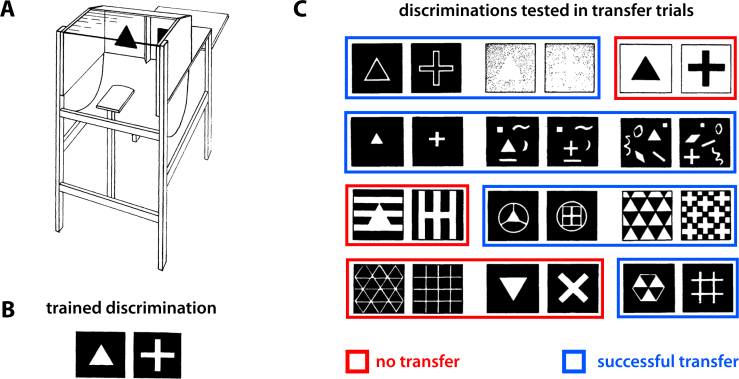
Extracts from Lashley's seminal study of rat pattern vision. (A) A sketch of the jumping stand apparatus introduced by Lashley to test rats in visual discrimination tasks (see Section 3.1 for a description). (B) An example of visual pattern discrimination, in which rats were trained in one of Lashley's experiments. (C) Alterations of the trained visual patterns (shown in B) to probe generalization of rat recognition in transfer trials. (For interpretation of the references to color in this figure legend, the reader is referred to the web version of this article.)
Fig. 2
Fig. 2
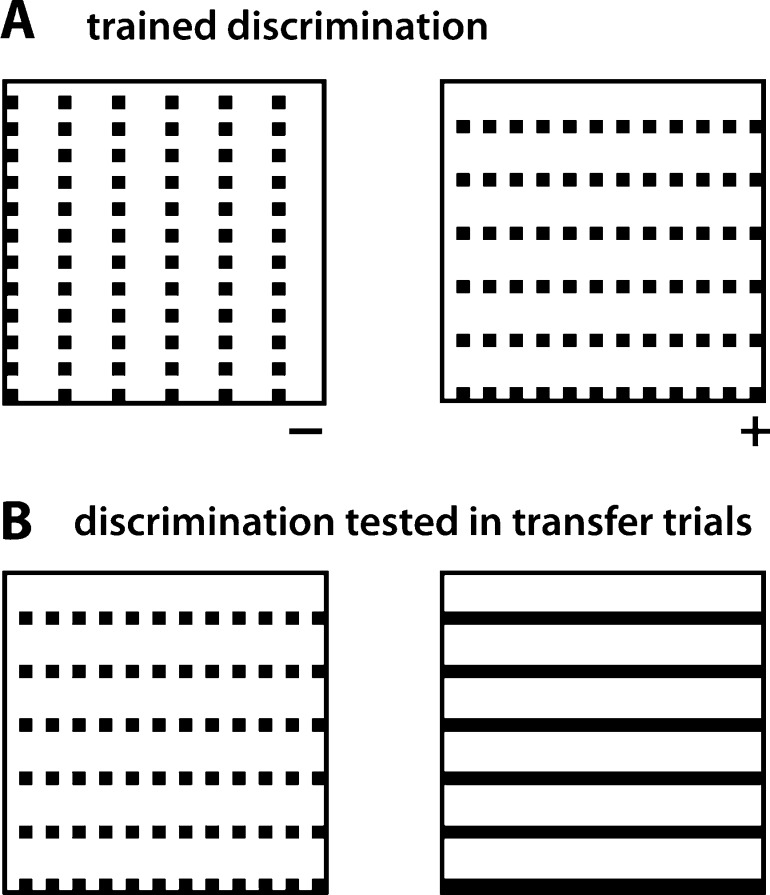
The visual patterns used by Krechevsky in his seminal study of perceptual grouping in rats. (A) Rats were initially trained to discriminate a negative (−) column pattern from a positive (+) row pattern. (B) When required to choose between the training-positive row pattern and a continuous horizontal grating, most rats consistently chose the latter.
Fig. 3
Fig. 3
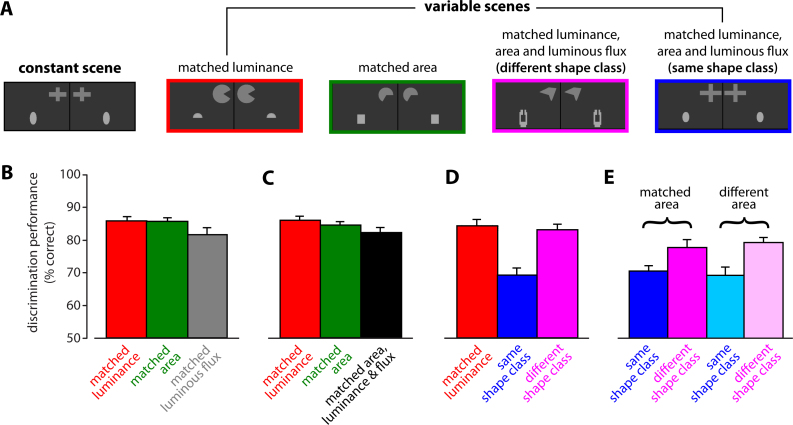
Summary of Simpson's and Gaffan's experimental design and results. (A) Examples of stimulus scenes used to probe rat pattern vision in Simpson's and Gaffan's study. In each trial, rats were rewarded for avoiding a negative-constant scene (right panel) and approaching a trial-specific variable scene (examples shown in the left panels). The objects in the variable scenes could be matched to those in the constant scene with respect to different visual properties: luminance, area, luminous flux (i.e., area × luminance), and shape class. (B–E) Rat recognition performance for different kinds of tested variable scenes. The color of the bars matches the color of the corresponding example variable scenes in (A). See Section 4.2 for a detailed description. (For interpretation of the references to color in this figure legend, the reader is referred to the web version of this article.)
Fig. 4
Fig. 4
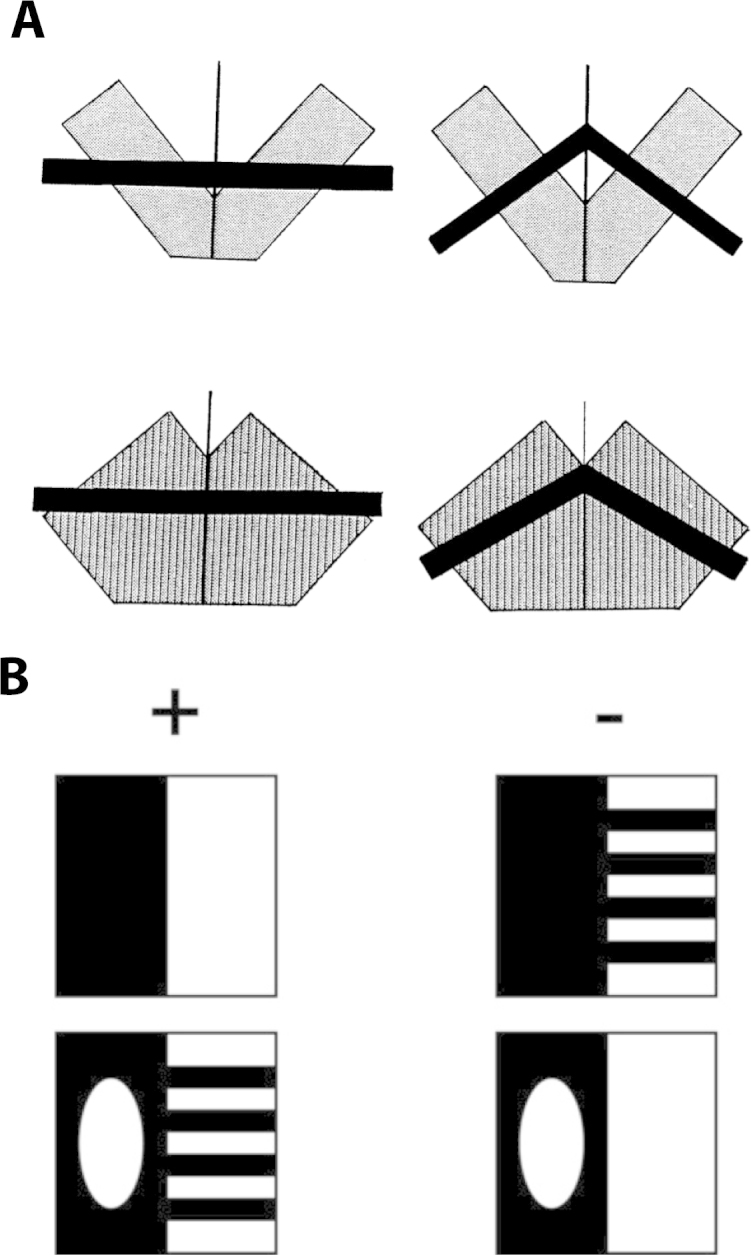
Visual patterns used the test configural discrimination in rats. (A) The stimuli used by Eacott et al. , which did not enforce a strictly configural processing strategy, because of the unique features created by the intersection of their constituent elements. (B) The stimuli used by Davies et al. , which more properly enforced a configural processing strategy.
Fig. 5
Fig. 5
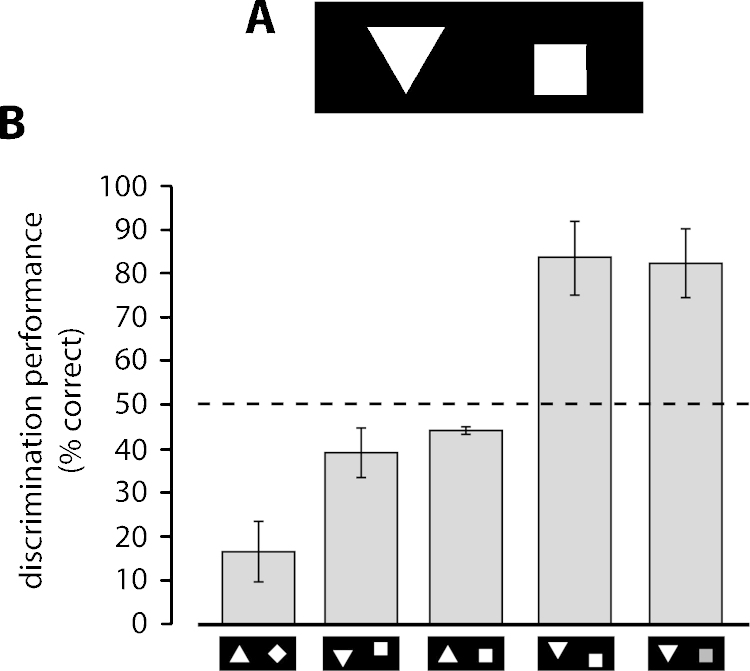
Summary of Minini's and Jeffery's experimental design and results. (A) The triangle vs. square discrimination in which rats were trained in one of Minini's and Jeffery's experiments. (B) Rat discrimination performance for different kinds of manipulations of the originally learned patterns (shown below the abscissa axis). Manipulations altering the relative brightness of the stimuli in the lower hemifield of the stimulus display made rat performance falling to chance (dashed line) or below it (see Section 4.4 for details).
Fig. 6
Fig. 6
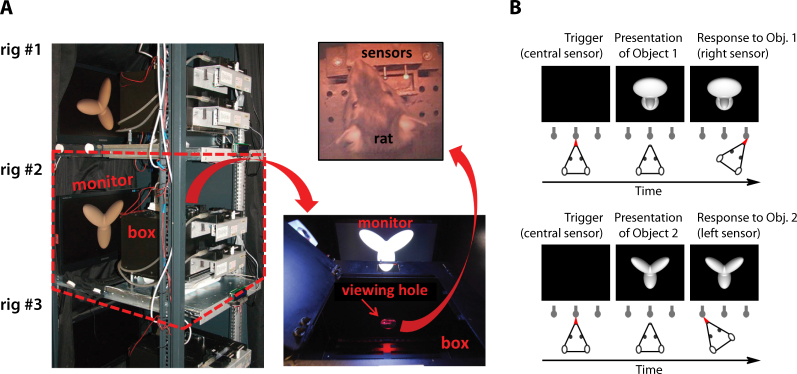
Behavioral rig and experimental design developed by Zoccolan et al. . (A) A picture of the behavioral rig (left), showing three operant boxes, each equipped with monitors for stimulus presentation, computer-controlled pumps for liquid reward delivery, and touch sensors for acquisition of behavioral responses. Rats learned to insert their head through a viewing hole, located in the wall facing the monitor (bottom-right picture), and interact with the array of sensors (top-right picture) to trigger stimulus presentation, report stimulus identity and collect the reward. This rig is currently used in D.D. Cox’ lab (Harvard) and D. Zoccolan's lab (SISSA). A similar high-throughput rig has also been developed by P. Reinagel's lab (UCSD). (B) Schematic of the object discrimination task. After triggering stimulus presentation by licking the central sensor, a rat had to lick either the right or left sensor, depending on object identity.
Fig. 7
Fig. 7
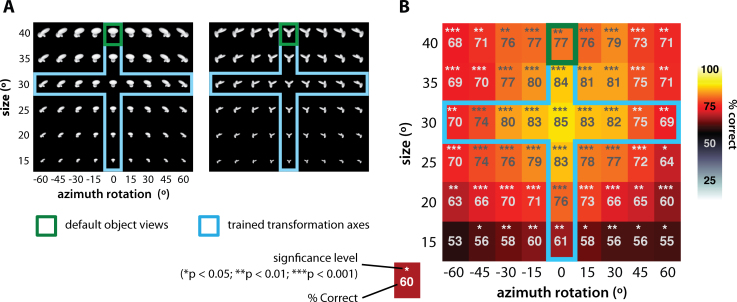
Object conditions and rat group average performance in Zoccolan et al. . (A) The full matrix of size and azimuth-rotation combinations used to test rat invariant recognition in Zoccolan et al. . The green frames show the default object views that rats originally learned. The light blue frames show the transformation axes that rats were trained tolerate, before being bested with the full set of transformations. (B) Rat group average performance for each of the object transformations shown in (A). The percentage of correct trials is both color-coded and reported in each cell, along with its significance. (For interpretation of the references to color in this figure legend, the reader is referred to the web version of this article.)
Fig. 8
Fig. 8
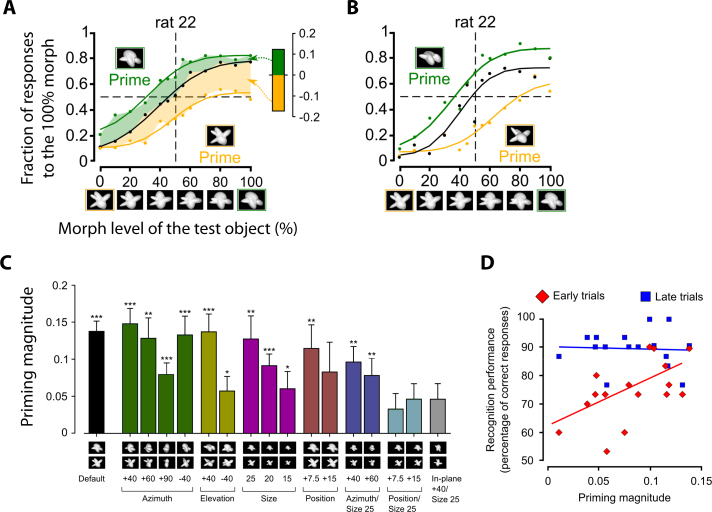
Visual priming produced by default and transformed object views in Tafazoli et al. . (A) Psychometric curves (i.e., fraction of times a morphed object was classified as being more similar to the rightmost prototype, corresponding to the 100% morph level) obtained for an example rat, when no primes were used (black) and when the default views of the 0% (orange) and 100% (green) morph prototypes (shown in the orange/green framed insets) were used as primes. The morph objects are shown below the abscissa (also reporting the morphing level). To quantify the priming magnitude (i.e., to obtain the orange and green bars shown in the inset), the average difference between the psychometric curves obtained in regular and prime trials was computed (orange and green shaded areas). (B) Psychometric curves for the same rat shown in (A), obtained for control trials (black) and prime trials (orange/green), in which 40° elevation-rotated views of the prototypes were used as primes (shown in the insets). (C) Group average priming magnitude (computed as shown in A) produced by all tested priming conditions, i.e., when either the default views (first bar) or the transformed views (all remaining bars) of the object prototypes were used as primes (the tested prototype views are shown below the abscissa; colors refer to transformations of the same kind, but with different magnitude). Asterisks indicate significant priming. (D) Relationship between rat recognition performance and priming magnitude in early (red diamonds) and late (blue squares) trials (data refer to all the 16 tested views of the object prototypes, as shown in C). (For interpretation of the references to color in this figure legend, the reader is referred to the web version of this article.)
Fig. 9
Fig. 9
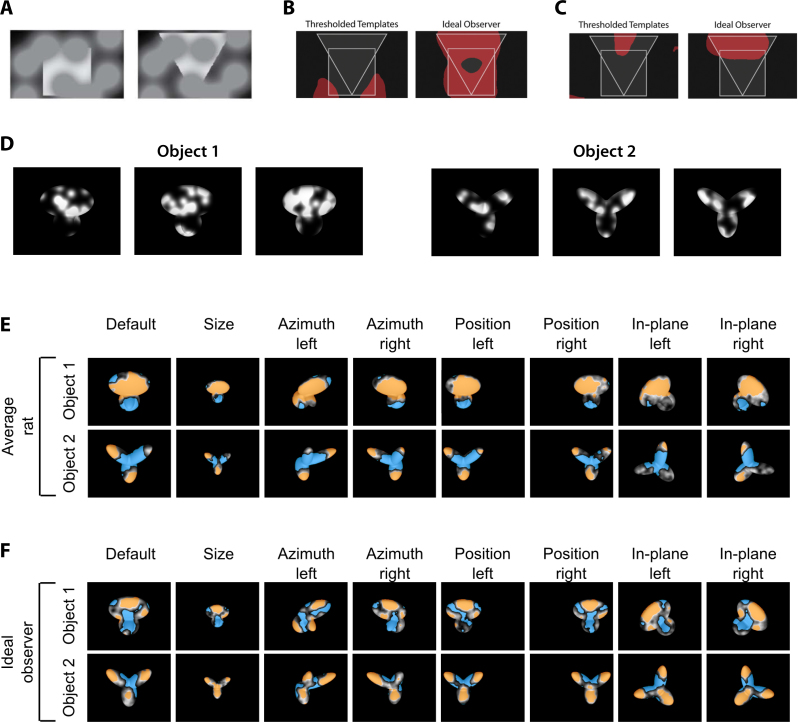
Rat visual object recognition strategy uncovered using the Bubbles method. (A) Examples of bubbles masked stimuli used by Vermaercke and Op de Beeck . (B) The regions (in red) that were found to be diagnostic of object identity (named thresholded behavioral templates) in Vermaercke's and Op de Beeck's study for rats (left) and for an ideal observer (right). (C) Behavioral templates obtained for the rats (left) and the ideal observer (right), using only trials in which the bottom part of the stimuli was masked. (D) Examples of bubbles masked stimuli used by Alemi-Neissi et al. . (E, F) Saliency maps, showing the patterns of significantly salient (in orange) and anti-salient (in light blue) features obtained for Objects 1 and 2 in the study of Alemi-Neissi and colleagues. (E) and (F) show, respectively, the results for the rats and for a simulated ideal observer. (For interpretation of the references to color in this figure legend, the reader is referred to the web version of this article.)
Fig. 10
Fig. 10
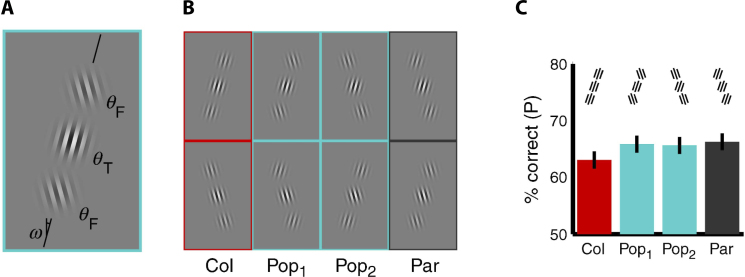
Extracts from Meier et al. study of collinear processing in rats. (A) Example of arrangement of a central target and two flanking gratings. ϑT and ϑF refer, respectively, to the orientation of the target and flanker gratings, while ω indicates the angular position of the flankers (relative to the vertical). (B) The four different kinds of target–flankers configurations tested by Meier et al. (2011). The red frames indicate the collinear conditions, the cyan frames indicate the pop out conditions, while the black frames indicate the parallel conditions (see Section 5.3 for details). (C) The performance on the four flanker conditions for an example rat (the color of the bars matches the color of the frames in B). (For interpretation of the references to color in this figure legend, the reader is referred to the web version of this article.)

Similar articles

Cited by

References

    1. Cox D.D. Do we understand high-level vision? Curr Opin Neurobiol. 2014;25:187–193. - PubMed
    1. Rust N.C., Stocker A.A. Ambiguity and invariance: two fundamental challenges for visual processing. Curr Opin Neurobiol. 2010;20:382–388. - PubMed
    1. Ullman S. MIT Press; Cambridge, MA: 1996. High level vision.
    1. DiCarlo J.J., Zoccolan D., Rust N.C. How does the brain solve visual object recognition? Neuron. 2012;73:415–434. - PMC - PubMed
    1. DiCarlo J.J., Cox D.D. Untangling invariant object recognition. Trends Cogn Sci. 2007;11:333–341. - PubMed

Publication types

MeSH terms